

- A credit linked note (CLN) is a debt security whose coupon and principal follow the performance of a defined credit exposure, such as a loan portfolio or a pool of receivables, rather than the general credit of the issuer.
- CLNs began as bank risk-management tools and are now used by non-bank lenders, specialist originators and emerging managers to fund defined portfolios through institutional-grade securities.
- Governance is fixed in the documents before the notes are issued: eligibility rules, limits, triggers and the payment waterfall are agreed at the outset and applied by independent counterparties.
- Because a CLN is a security, it can be held by many investors on identical terms, cleared through Euroclear or Clearstream and widened to new investors without reopening the structure.
- Luxembourg is the default jurisdiction for many CLN programmes, and CLNs are sold only to professional investors who can assess structured credit risk.
A credit linked note (CLN) is a debt instrument that pays a coupon and repays principal according to the performance of a defined credit exposure, such as a loan portfolio or a pool of receivables. Issuers use CLNs to fund specific assets through a security that investors can hold, and professional investors use them to take credit risk they can analyse and monitor.
This guide is written for issuers: specialist lenders, credit managers and asset owners considering a credit linked note to fund a loan book, a facility or a lending strategy. It explains how CLNs are structured, issued, settled and governed, and what professional investors will expect to see.
The idea is old, but its users have changed. What began as a tool for bank balance sheets now sits at the centre of how specialist lenders and credit managers connect their portfolios to institutional and wealth-channel investors. This guide explains how credit linked notes work, how they are structured, where they are issued and who uses them.
Where credit linked notes sit in today's private credit market
Private credit has grown up quickly. What began as a specialist corner of the alternatives universe has become a core allocation across institutional portfolios and, increasingly, the portfolios of the wealth channel. At the same time, the supply side of the market has changed. Lending is no longer dominated by banks alone, and now includes non-bank lenders, specialist originators, fintech platforms and emerging asset managers building focused credit strategies.
This shift has created a structural challenge. Investors want exposure to private credit, but they want it in forms they understand and can govern. Lenders want funding that allows them to scale, but without committing too early to heavyweight fund structures or giving up control of their business. The gap between those two positions is where credit linked notes have found renewed relevance.
CLNs present credit risk clearly, in a format that professional investors recognise, and they give issuers flexibility in how funding is structured and deployed. Their appeal comes from that structural fit, and it does not depend on market volatility or regulatory arbitrage.
What is a credit linked note?
At its simplest, a credit linked note is a debt instrument. An investor subscribes for the notes and receives a coupon. The defining feature is the way risk is defined.
In a traditional bond, investors are exposed to the general credit of the issuer. Performance depends on the strength of the balance sheet, the quality of management and the broader business strategy. In a credit linked note, exposure is tied to a specific credit reference. That reference might be a borrower, a portfolio of loans or a pool of assets generating cash flow.
The documentation sets out what that exposure is and how it behaves, so investors are underwriting credit performance rather than a business in the abstract. The distinction is subtle but important, because it forces clarity. Investors can focus on asset quality and cash-flow behaviour rather than relying on headline metrics, and issuers can fund defined activity rather than pledging their entire enterprise. For private credit markets, this separation of asset risk from corporate risk is a central attraction, particularly as the broader corporate loan market experiences stress. Our guide to how credit linked notes work follows the cash flows in more detail.
How banks originally used credit linked notes
Credit linked notes did not originate in private credit. They were developed inside banks, for banks. Historically, large financial institutions used CLNs to manage their balance sheets rather than to fund growth. Banks used them to transfer credit risk off their books without selling the underlying assets. By linking a note's performance to a reference loan or portfolio, banks could reduce regulatory capital requirements while retaining client relationships and origination economics.
In that context, CLNs were tools of risk management. They allowed banks to reshape exposure without changing the underlying lending activity. Risk could be redistributed to investors willing to hold it, while the bank continued to service the assets. The structure also allowed credit exposure to be packaged in a form that institutional investors understood and could price. The same logic survives today in synthetic risk transfer.
This early use explains several features that still define CLNs. Clear documentation, defined credit events and a note format rather than a partnership structure were all designed to satisfy internal risk committees and regulators long before alternative lenders or asset managers used the instrument.
From bank balance sheets to private credit platforms
The instrument has stayed the same, but the range of issuers who can use it has widened. Over time, the structural features that appealed to banks began to appeal to private credit markets. Non-bank lenders, corporate finance houses and specialist structuring platforms recognised that CLNs offered a way to present credit risk clearly without forcing issuers into fund structures or bank-style facilities. This shift is often described as democratisation, although professionalisation is the more accurate word.
Access to CLN structuring is no longer limited to large banks with proprietary balance sheets. Structuring firms and private credit specialists now provide the legal, operational and settlement infrastructure required to issue CLNs on behalf of founders, alternative lenders and emerging asset managers. For issuers, this has changed how lending strategies are funded. Strategies that would previously have relied on bilateral loans or informal funding arrangements can now be structured into institutional-grade securities and placed with CIOs and professional allocators. Credit exposure can be defined, documented and distributed without building a bank or launching a fund prematurely, and founders retain control over strategy while investors gain access to structures they recognise.
This has been particularly important for emerging asset managers. CLNs allow them to express a strategy, establish governance and build a track record before scale demands a fund vehicle. For private credit houses, they provide a way to structure tailored financing without sacrificing discipline or transparency. The result is broader access for the right participants. Credit linked notes remain instruments for professional investors and serious issuers; what has changed is that access is no longer restricted to institutions with legacy infrastructure.
How a credit linked note is structured
Most institutional credit linked notes are issued through a bankruptcy-remote special purpose vehicle. In Europe, this is most commonly done under Luxembourg securitisation law, which allows credit exposures to be structured without being wrapped in a traditional fund. The structure is simple in concept.
A defined set of credit exposures is identified. These may be loans that have already been originated, receivables generated through trading or lending activity, or facilities extended under a consistent underwriting framework. The issuing vehicle references those exposures and issues notes to investors, and the cash flows generated by the underlying assets are then used to service the notes.
The structure draws its strength from discipline. Assets are admitted under agreed eligibility rules. Cash flows follow a contractual order rather than discretionary decisions. Reporting is produced according to a timetable rather than on request. Investors rely on the structure itself, which does not make a CLN risk-free but does make the risk easier to understand and harder to blur. The practical steps from term sheet to settlement are set out in our guide to how to issue a credit linked note.
Why Luxembourg is the default jurisdiction for credit linked notes
A credit linked note is only as robust as the legal framework behind it, which is why jurisdiction remains a central consideration. Luxembourg has become the default jurisdiction for many CLN programmes because it combines flexibility with legal certainty. Its securitisation regime allows issuers to tailor structures to specific assets without forcing them into collective investment fund formats. Compartments can be created to isolate different strategies, and creditor rights are clearly defined and enforceable.
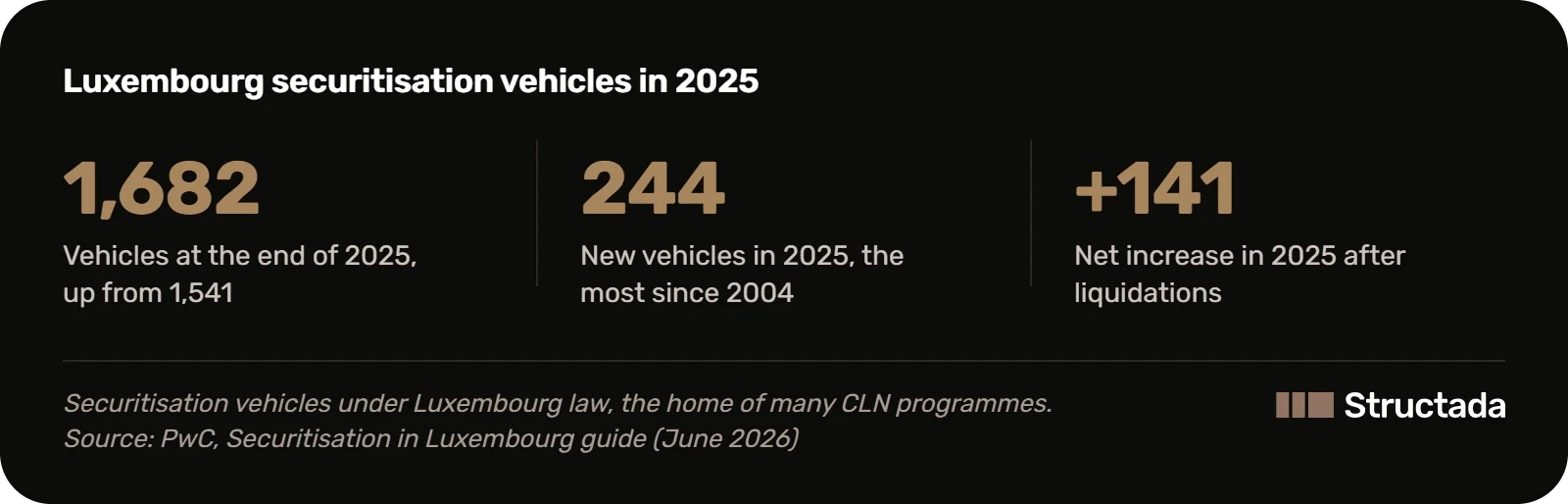
The market data supports this. PwC's Securitisation in Luxembourg guide (June 2026) counts 1,711 active securitisation vehicles as of March 2026, and estimates that around 8,000 compartments and transactions are active across them. The number of vehicles rose from 1,541 at the end of 2024 to 1,682 at the end of 2025, a net increase of 141 after liquidations. A total of 244 new vehicles were established in 2025, the highest annual figure since the securitisation law came into force in 2004. PwC's 2026 market survey, prepared with LuxCMA, also found that multi-compartment vehicles remain the standard approach, with most operating between two and ten compartments.
From an investor's perspective, familiarity matters. Luxembourg structures are well understood by private banks, family offices and institutional allocators. Administrators, trustees and legal advisers know how they work, and when problems arise there is a clear legal path. Research from PwC on European securitisation markets highlights a growing investor preference for structures where priority of payments, cash-flow rights and enforcement mechanics are defined at the outset rather than negotiated after the fact. For issuers, this provides room to structure intelligently. For investors, it provides confidence that the framework will hold when tested. Our guide on why issuers choose Luxembourg for credit linked notes covers the regime in more depth.
How other jurisdictions are used for CLN issuance
Luxembourg is the default for many credit linked note programmes, but other jurisdictions are well established in structured credit. Each tends to be selected for different reasons, often reflecting investor base, asset location, regulatory familiarity or legacy structuring preferences. Each brings trade-offs that issuers need to understand before structuring begins, and none is better in every case.
Ireland
Ireland is commonly used for debt issuance programmes aimed at European institutional investors, particularly where listing on Euronext Dublin or another exchange admission is expected. Its regulatory environment is familiar to international banks and asset managers, and an Irish DAC is often used where alignment with EU frameworks is a priority. In practice, Ireland works well for standardised issuance programmes, but it can be less flexible than Luxembourg when structures need to be adapted to tailored asset pools or developing strategies.
United Kingdom
The UK is sometimes used where assets, management teams or investors are UK-based, particularly in real estate and specialty finance. English law documentation is widely understood, and the legal framework is well tested. That said, UK structures are often more exposed to regulatory interpretation and can be less efficient when cross-border distribution or securitisation-style compartmentalisation is required. As a result, UK vehicles are frequently paired with offshore or EU issuance structures rather than used in isolation.
Jersey and Guernsey
The Channel Islands are widely used in private markets, especially where investors are comfortable with offshore structures but still want proximity to UK legal concepts. They are often selected for private credit strategies that sit closer to fund-like arrangements, or where investor familiarity with these jurisdictions already exists. For CLNs, cell companies such as the Jersey PCC tend to be used for more tailored or relationship-driven issues rather than broadly syndicated programmes. Flexibility is a strength, but global distribution can be more limited.
Cayman Islands
The Cayman Islands are a well-established jurisdiction for structured finance and capital markets, particularly where the investor base is global or US-centric. Cayman vehicles, often an orphan SPV, are frequently used in securitisation and note issuance structures linked to private credit, specialty finance and alternative lending. From an issuer's perspective, Cayman offers flexibility and neutrality. From an investor's perspective, familiarity is high, particularly among hedge funds, family offices and alternative credit allocators. The trade-off is that some European investors prefer EU-based structures for regulatory or policy reasons.
Mauritius
Mauritius is often used where assets or operating platforms are located in Africa, India or parts of Asia. It benefits from an extensive treaty network and is commonly chosen for cross-border investment into emerging markets. In CLN structures, Mauritius tends to be used where asset geography or tax considerations drive jurisdictional choice, and its use is typically strategy-specific rather than generic.
Credit linked notes vs bilateral loans and private credit funds
CLNs vs bilateral lending
Bilateral lending remains common in private credit, particularly among founder-led businesses and non-bank lenders. It is familiar and often quick to execute, but it becomes restrictive as funding needs grow. Loan agreements are difficult to transfer. Reporting standards vary widely. Governance often depends on relationships rather than formal controls, and these issues become more visible as investor bases broaden.
Credit linked notes address this by packaging credit exposure in a form that can be analysed and monitored consistently. Rather than reviewing individual loan agreements, investors assess a defined structure with documented rules around asset selection, cash-flow allocation and reporting. For issuers seeking to reach a wider pool of professional investors, that consistency matters.
CLNs vs private credit funds
Private credit funds remain the dominant vehicle for large-scale private credit allocation, but they are not always the right starting point. Launching a fund involves regulatory complexity, longer timelines and the challenge of securing commitments before assets are fully deployed. CLNs allow defined exposures to be funded without creating a blind pool. Investors know what they are financing, and issuers avoid committing to a fund structure before the strategy has fully matured.
For emerging managers, CLNs are often used to establish a track record and demonstrate institutional discipline before moving into a fund format. They work alongside funds, and frequently as a sensible precursor to one.
For an emerging asset manager, the CLN often sits between the two routes. A bilateral loan can fund a first portfolio quickly, but it gives a wider group of investors little to rely on. A fund gives them a familiar vehicle, but it usually needs a longer runway and a track record that a new manager does not yet have. A CLN issued against a defined pool of assets provides documented eligibility rules, regular reporting and a fixed payment waterfall, and it lets the manager show how the strategy performs under those rules. Once that record exists and the investor base has grown, the manager can move the strategy into a fund with evidence to support it, and the notes can continue to run alongside.
How credit linked notes are syndicated
One of the less obvious advantages of credit linked notes is how naturally they lend themselves to syndication. For issuers, this matters earlier than many expect. Even where the first notes are taken up by a small number of investors, concentration becomes a constraint over time. Funding risk increases when one investor dominates, and flexibility decreases when every change requires bilateral negotiation. Scaling a strategy often requires broadening the investor base, not simply increasing ticket size.
CLNs are designed with this in mind. Because a CLN is a security rather than an individually negotiated loan agreement, it can be issued in denominations that allow multiple investors to participate on identical terms. Each investor holds the same instrument, references the same underlying exposure and sits within the same contractual framework. There is no need to replicate documentation or manage parallel facilities, and that uniformity is what makes syndication practical.
From an operational standpoint, CLNs can be issued with standard identifiers such as an ISIN and a Bloomberg ticker, settled through recognised clearing systems such as Euroclear and Clearstream, and recorded in the custody accounts of private banks, investment platforms and life companies in the same way as other debt securities. For professional investors, this familiarity reduces friction. For issuers, it widens the pool of potential investors without increasing administrative burden. Our guide to how credit linked notes reach investors explains the custody and distribution chain.
Just as importantly, syndication does not dilute control. Issuers retain control over the structure and underlying strategy, and adding investors does not require reopening terms or renegotiating economics. The structure scales horizontally rather than changing shape as the programme grows. This is particularly valuable for issuers who expect funding needs to grow over time or who wish to diversify their investor base gradually.
Syndication also improves resilience. A broader investor base reduces refinancing risk and mitigates the impact of individual investor behaviour. Funding becomes less binary, and if one investor steps back, the structure remains intact. This stability is often underestimated at launch but becomes critical as strategies mature. In practice, the syndication features of CLNs allow issuers to think beyond the first issue, moving from anchor investors to a broader investor base without structural resets. For credit strategies built to last, that continuity can be as important as pricing.
How risk is positioned within a credit linked note
One of the practical strengths of credit linked notes is how adaptable they are across different risk profiles. Some notes are structured to reflect senior secured exposure. Advance rates are conservative, and cash flows are prioritised to protect principal. These structures are designed for investors seeking predictable income and controlled downside.
Other notes take on more risk where asset coverage is strong and performance history supports it. In these cases, investors are compensated for assuming greater exposure, but the risk is still defined and documented. The note format allows these differences to be expressed clearly, and risk is positioned deliberately rather than averaged across a portfolio by default. For allocators, this makes CLNs easier to integrate into broader portfolios, because duration, yield and downside behaviour can be aligned with specific objectives instead of being accepted as a compromise. Where a note sits in the capital stack is therefore a design choice made at the outset.
Governance in a credit linked note
Governance in a credit linked note means pre-commitment: the key decisions are made before the notes are issued. Asset eligibility is defined at the outset. Limits are set before growth accelerates. Cash-flow priorities are agreed before stress appears. The structure relies on rules fixed in advance, rather than on judgement calls made later under pressure.
This matters because private credit often fails slowly. Problems emerge gradually, reporting lags and risk migrates before investors have time to react. A well-governed CLN reduces that drift by constraining behaviour rather than monitoring intentions. In practice, governance is expressed through documentation that limits discretion. Advance rates cap leverage. Concentration limits prevent hidden risk build-up. Trigger mechanics force issues to surface when performance deteriorates, rather than months later.
For investors, this is the real appeal. Governance sits in the structure and is enforced mechanically, so it does not depend on meetings or on the goodwill of the sponsor. The note either complies with its terms or it does not.
Counterparties in a credit linked note structure
If governance defines intent, counterparties determine whether it works. A credit linked note relies on a network of independent counterparties to execute the structure as written. These parties exist so that the structure behaves the same way on day one as it does under stress, and so that the issuer cannot step outside the framework once the notes are in issue.
The issuer or sponsor typically originates the credit exposure or manages the underlying assets. That role is commercial by nature, and everything else is deliberately non-commercial. The issuing vehicle exists only to issue the notes and reference the credit exposure, and it does not make decisions. A note administrator applies the mechanics of the structure, calculating cash flows, testing coverage and producing reports based strictly on the documentation. A paying agent ensures that funds move according to the waterfall, not according to preference or timing pressure.
Where security is involved, a security trustee or collateral agent holds and enforces it on behalf of investors. This matters most when things go wrong, because enforcement decisions are made by reference to contractual thresholds rather than relationships. Calculation agents apply the formulas and triggers that determine whether performance events have occurred, and they apply outcomes without interpreting them. This counterparty framework is what makes a CLN investable at scale. It removes reliance on issuer discretion and replaces it with process, and for professional investors that is often the line between a structure they can allocate to and one they cannot.
Why credit linked notes are limited to professional investors
Credit linked notes are designed for professional investors, and they are kept out of retail portfolios deliberately. They reference defined credit risk, often linked to private assets that do not benefit from daily pricing, public disclosure or secondary market liquidity. Understanding that risk requires the ability to analyse documentation, assess downside scenarios and accept that capital may be exposed to credit events without immediate exit options.
For these reasons, CLNs are typically offered only to professional or qualified investors under applicable securities regimes, and the restriction exists for reasons of suitability. Professional investors are expected to understand how structured credit behaves under stress. They can assess how cash flows are prioritised, how recoveries may be realised and how enforcement works in practice rather than theory, and they can absorb the administrative and legal complexity that comes with tailored credit structures. This professional-only framework is one of the reasons CLNs remain a credible tool in institutional private credit, because it ensures that risk is taken knowingly rather than distributed widely and misunderstood.
Where credit linked notes are most commonly used
Credit linked notes are structurally flexible, but they tend to cluster around certain use cases where their advantages are most pronounced.
Real estate credit
In real estate lending, outcomes are driven by asset quality, execution and cash-flow timing. CLNs allow investor exposure to be linked directly to development loans, bridge facilities or income-producing assets without relying on the sponsor's wider balance sheet. This makes downside analysis more precise, because investors can focus on collateral value and exit assumptions rather than corporate leverage.
Non-bank financial institutions
Non-bank financial institutions (NBFIs) use CLNs to finance loan origination, receivables or specialist credit strategies without transforming their entire business into an investment product. Funding can be matched to specific portfolios, and risk can be segregated by strategy, geography or vintage. For investors, this provides clearer visibility into how their money is deployed and how performance should be assessed.
Asset-based lending and receivables finance
Receivables-backed strategies are particularly well suited to CLNs. Cash flows are observable, portfolios turn over predictably and performance data can be reported with regularity. CLNs allow these characteristics to be expressed cleanly in a note format that institutions recognise.
Emerging asset and credit managers
For managers building new strategies, CLNs often provide a way to establish institutional processes before launching a fund. They allow a track record to be built, reporting discipline to be demonstrated and investor confidence to develop without committing to a full fund structure prematurely.
Outlook for credit linked notes in private credit
Credit linked notes offer no shortcut around disciplined underwriting. Used properly, they align funding with credit risk in a form that investors understand and issuers can sustain. As private credit continues to mature, structures that make risk explicit rather than implicit are likely to remain in demand, and credit linked notes sit firmly in that category.
For issuers, the practical lesson is to treat the note as infrastructure from the start. The vehicle, the jurisdiction, the eligibility rules and the settlement arrangements are interlocking choices, and settling them before the first series is issued is what allows a programme to grow without being rebuilt.