- The capital stack is the combination of debt and equity used to fund a business, asset or transaction, ranked by who gets paid first.
- From top to bottom it typically includes senior debt, mezzanine or junior debt, preferred equity and common equity.
- The higher a layer sits, the lower its risk and expected return. The lower it sits, the more it is exposed to losses and the more it expects to earn.
- Ranking is set by security, contracts and corporate structure, through intercreditor agreements, structural subordination and payment waterfalls.
- The same logic applies to securitisation, where notes are issued in senior, mezzanine and junior tranches backed by one pool of assets.
A developer buys a building for £50 million. A bank lends £30 million, a mezzanine lender adds £10 million, a family office puts in £4 million of preferred equity and the developer invests the remaining £6 million. Two years later the building sells for £42 million. The bank is repaid in full, and so is the mezzanine lender. The family office recovers £2 million of its £4 million. The developer loses everything.
The same building and the same sale produced four very different outcomes. The difference lay entirely in where each investor sat in the capital stack.
Every credit decision is, at bottom, a decision about position. Two loans to the same borrower, at the same rate, can carry entirely different risks depending on what ranks above them, what security they hold and how the documents allocate cash when things go wrong. Understanding the capital stack is how investors tell them apart.
What is the capital stack?
The capital stack is the full set of funding behind a business, asset or transaction, arranged in order of priority. Those at the top are paid first, both from income and from the proceeds of a sale or enforcement. Those at the bottom are paid last, and only if money is left.
Each layer is defined by three things: its priority, meaning where it ranks for payment; its security, meaning the assets, if any, over which it has a claim; and its return, meaning what it expects to earn for the risk it takes. Those three attributes move together. The more protected the position, the less it earns.
The layers of the capital stack
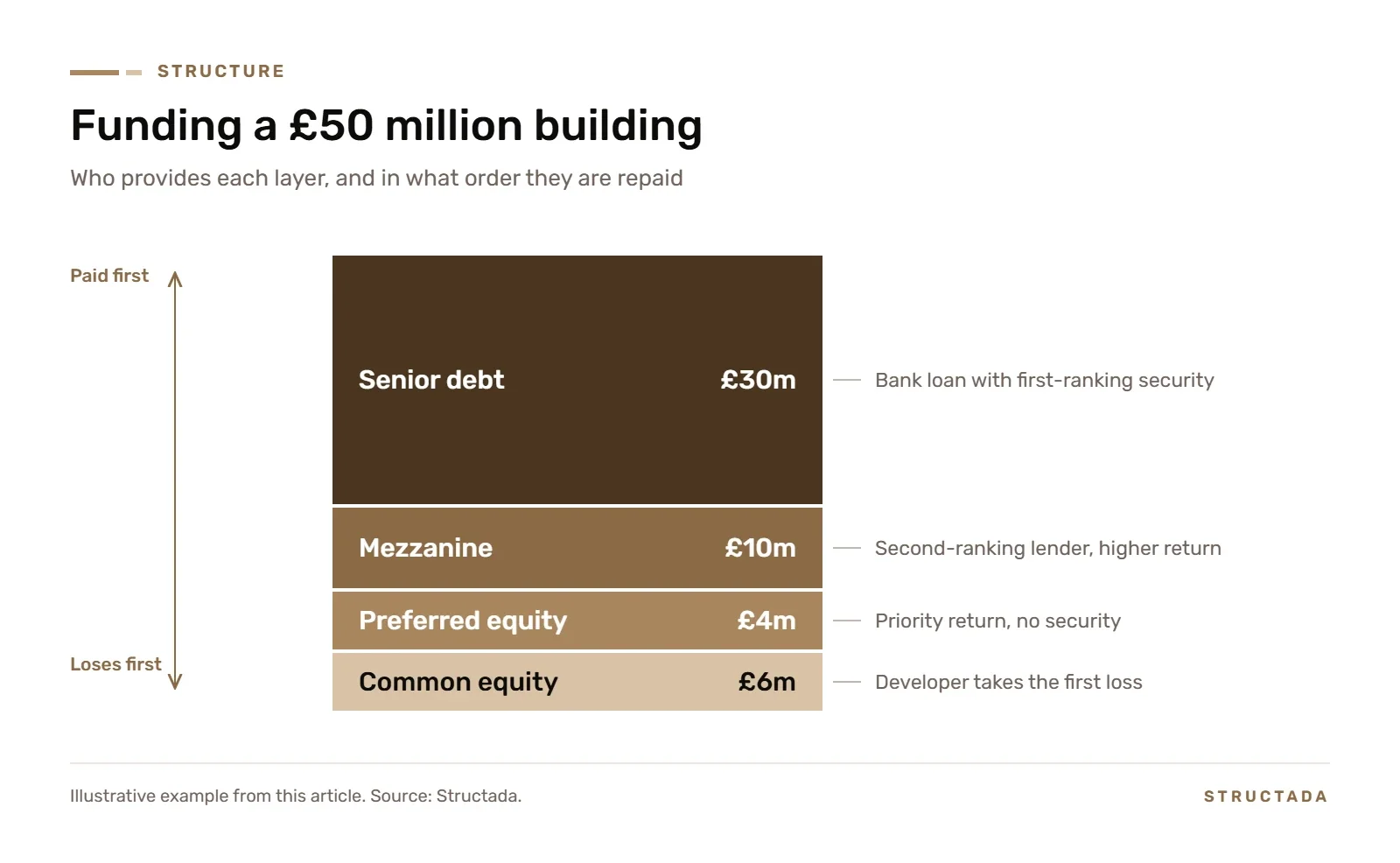
Senior secured debt sits at the top. It usually takes the form of a term loan with first-ranking security over the assets, financial covenants and the right to enforce on default. It carries the lowest risk and the lowest return, and its holders are usually banks or senior private credit lenders.
Mezzanine debt sits below senior debt and above equity. It may be a second-lien loan over the same assets, or a loan to a holding company secured by a share pledge over the company that owns the assets. Mezzanine lenders accept more risk for a higher return, sometimes with equity-like upside through warrants.
Preferred equity ranks below all debt but ahead of common equity. It usually carries a fixed or target return and priority on distributions, but no security and limited enforcement rights. It often appears where the senior lender will not permit further debt, filling the same economic gap as mezzanine in a form that sits outside the lender's restrictions.
Common equity sits at the bottom. It takes the first loss and has no fixed return, but it keeps all the upside once everyone above has been paid. It is usually provided by the sponsor or owner, and its presence is what gives lenders comfort that the people running the business have the most to lose.
Risk and return through the stack
| Layer | Priority | Typical security | Risk | Return |
|---|---|---|---|---|
| Senior debt | First | First-ranking over assets | Lowest | Lowest, usually contractual interest |
| Mezzanine | Second | Second-ranking or share pledge | Moderate | Higher interest, sometimes with upside |
| Preferred equity | Third | Usually none | Higher | Target preferred return |
| Common equity | Last | None | Highest | All remaining upside |
In real estate, lenders often express each layer by loan-to-value. Senior debt might cover the first 50% to 65% of value, with mezzanine extending total leverage to around 75% to 85%, though the right levels depend on the asset and the market. The opening example shows why those thresholds matter: a 16% fall in value wiped out the equity, halved the preferred investor and left both lenders whole.
How ranking is enforced
Priority does not arise by itself. It is created by legal documents and by structure, and it is only as good as the drafting behind it.
Security is the first tool: a lender with first-ranking security is paid first from the secured assets. Where more than one lender has a claim, an intercreditor agreement sets out who is paid when, what the junior lender may do on default, and how enforcement is controlled. Junior lenders typically accept standstill periods during which only the senior lender may enforce.
Structural subordination works differently. A lender to a holding company ranks behind the creditors of the operating company beneath it, because it can only reach the assets through the shares. However strong its documents, it is paid from whatever value remains after the operating company's creditors are settled.
Finally, payment waterfalls apply cash in a set order: first to senior interest, then to junior interest, then to principal and finally to equity. In a stressed situation, the waterfall decides who receives the last pound of income, and its terms often matter more than the headline coupon.
Unitranche loans
A unitranche loan combines senior and junior debt into a single loan at a blended rate, with one set of documents. The borrower deals with one lender group, and the lenders may split the risk privately between themselves through an agreement among lenders. The stack still exists, but it is hidden from the borrower and negotiated among the lenders. Our guide to the unitranche loan as a credit linked note shows how such loans can be packaged for investors.
The capital stack in securitisation
Securitisation applies the same principle to a pool of assets rather than a single borrower. A vehicle holds loans or receivables and issues notes in tranches. Senior notes are paid first and are usually the largest tranche. Mezzanine notes absorb losses once the junior tranche is exhausted. Junior notes or equity take the first losses and keep the excess return, and are often held by the originator to align its interests with those of investors.
Our guide to how securitisation works explains tranching in more detail. Banks use the same structure in synthetic risk transfer, selling protection on a single tranche of a loan portfolio. Banks' own capital stacks include hybrid layers such as CoCos, which absorb losses before senior creditors.
Where notes fit in the capital stack
Notes can be issued at any level of the stack. A credit linked note may give investors exposure to a senior secured term loan, a mezzanine loan or a whole portfolio. The note itself is a wrapper. What determines the risk is the position of the underlying loan in the borrower's capital stack, and the security and intercreditor terms that protect it.
What this means for issuers
The capital stack decides who takes which risk and who earns which return, and investors increasingly look through the instrument they are offered to the position beneath it. A note backed by a first-ranking term loan with a clean intercreditor agreement is a very different proposition from one backed by holding company debt, even if the coupon is similar.
Lenders funding their books through notes should be able to explain, loan by loan, where each exposure sits, what ranks ahead of it and how enforcement would work. That clarity is one of the first things professional investors ask for, and documentation that answers it before the question is raised shortens every subsequent conversation.
Frequently Asked Questions
What is the capital stack?
The combination of debt and equity funding a business, asset or transaction, ranked by priority of payment.
What are the layers of the capital stack?
Typically senior debt, mezzanine or junior debt, preferred equity and common equity, from top to bottom.
Who gets paid first in the capital stack?
Senior secured lenders, followed by mezzanine lenders, preferred equity and finally common equity.
What is mezzanine finance?
Debt that ranks below senior debt and above equity, earning a higher return for higher risk, sometimes with equity upside.
What is structural subordination?
The lower ranking of a lender to a holding company compared with creditors of the operating company, because it can only reach the assets through the shares.
How does the capital stack apply to securitisation?
Securitisation notes are issued in senior, mezzanine and junior tranches, with losses absorbed from the bottom up and payments made from the top down.