- A warrant is a right, but not an obligation, to buy shares in a company at a fixed price, the strike price, before a set expiry date.
- Equity warrants are issued by the company itself, so exercising them creates new shares and dilutes existing shareholders.
- Lenders often take warrants alongside venture and growth loans as an "equity kicker", typically worth 2% to 10% of the loan amount, according to Kruze Consulting.
- Covered warrants are a separate product: they are issued by banks as structured products on shares, indices or other assets, and do not involve the underlying company.
- The terms that matter most are coverage, strike price, expiry, share class and the treatment of anti-dilution and exit events.
Every lender to a young, fast-growing company faces the same arithmetic. The risk of the loan may justify an interest rate the borrower cannot carry, and a rate the borrower can carry may not compensate the lender for the risk. A warrant closes that gap. The lender accepts a lower cash return in exchange for the right to buy a small amount of the company's equity at today's price, and shares in the upside if the business succeeds.
That trade explains why warrants appear in so much venture debt, growth lending and mezzanine finance. For a borrower, a warrant looks cheap at signing and can prove expensive at exit, and how it is drafted decides which.
What is a warrant?
A warrant gives its holder the right to buy a set number of shares at a fixed price, known as the strike or exercise price, at any time before the warrant expires. On exercise, the holder pays the strike price and the company issues new shares in return.
Warrants resemble call options, with two important differences. An equity warrant is issued by the company itself rather than written by another investor, and exercising it creates new shares rather than transferring existing ones. Every warrant exercised therefore enlarges the share capital and dilutes existing shareholders, which is the central point for any company granting them.
How a warrant works
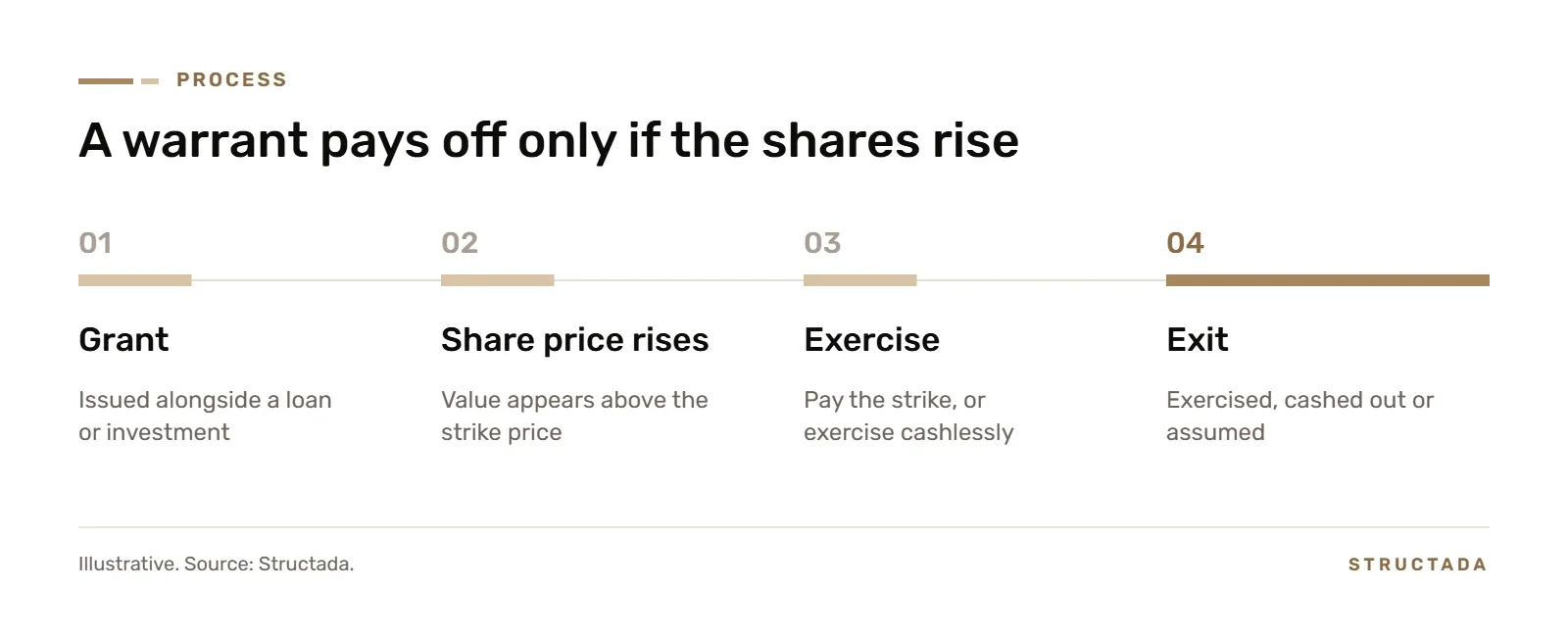
The life of a warrant follows a predictable course. The company grants it, usually alongside a loan, bond or equity investment, and the warrant instrument fixes the number of shares, the strike price, the share class and the expiry date, which is often seven to ten years after grant.
If the share price rises above the strike price, the warrant has intrinsic value. When the holder chooses to exercise, it can pay the strike price in cash and receive new shares, or, where the terms allow a cashless exercise, surrender part of the warrant and receive shares equal to the value of the remainder.
In private companies, the decisive moment is usually the exit. On a sale or a listing, the warrant instrument will say whether the warrants must be exercised, are cashed out at their intrinsic value or are assumed by the buyer. Much of the negotiation over a warrant, in practice, is negotiation over what happens on that day.
Warrants in venture and growth lending
Venture and growth lenders lend to companies that may not yet be profitable, often with limited hard collateral. Warrants allow them to earn a return that reflects that risk without loading the borrower with an interest rate it cannot service.
The size of the grant is expressed as warrant coverage: the value of shares covered by the warrant as a percentage of the loan. Kruze Consulting reports that lenders often ask for 2% to 10% of the loan amount. On a £1 million loan, 5% coverage means warrants over £50,000 of shares, priced at the strike.
The strike price is usually set at the price of the most recent equity round, or at a discount to it. Coverage may be granted in full at signing, on each drawdown or split between commitment and usage, which matters where a facility may never be fully drawn. The warrants are often over the same class of preferred shares issued to the latest equity investors, bringing with them the liquidation preferences and other rights attached to that class.
Covered warrants
Covered warrants share the name but serve a different purpose. They are issued by banks and other financial institutions, not by the company whose shares they reference, and are usually listed and traded on exchanges. They can give exposure to individual shares, indices, currencies or commodities, with call warrants profiting from rises and put warrants from falls. Because the bank creates them and hedges its own exposure, exercising a covered warrant does not create new shares in the underlying company.
Covered warrants belong to the wider family of structured products, alongside certificates, structured notes and credit linked notes.
Warrants vs other instruments
| Equity warrant | Call option | Convertible loan | Covered warrant | |
|---|---|---|---|---|
| Issued by | The company | Another investor or exchange | The company | A bank |
| New shares on exercise | Yes | No | Yes, on conversion | No |
| Paid for separately | Usually granted with debt or equity | Premium paid | Loan amount converts | Purchase price |
| Typical term | 5 to 10 years | Months to a few years | 12 to 24 months | Months to a few years |
| Main use | Equity kicker for lenders and investors | Hedging and trading | Bridge financing | Trading and investment |
The closest alternative for a borrower is a convertible instrument, where the debt itself turns into equity rather than sitting alongside a separate right to buy shares. Our guide to convertible loans explains how that works.
How warrants are valued
Warrants are usually valued with option pricing models such as Black-Scholes, adjusted for the dilution that exercise causes. The value rises with the share price relative to the strike, with the time left to expiry and with the volatility of the shares, since the more a price moves, the more valuable a right to buy at a fixed level becomes.
For listed companies these inputs are observable. For private companies they are largely assumptions: the current share value, the expected volatility of a company with no traded price and the likely timing and form of an exit. Two reasonable advisers can reach very different figures. Accounting adds a further layer, since depending on their terms warrants may need to be classified as equity or as a liability, with the latter bringing fair value changes through the income statement.
Negotiating warrant terms
For an issuer, the economic cost of a warrant sits in its detail. Coverage and strike price set the headline value, but expiry determines how long the lender holds a free option on the company's success, and anti-dilution provisions decide whether that option is protected when the company issues shares at a lower price in a later round. Broad-based weighted average adjustments are generally more balanced for the company than full ratchets, which can reprice the warrant entirely.
Exit treatment deserves equal attention. A requirement that warrants be cashed out at intrinsic value on a sale is simpler for buyers than one that obliges them to assume outstanding warrants. Transferability matters too: a lender free to sell its warrants to a third party may leave the company with an unfamiliar shareholder on its register. The terms of the warrant should also be read alongside the loan covenants in the facility, since the two together define the lender's full position.
When warrants make sense
Warrants suit high-growth companies where the equity upside is real and the cash cost of debt matters more than a modest amount of future dilution. They are much harder to justify for businesses with steady cash flows or strong assets, such as specialist lenders with performing loan books. In those cases the lender can be paid adequately through interest and fees, and the financing can be structured around the assets themselves. A unitranche loan funded through a credit linked note is one example of a non-dilutive route, and our guide to the capital stack shows where each layer of finance sits.
What this means for issuers
A warrant is a straightforward way to trade future equity for cheaper capital today, and used with care it aligns a lender with the company's success at a reasonable price. Used carelessly, with high coverage, low strike prices, generous anti-dilution terms or loosely drafted exit provisions, it can hand away more of the company than the founders ever intended.
The disciplined approach is to model the dilution across a range of outcomes before signing, to price the warrant as part of the total cost of the facility rather than as a sweetener, and to compare that total cost honestly with non-dilutive alternatives. For a business whose strength lies in its assets rather than its growth story, that comparison often points away from equity altogether.
Frequently Asked Questions
What is a warrant in finance?
A right to buy shares in a company at a fixed price before a set expiry date, usually issued by the company itself.
What is warrant coverage?
The value of shares a lender can buy through warrants, expressed as a percentage of the loan amount, often 2% to 10% in venture lending.
Are warrants dilutive?
Equity warrants are dilutive because exercising them creates new shares. Covered warrants issued by banks do not create new shares in the underlying company.
What is the difference between a warrant and an option?
A warrant is issued by the company and creates new shares on exercise. An option is usually written by another party and involves existing shares.
How long do warrants last?
Equity warrants issued with loans commonly last five to ten years, while covered warrants are usually shorter.
What is a covered warrant?
A warrant issued by a bank on shares, an index or another asset, traded on an exchange and settled without the underlying company issuing new shares.