- A loan covenant is a promise in a loan agreement that requires the borrower to do something, or stops it doing something, for as long as the loan is outstanding.
- Covenants fall into three groups: affirmative (what the borrower must do), negative (what it must not do) and financial (ratios it must stay within).
- A breach usually starts a process of cure periods, waivers and amendments, but a breach that is neither cured nor waived can become an event of default.
- Lenders to specialty finance companies rely heavily on portfolio covenants, such as borrowing bases, advance rates, concentration limits and performance triggers.
- The best time to shape covenants is before signing, and issuers should negotiate definitions, headroom, testing frequency and cure rights as carefully as price.
Every loan carries two prices. The first is the interest rate, which is agreed in a line of the term sheet and rarely revisited. The second is the set of promises the borrower makes in order to receive the money, and over the life of a facility those promises often matter more. They are the loan covenants.
Covenants decide how much freedom a borrower keeps once the funds arrive: whether it can pay dividends, take on further debt, buy another business or keep lending when its portfolio has a poor month. Well drafted, they give the lender comfort and the borrower room to operate. Badly drafted, they turn a temporary dip into a negotiation, and a negotiation into a default.
For growth-stage businesses and specialist lenders taking their first institutional facility, covenants are usually the least examined part of the deal and the part most likely to cause trouble later.
What is a loan covenant?
A loan covenant is a condition in a loan or credit agreement that the borrower agrees to meet for the life of the loan. Covenants protect the lender in two ways: by setting rules for how the borrower runs its business and finances, and by giving the lender early warning, and leverage, if things begin to go wrong.
The same principle applies to bonds and notes. In a credit linked note or other note issue, the equivalent promises sit in the note terms or in the underlying facility agreement, and are monitored on investors' behalf by a trustee or agent.
Types of loan covenant
Covenants fall into three families. Affirmative, or positive, covenants require the borrower to do things: deliver financial statements and compliance certificates, maintain insurance, pay its taxes and keep its licences in good standing. They are largely administrative, but a missed reporting deadline is still a breach.
Negative covenants stop the borrower doing things without the lender's consent. The usual list covers taking on more debt, granting security to other creditors, paying dividends, selling key assets and changing ownership. Together, they protect the lender's position in the capital stack by preventing value from leaking out of the business or other creditors from stepping ahead.
Financial covenants require the borrower to stay within agreed financial limits. Where affirmative and negative covenants set the rules of behaviour, financial covenants measure whether the business remains as strong as it was when the loan was made.
Common financial covenants
| Covenant | What it measures | Typical test |
|---|---|---|
| Leverage ratio | Debt relative to earnings (debt ÷ EBITDA) | Must stay below a maximum |
| Interest cover | Earnings relative to interest (EBITDA ÷ interest) | Must stay above a minimum |
| Debt service cover | Cash available relative to interest and principal due | Must stay above a minimum, often 1.2x or more |
| Loan to value | Debt relative to the value of the security | Must stay below a maximum |
| Minimum liquidity | Cash and available facilities | Must stay above a floor |
| Minimum tangible net worth | Equity excluding intangible assets | Must stay above a floor |
The definitions matter as much as the numbers. How EBITDA is calculated, which one-off costs can be added back and what counts as debt can move a ratio a long way.
Maintenance vs incurrence covenants
Maintenance covenants are tested at regular intervals, usually every quarter, whatever the borrower does. If performance slips below the test, the covenant is breached. Incurrence covenants are tested only when the borrower takes a specific action, such as taking on new debt or paying a dividend. If the business would fail the test after the action, it cannot proceed.
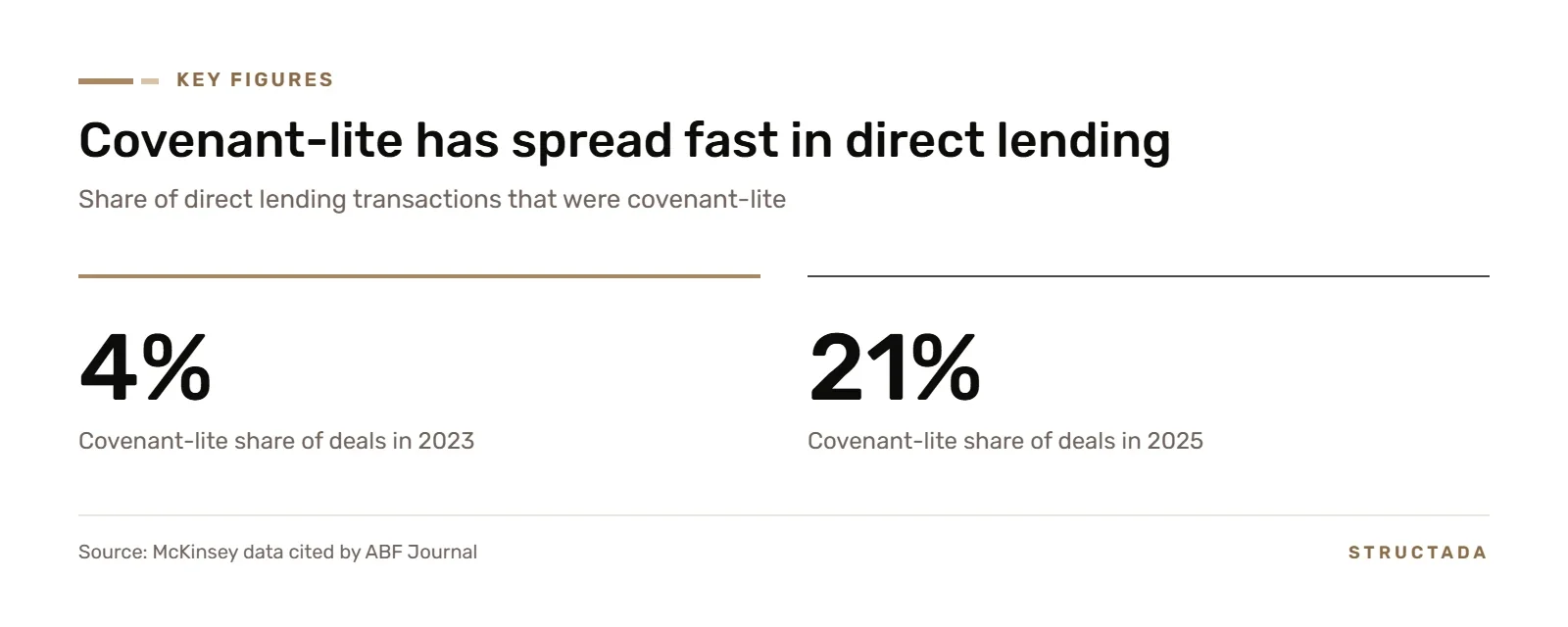
Loans with few or no maintenance covenants are known as covenant-lite. Once mainly a feature of large syndicated loans, they have spread into private credit as lenders compete for deals: covenant-lite deals made up 21% of direct lending transactions in 2025, up from 4% in 2023, according to McKinsey data cited by ABF Journal. For smaller borrowers and specialty lenders, maintenance covenants remain the norm.
Covenants in lender finance and asset-based facilities
Specialty lenders that borrow against their loan books face a different set of covenants, built around the portfolio rather than company earnings. The main portfolio protections are these:
- Borrowing base and advance rate
- Eligibility criteria
- Concentration limits
- Portfolio performance triggers
- Corporate covenants at the lender
- Monthly reporting and audit rights
The borrowing base limits drawings to a set percentage of eligible loans, leaving a cushion of the lender's own equity beneath the facility. Eligibility criteria decide which loans count, by borrower type, size, tenor, arrears status and documentation, and concentration limits cap exposure to any single borrower, sector or region. Performance triggers set limits on arrears, defaults, dilution or loss rates and are often tested monthly, supported by loan tapes and borrowing base certificates.
When a performance trigger is hit, the usual result is a step-up in protection rather than an immediate default: a lower advance rate, a stop on new drawings or early amortisation, where collections are applied to repaying the facility. Our article on how non-bank lenders use credit linked notes for funding explains where these facilities sit in a funding stack, and the same structures appear in fund finance and NAV lending.
What happens if you breach a covenant?
A breach usually starts a process. Most agreements give the borrower a cure period to remedy the problem, and some allow an equity cure, in which shareholders inject funds to bring a ratio back into line. Failing that, the borrower can ask for a waiver or an amendment, usually in return for a fee, a higher margin or tighter terms.
Only if the breach is neither cured nor waived does it become an event of default. At that point the lender can stop further lending, demand immediate repayment and, ultimately, enforce its security, often through a collateral agent. In practice, lenders prefer to negotiate. Enforcement is slow and costly, and a constructive borrower is usually worth more than a seized asset.
Breaches also differ in weight. A late compliance certificate is a technical breach and easily remedied. A missed payment or a sharp rise in leverage is a financial breach, and it changes the relationship.
How issuers should negotiate covenants
The starting point is headroom. Covenants should be run against the borrower's own forecasts and a downside case, with room for an ordinary bad quarter. A covenant that only holds if the plan is met in full is a default waiting for a date.
Definitions deserve more attention than headline ratios. EBITDA add-backs, the meaning of eligible receivables and the definition of debt often decide whether a business passes or fails a test. Testing frequency should match the business: quarterly suits most companies, portfolio covenants for lenders are usually monthly, and seasonal businesses may need adjusted tests. Cure periods and equity cure rights buy time to fix a problem before it becomes a default, and they are far easier to win at signing than after a breach.
Reporting obligations should be ones the finance team can meet on time, every time, since late reporting is among the commonest breaches. And permitted debt, acquisitions and new products should be written to accommodate the business plan, or the borrower will be seeking consents within a year. For issuers using a credit linked note, covenants are typically agreed in the term sheet alongside price and tenor. Our guide on how to issue a credit linked note sets out where that fits, and our comparison of credit linked notes and bilateral loans shows how terms differ between the two routes.
What this means for issuers
Covenants are the operating manual for a loan. They tell the lender how the borrower will behave, and they give both sides an early warning when performance weakens. The aim for any issuer is a set of covenants that fits the business, leaves room for normal volatility and makes plain what happens if something goes wrong.
The negotiation is easiest before the money is drawn. Once a covenant has been tested and missed, the leverage passes to the lender, and terms that seemed academic at signing become the terms on which the business is run.
Frequently Asked Questions
What is a loan covenant in simple terms?
A promise in a loan agreement that the borrower will do certain things, avoid others and stay within agreed financial limits until the loan is repaid.
What are the three types of loan covenant?
Affirmative covenants, which require actions such as financial reporting; negative covenants, which restrict actions such as extra borrowing or dividends; and financial covenants, which set limits such as maximum leverage or minimum interest cover.
What happens if a borrower breaks a loan covenant?
Usually there is a cure period, and the borrower can seek a waiver or amendment, often for a fee. If the breach is neither cured nor waived, it can become an event of default, allowing the lender to demand repayment and enforce security.
What is a covenant-lite loan?
A loan with few or no maintenance covenants, so financial tests apply only when the borrower takes specific actions such as taking on new debt.
What is a maintenance covenant?
A financial covenant tested at regular intervals, usually quarterly, regardless of what the borrower does.
Do credit linked notes have covenants?
Yes. The protections are written into the note terms or the underlying facility agreement, and are typically monitored by a trustee or agent on behalf of investors.