- A collateral agent, often called a security agent, holds and administers security on behalf of a group of lenders or noteholders, so the borrower grants security once to a single party rather than to every creditor.
- It takes and perfects the security, holds it for the secured parties, monitors it, releases it when permitted and, on default, enforces it on the creditors' instructions.
- It acts on instructions from the lenders or noteholders, usually through a facility agent or note trustee, and is not expected to exercise its own judgement on commercial decisions.
- Under English law the role is usually structured as a security trustee; in the US and some civil law countries, as an agent, sometimes supported by a parallel debt.
- Any financing with more than one secured creditor, changing creditors or tradable notes usually needs one, from syndicated loans and private credit to securitisations and credit linked notes.
Security is simple when there is one lender. The borrower charges its shares, accounts and receivables to that lender, the charges are registered, and the lender holds them until the loan is repaid. The position changes as soon as there are ten lenders, or several hundred noteholders, and those creditors expect to sell their positions to others during the life of the debt.
Granting separate security to every creditor, and retaking it each time one sells, would be unworkable. The market's answer is the collateral agent: a single party that takes the security once and holds it for whoever the secured creditors happen to be from time to time. When the creditors change, the security stays where it is. When something goes wrong, one party enforces on behalf of all.
The role looks administrative, and most of the time it is. Its importance becomes clear in a default, when the way the collateral agent was appointed, instructed and protected decides how quickly and cleanly creditors can recover.
What is a collateral agent?
A collateral agent is a bank, trust company or specialist agency firm appointed to hold security on behalf of a group of secured creditors. The term is common in US practice. In English law and international transactions the same role is usually called a security agent or security trustee.
Its work is administrative and legal. It holds the security, ensures it is perfected and maintained, releases it when the documents allow and enforces it when instructed. It does not lend money or take credit decisions, and its liability is usually limited to gross negligence or wilful misconduct, reflecting the modest fee it earns relative to the value of the assets it holds.
What a collateral agent does
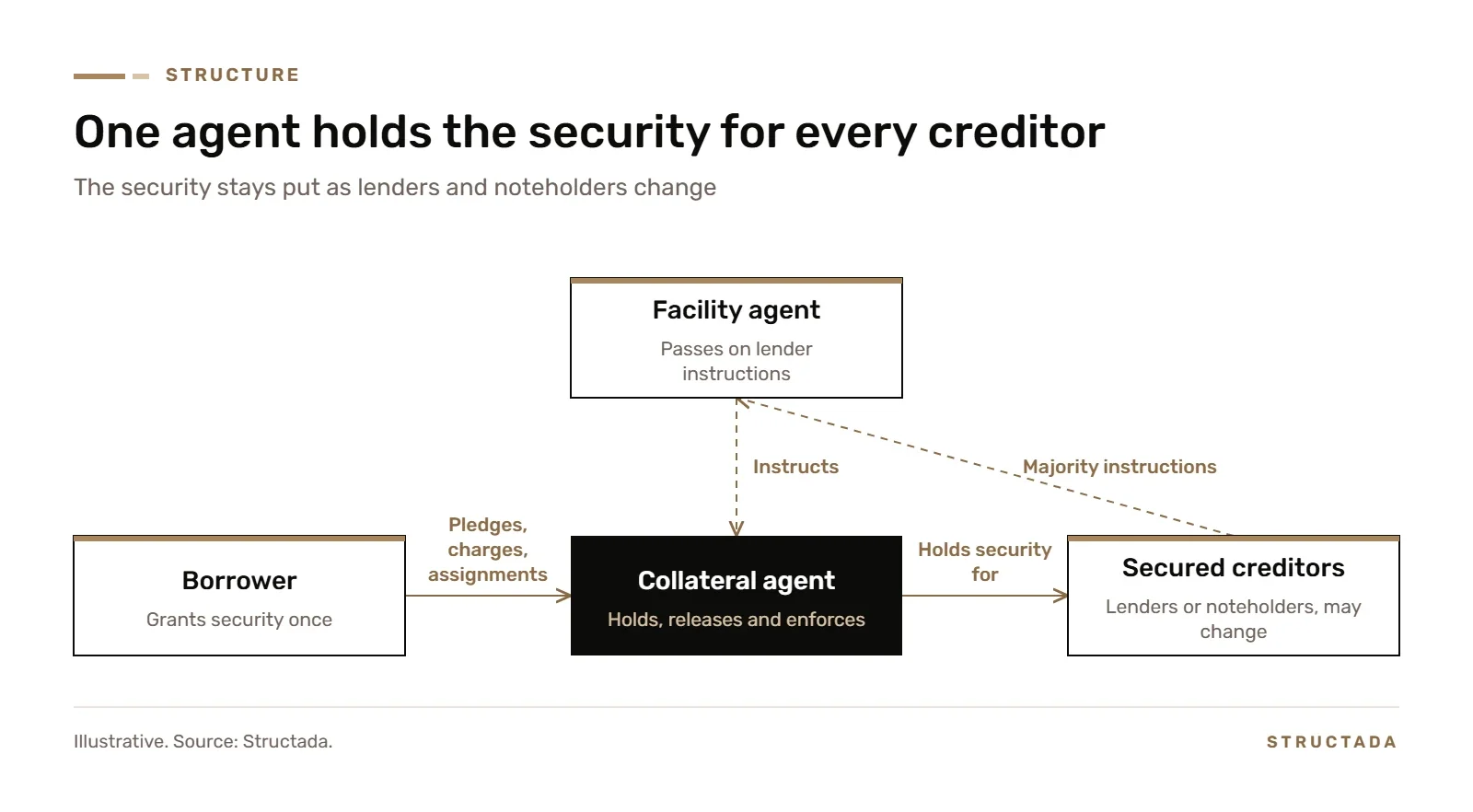
The collateral agent is the named secured party in the share pledges, account charges, assignments of receivables and other security documents. It makes, or oversees, the registrations, filings and notices required for that security to be effective against third parties, a step that is easily underestimated. Our guide to perfection of security explains why it matters: security that is valid between the parties but unperfected can fail against a liquidator or a competing creditor.
Once the security is in place, the agent holds it on trust or as agent for all the lenders or noteholders, whoever they are at any given time. It keeps custody of share certificates and original documents, tracks registrations and renewals, and receives notices under the security documents. It releases security when the debt is repaid, when assets are sold in a permitted disposal or on other agreed events. On default, and on the creditors' instructions, it enforces the security and applies the proceeds in the order set out in the payment waterfall.
How a collateral agent fits with other parties
| Role | What it does | Acts for |
|---|---|---|
| Collateral or security agent | Holds and enforces the security | All secured creditors |
| Facility agent | Administers a loan: payments, notices, voting | Lenders under a loan |
| Note trustee | Represents noteholders and can take action on their behalf | Noteholders |
| Paying agent | Makes payments to noteholders | The issuer |
| Arranger | Designs and coordinates the transaction | The issuer or borrower |
The roles are distinct, but one institution often holds several of them. In a note issue, the note trustee and the security trustee are frequently the same entity, while the paying agent handles cash flows to investors and the arranger designs the structure in the first place.
Security trustee, agent or parallel debt
How the role works depends on the law governing the security. Under English law and other common law systems, the security is usually held on trust by a security trustee for the benefit of all secured creditors. The trust separates the security from the trustee's own assets and allows the beneficiaries to change without the security having to be retaken, which is why it is the preferred model for syndicated loans and tradable notes.
In the US, the collateral agent holds the security as agent for the secured parties, and filings such as UCC financing statements name it as secured party. Our guide to UCC filings explains how that works.
Civil law systems present a harder problem. Some do not recognise trusts or allow security to be held for the benefit of others. Transactions there often use a parallel debt, under which the borrower owes the security agent an amount equal to what it owes all the creditors together, so the agent can hold security in its own name for a debt of its own. Luxembourg's financial collateral law expressly allows security to be held by an agent for others, which removes much of that difficulty for Luxembourg vehicles.
The UAE has its own requirements. Foreign lenders often need a locally licensed security agent, particularly for real estate mortgages, and our guide to perfecting security in the UAE covers the local rules.
Instructions, indemnities and fees
The collateral agent acts on instructions, usually given by a majority of lenders through the facility agent or by noteholders through the note trustee. The documents define who can instruct it, what majorities are required and what it may do without instructions, such as releases the documents already permit.
Because the agent is paid a modest fee and holds no economic interest in the debt, it is protected accordingly. Creditors must indemnify it before it takes costly action such as enforcement, and its liability is generally limited to gross negligence or wilful misconduct. It typically charges an acceptance fee and an annual fee, with additional charges for enforcement or unusual work. The documents also set out how it may resign and how a successor is appointed and the security transferred, provisions that matter more than they appear when a transaction runs for many years.
Where creditors rank differently, an intercreditor agreement determines who instructs the collateral agent and how enforcement proceeds are shared. In practice, much of the negotiation in a multi-tranche financing concerns these instruction rights rather than the security itself.
Collateral agents in structured finance
In securitisations and note issues, the issuing vehicle typically grants security over its assets, bank accounts and rights under the transaction documents to a security trustee or collateral agent for the noteholders and other secured parties, such as swap counterparties and service providers. That security works alongside the limited recourse and non-petition provisions that protect investors, ensuring that creditors look only to the assets of the transaction and cannot push the vehicle into insolvency. Our guide to how securitisation works sets out the wider structure.
In private credit funded through notes, such as a credit linked note referencing a loan, there may be two layers of security: security granted by the underlying borrower to secure the loan, and security granted by the issuing vehicle to secure the notes. A collateral agent can hold either or both, and aligning the two layers is one of the more important pieces of structuring work.
When a collateral agent is needed
A collateral agent is needed wherever more than one secured creditor shares the same security or the identity of the creditors may change. That covers syndicated and club loans, notes held by many investors, transactions with several tranches or classes of creditor, cross-border security over assets in several countries and private credit facilities where lenders may sell down or bring in new participants. For a straightforward bilateral loan, the lender usually holds the security directly and no separate agent is required.
What this means for issuers
A collateral agent is what makes secured financing with multiple or changing creditors workable. It lets the borrower grant security once, keeps that security in place as investors come and go, and gives creditors a single party to act for them if things go wrong.
The decisions that matter are made at the start: which institution to appoint, how the role is structured under each governing law, and how instructions, indemnities, fees and enforcement are documented. Those choices rarely attract attention while a transaction performs, but in a default they determine whether recovery is orderly or contested, and correcting them at that stage is far more expensive than settling them at signing.
Frequently Asked Questions
What is a collateral agent?
A party, usually a bank or trust company, that holds and administers security on behalf of a group of lenders or noteholders.
Is a collateral agent the same as a security agent?
Broadly yes. "Collateral agent" is common in US practice; "security agent" or "security trustee" is more common in English law and international transactions.
What is the difference between a collateral agent and a facility agent?
A facility agent administers the loan itself, including payments and notices. A collateral agent holds and enforces the security.
Who instructs the collateral agent?
Usually the lenders or noteholders, acting by the majorities set out in the documents, often through a facility agent or note trustee.
What is a parallel debt?
A legal device used in some civil law countries, under which the borrower owes the security agent an amount equal to its debts to all creditors, so the agent can hold security in its own name.
Do I need a collateral agent for a bilateral loan?
Usually not. A single lender can normally hold the security directly.