- An arranger is the firm that designs and coordinates a financing on behalf of the issuer or borrower, from structure and documents to service providers, timetable and investor approach.
- The role appears in bond and note issues, syndicated loans, securitisations and medium term note programmes, sometimes under titles such as lead arranger or mandated lead arranger.
- Arrangers are distinct from bookrunners and placement agents, who sell the securities, and from trustees and paying agents, who administer them, although one firm often holds several roles.
- Arrangers are usually paid an arrangement fee, often linked to the size of the deal, and sometimes a retainer or success fee.
- A good arranger brings experience of the asset class, access to investors and service providers, and a structure that works for both the issuer and the people buying the notes.
A note issue has more moving parts than most issuers expect. It needs a structure, a vehicle, lawyers, a trustee, a paying agent, an ISIN, clearing, sometimes a rating and a listing, and above all investors. Each of those parties works to its own checklist and its own timetable. Someone has to design the transaction, line up the parties, keep the documents moving and bring everything to close on the same day. That firm is the arranger.
For a first-time issuer, the arranger is often the most consequential appointment in the whole process. A strong arranger can turn a promising set of assets into a security investors want to hold. A weak one can leave a sound business with a transaction that stalls in documentation or never reaches investors at all.
Understanding what an arranger does, how the role differs from the others on a deal and how arrangers are paid is the starting point for appointing the right one.
What is an arranger?
An arranger is a bank, broker, advisory firm or structuring specialist appointed by an issuer or borrower to design and organise a financing. The arranger works out how the deal should be structured, coordinates the advisers and service providers, prepares or oversees the documents and, in many deals, leads the approach to investors.
The title changes with the market. In syndicated loans, the lead bank is often called the mandated lead arranger. In bond issues, the equivalent role is usually the lead manager or bookrunner. In medium term note programmes, the arranger sets up the programme while dealers sell individual issues. In securitisations and credit linked notes, the arranger designs the structure and brings together the vehicle, the agents and the investors.
What does an arranger do?
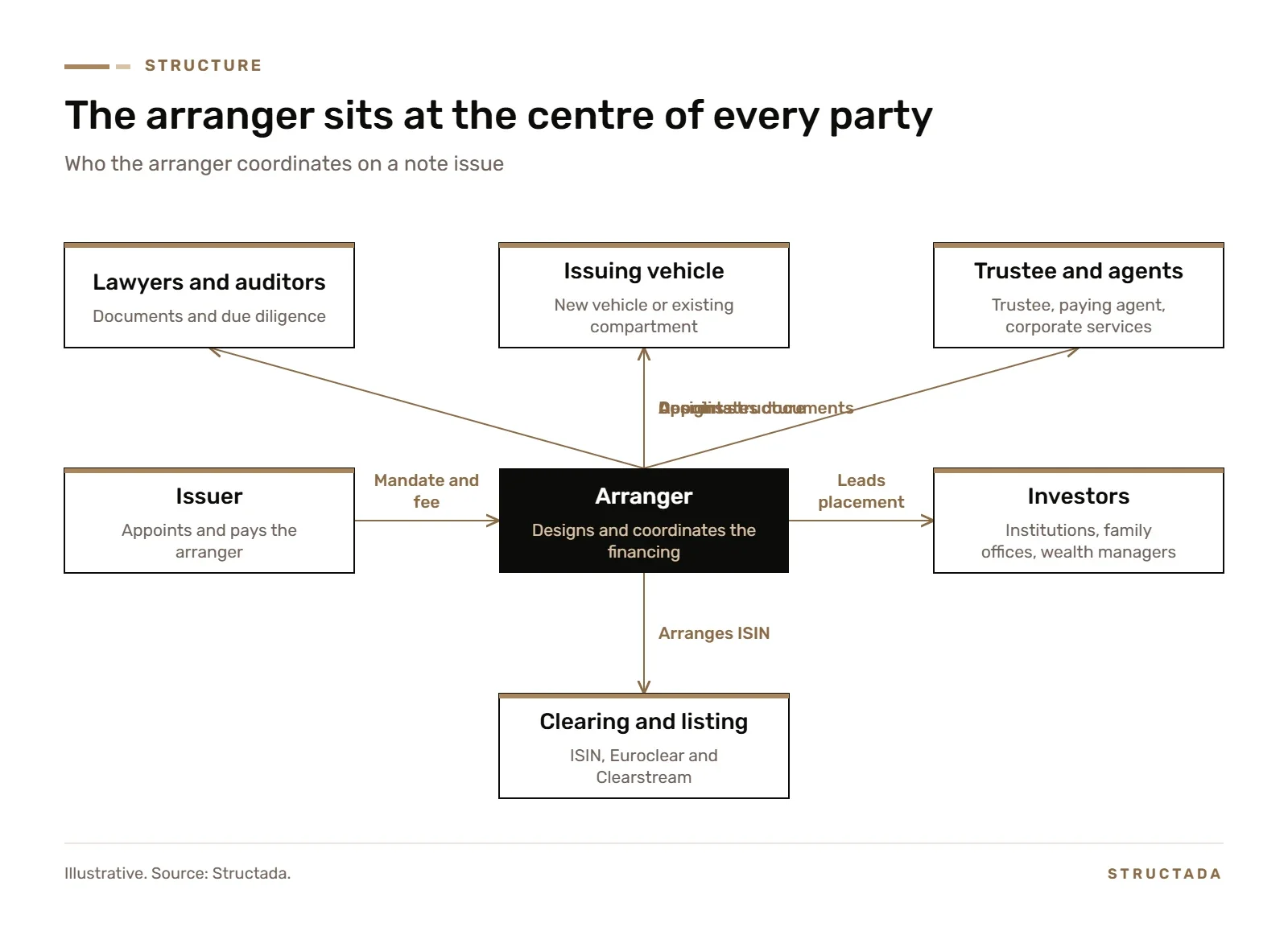
The work begins before any document is drafted. The arranger reviews the assets, the issuer and the funding need, and tests whether a transaction is achievable at all. If it is, the arranger designs the structure: the instrument, the vehicle, the jurisdiction, any tranching, the security package and the key commercial terms.
Next comes the team. The arranger appoints or recommends the lawyers, the vehicle and its corporate services provider, the trustee, the paying agent, the auditors and, where needed, the rating agencies. From that point, much of the arranger's value lies in coordination. Due diligence, know-your-customer onboarding with each service provider and the documents themselves all run on separate tracks, and the arranger's job is to bring them together so that every party is ready to sign at the same moment.
Alongside the structuring work, the arranger prepares the investor materials, typically a term sheet, an information memorandum and a data pack, and leads or supports the approach to investors, either directly or alongside placement agents and bookrunners. At closing, it oversees signing, the issuance of the notes, the allocation of an ISIN, clearing set-up and settlement.
Arranger vs other roles on a deal
| Role | What it does | Typical holder |
|---|---|---|
| Arranger | Designs and coordinates the financing | Bank, broker or structuring firm |
| Mandated lead arranger | Leads a syndicated loan and often commits the largest share | Bank |
| Bookrunner | Runs the order book and allocates securities in a bond issue | Investment bank |
| Lead manager or dealer | Sells the securities, alone or in a syndicate | Investment bank or broker |
| Placement agent | Introduces the deal to eligible investors in a private placement | Broker or advisory firm |
| Trustee | Acts for investors and holds security | Trust company |
| Paying agent | Makes payments to investors | Bank |
| Corporate services provider | Runs and administers the issuing vehicle | Fiduciary or administrator |
The titles can mislead. As BBVA explains for loans and bonds, the senior roles reflect who leads the structuring and placement, while junior titles often carry little real function. On large syndicated deals, a long list of arrangers may appear on the cover of the documents, with only one or two doing the substantive work.
On smaller and private transactions the position is reversed: one firm frequently acts as arranger, placement agent and sometimes dealer at once. In a private placement, the arranger that designed the notes is often the firm best placed to explain them to investors.
The arranger in a securitisation or credit linked note
In a securitisation or a credit linked note, the arranger's role is especially broad, because the transaction has to be built around the assets rather than around the issuer's balance sheet. The arranger's work typically includes:
- Analysing the loan book or reference assets and their data.
- Deciding whether to use a new vehicle or a compartment on an existing platform.
- Setting eligibility criteria, advance rates and protections for investors.
- Coordinating the Luxembourg securitisation vehicle or other issuer, its corporate services provider and agents.
- Arranging the ISIN, clearing through Euroclear and Clearstream and any listing.
- Introducing the notes to professional investors, often through private placement.
The quality of the data work shapes everything that follows. Investors in asset-backed notes price the assets, and an arranger that can present a loan book clearly, with eligibility criteria that match its real performance, will meet fewer objections in diligence. Our guide on how to issue a credit linked note walks through each step the arranger coordinates.
How are arrangers paid?
Arrangers are usually paid an arrangement fee on closing, often calculated as a percentage of the amount issued. Some charge a retainer or work fee during structuring, particularly on complex or first-time transactions, with the balance paid on success. Where the arranger also places the notes, a placement fee may apply, and on programmes arrangers may also earn fees on each issue.
The headline fee is rarely the whole cost. Legal fees, vehicle set-up, agent fees, listing and rating costs are usually borne by the issuer, and some arrangers pass through their own expenses. Issuers should agree the full fee structure, including expenses and third-party costs, at the outset in a mandate or engagement letter.
How to choose an arranger
Experience in the asset class comes first. An arranger that has structured transactions for similar assets will know what investors will accept, which terms will be challenged and how the data should be presented. Investor access follows closely: the ability to reach the right investors, whether institutions, family offices or wealth managers, determines whether a well-structured deal actually closes.
Platform and relationships matter more than many issuers realise. Access to existing vehicles, compartments and service providers can save months and significant cost compared with building from scratch. Independence deserves scrutiny too. Issuers should understand whether the arranger also invests in, lends to or distributes the transaction, and how those conflicts are managed. Finally, look for transparency on fees and timetable from the start, and an execution record of transactions actually closed, on time and as described.
What this means for issuers
The arranger is the issuer's guide through a financing. It shapes the structure, assembles the parties and carries the transaction to close. For issuers new to the capital markets, choosing the right arranger often matters as much as the price of the funding itself.
The strongest appointments share three features: an arranger that understands the assets, knows the investors and can draw on an existing platform. With those in place, the issuer can spend its time on its business rather than on the mechanics of the deal, and the second transaction becomes far easier than the first.
Frequently Asked Questions
What is an arranger in finance?
A firm appointed by an issuer or borrower to design, organise and coordinate a financing, from structure and documents to service providers and investors.
What is the difference between an arranger and a bookrunner?
An arranger designs and coordinates the deal. A bookrunner runs the order book and allocates securities to investors in a bond issue. The same bank often holds both roles.
What is a mandated lead arranger?
The lead bank in a syndicated loan, mandated by the borrower to structure and syndicate the loan, often committing the largest share itself.
What does an arranger do in a securitisation?
It analyses the assets, designs the structure, appoints the vehicle and service providers, prepares investor materials, arranges clearing and listing, and brings the deal to close.
How much does an arranger charge?
Fees vary by deal type, size and complexity. Most arrangers charge an arrangement fee on closing, often a percentage of the amount issued, sometimes with a retainer.
Is an arranger the same as a placement agent?
Not necessarily. An arranger structures and coordinates the deal; a placement agent introduces it to investors. In private placements, one firm often does both.