- A credit rating is an independent opinion on the likelihood that an issuer, or a specific bond or note, will pay interest and principal in full and on time.
- Ratings are expressed on letter scales, from AAA down to D; bonds rated BBB- or Baa3 and above are investment grade, and those below are high yield or speculative grade.
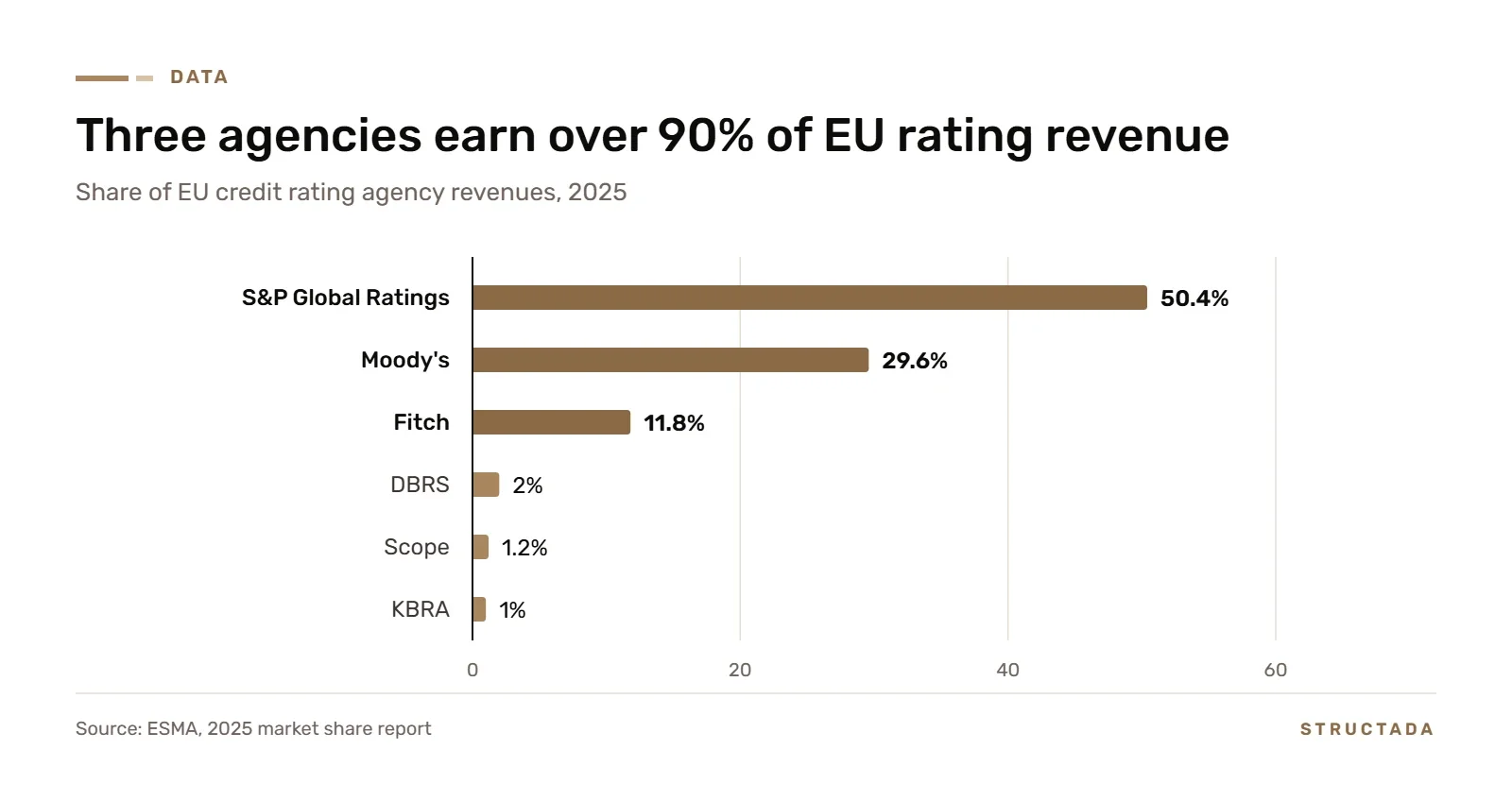
- Three agencies, S&P, Moody's and Fitch, hold around 92% of the EU market by revenue, according to ESMA, alongside smaller agencies such as DBRS Morningstar, Scope and KBRA.
- Ratings can be public or private. Private ratings, shared only with the issuer and selected investors, have grown fast alongside private credit, especially for insurance company investors.
- Many private placements and credit linked notes are issued unrated; a rating is worth paying for when target investors need one, by rule or by policy.
An investor lending to a company it has never met needs a way to judge whether it will be repaid. Reading the accounts, the contracts and the market for every borrower is slow and expensive, and few investors have the staff to do it across a whole portfolio. A credit rating offers a shortcut: a single letter grade from an independent agency, summarising the risk of default.
That shortcut now sits at the centre of the debt markets. Ratings decide which investors can buy a bond, how much capital insurers and banks must hold against it, which indices it can join and, often, the price the issuer pays. Yet a large part of the private debt market operates without them, and for good reason.
For an issuer, the real question is less how ratings work in the abstract and more whether its own investors need one. Answering it starts with understanding what a rating measures, who provides it and what it costs to obtain and keep.
What is a credit rating?
A credit rating is an agency's opinion on creditworthiness. It can apply to an issuer as a whole, such as a company, bank or government, or to a specific debt instrument, such as a bond, note or securitisation tranche. A rating addresses one question: how likely is it that this debt will be paid as promised? It makes no recommendation to buy or sell, and it does not cover market risks such as price or liquidity.
Ratings are forward-looking and kept under review. Agencies can upgrade, downgrade or place a rating on watch as circumstances change, and a downgrade can have consequences well beyond sentiment, since investors bound by rating limits may be required to sell.
Credit rating scales
| S&P and Fitch | Moody's | What it means |
|---|---|---|
| AAA | Aaa | Highest quality, minimal credit risk |
| AA | Aa | Very high quality |
| A | A | High quality, low credit risk |
| BBB | Baa | Good quality, moderate risk: the lowest investment grade band |
| BB | Ba | Speculative: the highest high yield band |
| B | B | Highly speculative |
| CCC to C | Caa to C | Substantial risk, near or in default |
| D | (C) | In default |
Within each band, agencies add modifiers: + and - for S&P and Fitch, and 1, 2 and 3 for Moody's. The line between BBB- (Baa3) and BB+ (Ba1) is the most important on the scale, because many investors can only buy investment grade debt. A single notch across that line can change the investor base for a bond entirely.
Structured finance ratings, such as those on securitisations and asset-backed securities, use the same scale with an "sf" suffix, for example AAA(sf), to show they apply to a structured instrument.
Who are the credit rating agencies?
The market is dominated by three firms: S&P Global Ratings, Moody's and Fitch. In the EU, ESMA's 2025 market share report puts S&P at 50.4%, Moody's at 29.6% and Fitch at 11.8% of rating revenues, a combined 91.9%. The next largest are DBRS at 2.0%, Scope at 1.2% and KBRA at 1.0%.
Agencies are regulated. In the EU, they must be registered with ESMA under the Credit Rating Agencies Regulation; in the UK, with the FCA; and in the US, many are registered with the SEC as Nationally Recognised Statistical Rating Organisations (NRSROs). Regulation covers conflicts of interest, transparency of methodology and governance, though not the ratings themselves, which remain the agency's opinion.
How a credit rating is assigned
The process follows a well-established sequence, and a rated transaction should allow for it in the timetable:
- Engagement, where the issuer, usually advised by its arranger, appoints one or more agencies and agrees the fee.
- Information, where the issuer provides financial statements, business plans, legal documents and, for structured deals, loan-level data.
- Analysis of the business, financial strength, management, legal structure and, for securitisations, the assets and cash flow waterfall.
- A rating committee of analysts, which votes on the rating; the issuer may be allowed to appeal or provide further information.
- Publication, with a rationale for public ratings, or private delivery to the issuer and permitted parties.
- Surveillance for the life of the rating, with updates as circumstances change.
The final stage is easily overlooked. A rating is a continuing relationship, with ongoing fees, reporting obligations and the possibility of an unwelcome change during the life of the notes.
Public vs private credit ratings
A public rating is published and available to all investors. A private rating is shared only with the issuer and a limited group of parties, such as specific investors or their regulators.
Private ratings have grown quickly with the rise of private credit, especially among insurers, who use them to set regulatory capital. According to the Structured Finance Association, private letter ratings made up 42% of the 19,443 securities filings reviewed by the US insurance regulator, the NAIC, in 2024, up from 25% the year before. More than 80% of private ratings used by insurers come from small and mid-sized agencies. Regulators have responded with closer scrutiny of how those ratings are produced and used.
Why issuers get rated
The strongest reason is investor access. Many institutional investors can only buy rated, or investment grade, debt under their mandates, and for them an unrated note is simply outside the opportunity set. Regulatory capital reinforces the point: banks and insurers hold less capital against highly rated debt, which makes rated notes more attractive to them and can widen demand enough to lower the cost of borrowing. Index inclusion often depends on ratings too.
Structured finance adds a further dimension. A securitisation can achieve a rating on its senior notes well above the originator's own, because the notes are backed by ring-fenced assets and protected by subordination, opening cheaper funding than the originator could obtain on its own name. Our guide to how securitisation works explains why.
When a credit rating is not needed
Ratings cost money and time, and bring ongoing disclosure and surveillance. Many issues do without them. Private placements to investors who do their own credit work are commonly unrated, as are notes sold to family offices, wealth managers and professional investors who assess the assets directly. On smaller issues, the cost of a rating can be high relative to the amount issued.
Credit linked notes referenced to defined loans or portfolios are a common example. Investors look through to the underlying assets, and the loan-level data they receive often tells them more than a letter grade would. The decision usually comes down to the target investors. If they require a rating, the cost is part of the price of access. If they do not, it may add little.
The criticisms of credit ratings
Ratings have faced sustained criticism, most sharply after the 2008 financial crisis, when many highly rated mortgage securities suffered heavy losses. Under the issuer-pays model, the entity being rated pays the agency, which creates an obvious conflict of interest. Issuers may engage in ratings shopping, choosing the agency likely to give the highest grade. The market is concentrated in a small number of firms, and investors may lean on ratings in place of their own analysis.
Regulation since the crisis has addressed some of these issues, and investors are encouraged to treat ratings as one input rather than the answer. The growth of private ratings from smaller agencies has revived some of the same questions.
What this means for issuers
A credit rating is a passport to certain investors and certain prices. For large, repeat issuers and public securitisations, it is often essential. For many private placements and credit linked notes sold to professional investors, it may be unnecessary, and the money is better spent on clear data and strong documentation.
The useful question is whether the investors you want require one. That should be settled early, alongside the choice of vehicle and the offering document, because a rating affects the structure, the timetable and the ongoing cost of the notes. An experienced arranger will weigh the cost of a rating against the investors and pricing it would unlock.
Frequently Asked Questions
What is a credit rating in simple terms?
An independent grade, such as AAA or BB, that shows how likely an issuer or a bond is to repay its debt in full and on time.
Who are the main credit rating agencies?
S&P Global Ratings, Moody's and Fitch, which together hold around 92% of the EU market, followed by smaller agencies such as DBRS Morningstar, Scope and KBRA.
What is investment grade?
A rating of BBB- or higher from S&P and Fitch, or Baa3 or higher from Moody's. Anything below is called high yield or speculative grade.
Who pays for a credit rating?
Usually the issuer, under what is known as the issuer-pays model.
What is a private credit rating?
A rating shared only with the issuer and a limited group of parties, such as specific investors or their regulators, rather than published.
Do I need a credit rating to issue notes?
Not always. Many private placements and credit linked notes are issued unrated. A rating is needed when target investors require one by regulation or mandate.