- A CoCo, or contingent convertible, is a bond that converts into equity or is written down if the issuer's capital falls below a set level or its regulator decides it is no longer viable.
- Most CoCos are Additional Tier 1 (AT1) instruments issued by banks to meet capital requirements under Basel III.
- They are perpetual, usually callable after at least five years, and their coupons can be cancelled at the issuer's discretion without causing a default.
- In the EU, AT1 instruments must convert or be written down at least when a bank's Common Equity Tier 1 ratio falls below 5.125%, although many have higher triggers.
- The full write-off of around CHF 16 billion of Credit Suisse AT1s in March 2023 showed how the risk can play out, and a Swiss court annulled that decision in October 2025.
After the 2008 financial crisis, governments spent hundreds of billions rescuing banks while bondholders were largely paid in full. Regulators resolved that the next failure would be handled differently, with private investors absorbing losses before taxpayers were asked to step in.
Their answer was the contingent convertible bond, or CoCo. In normal times it pays a coupon above that on the bank's senior debt. If the bank's capital falls too low, or its regulator judges that it is failing, the bond converts into shares or is written down, in part or in full.
A CoCo bond is therefore a wager on the health of a bank and on the behaviour of its regulator. The second half of that wager was tested in March 2023, and the outcome still shapes how the market prices these instruments.
What is a CoCo bond?
A CoCo is a hybrid security: it pays interest like a bond but can turn into equity, or disappear, when a trigger is hit. The word "contingent" refers to that trigger. In an ordinary convertible loan or convertible bond, the investor chooses whether to convert, and conversion is usually a route to upside. In a CoCo, conversion or write-down happens automatically or at the regulator's direction, and it arrives precisely when the issuer is in difficulty.
Most CoCos are issued by banks as Additional Tier 1 (AT1) capital, which counts towards their regulatory capital requirements under Basel III. Insurers issue similar instruments, known in Europe as Restricted Tier 1, and some Tier 2 instruments also carry loss-absorbing features. In the capital stack, AT1 sits just above common equity and below every other form of debt.
How a CoCo bond works
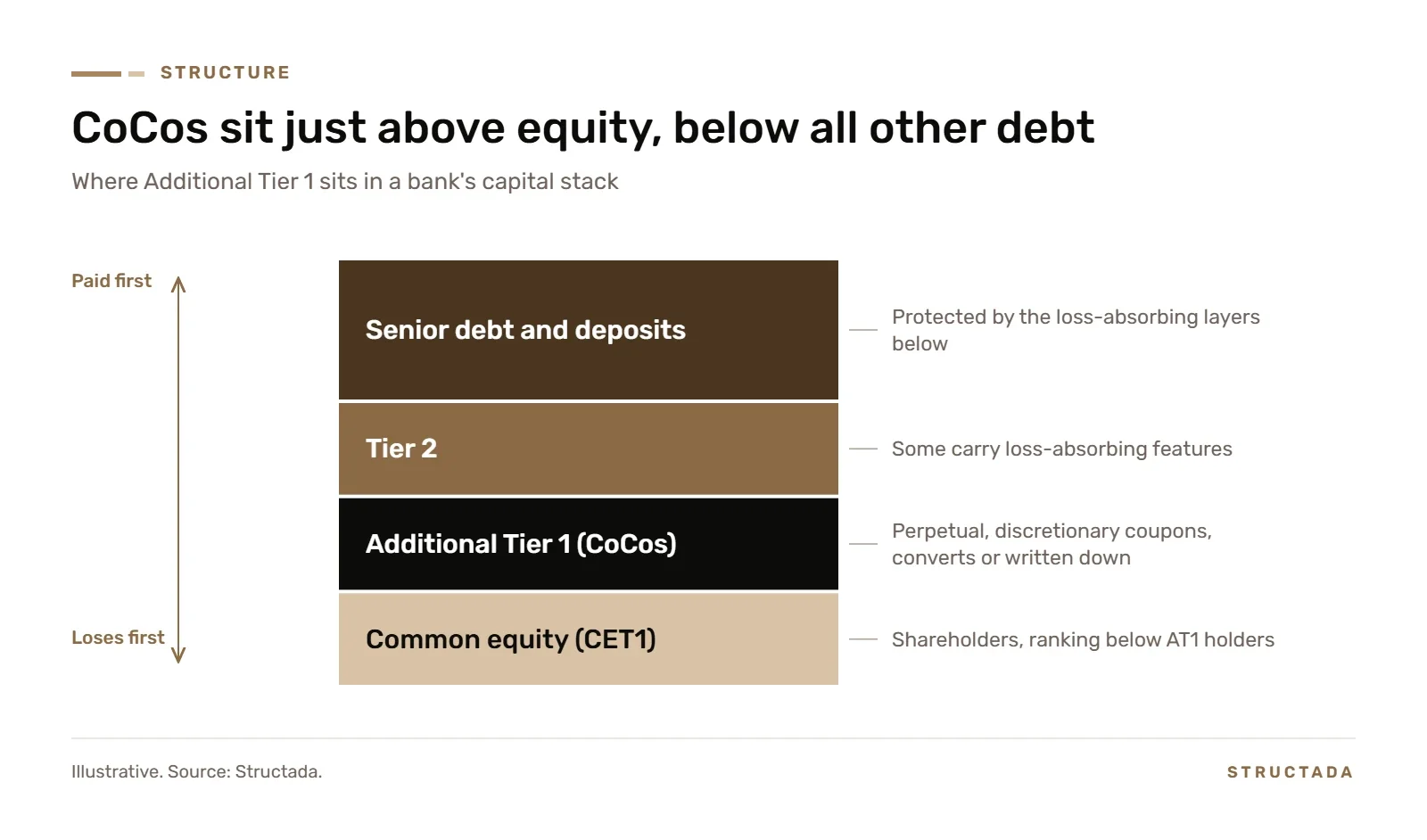
In normal conditions, the bank pays a coupon, usually higher than on its senior bonds. That coupon is fully discretionary. The bank, or its regulator, can cancel it at any time, cancelled coupons are not owed later, and cancellation is not an event of default. An investor in a CoCo has no right to insist on being paid in the way a senior creditor does.
AT1 CoCos are also perpetual, with no maturity date. The bank can usually redeem them from five years after issue, with regulatory approval, but is under no obligation to do so. The market has long assumed that banks will call at the first opportunity, and much of the pricing rests on that assumption.
The decisive feature is the trigger. If the bank's capital ratio falls below a defined level, or the regulator declares a point of non-viability, the CoCo absorbs losses and ceases to behave as debt.
CoCo triggers
| Trigger type | What sets it off |
|---|---|
| Mechanical trigger | The bank's Common Equity Tier 1 (CET1) ratio falls below a set level. In the EU, AT1s must trigger at 5.125% CET1 or higher; some use 7% |
| Point of non-viability | The regulator decides the bank is failing or would fail without public support |
| Resolution | Authorities use bail-in powers to write down or convert the instrument as part of a resolution |
The mechanical trigger gets most of the attention, but in practice banks usually get into difficulty well before their CET1 ratio reaches 5.125%. Confidence and funding tend to go first. That is why the point of non-viability trigger, and the regulator's judgement behind it, matter most to investors.
Conversion and write-down
When a trigger is hit, the terms of each instrument determine what happens. Some CoCos convert into equity, usually at a low conversion price, so investors become shareholders who share in any recovery but suffer heavy dilution. Others are written down permanently, with principal reduced partly or to zero and nothing paid for the amount written off. A third group uses a temporary write-down, under which principal can be written back up from future profits if the bank recovers.
These differences are material and are set out instrument by instrument. Two CoCos issued by banks of similar strength can behave very differently under stress, which is why the terms deserve as much scrutiny as the issuer's capital ratios.
The Credit Suisse AT1 write-off
In March 2023, as UBS agreed to take over Credit Suisse with government support, the Swiss regulator FINMA ordered a full write-off of Credit Suisse's AT1 bonds, worth around CHF 16 billion, as finews reported. FINMA said the terms allowed a write-down where extraordinary government support was granted, and an emergency ordinance gave it authority to order one. Shareholders, who rank below AT1 investors, received UBS shares.
The decision shocked investors who had assumed equity would always be wiped out first. In October 2025, the Swiss Federal Administrative Court annulled FINMA's decision, finding there was no valid contractual or legal basis for the write-off, according to a summary of the ruling. The ruling may be appealed, and compensation had not been decided.
EU and UK regulators said after the event that, in their regimes, shareholders absorb losses before AT1 holders. The episode remains a reminder that CoCo risk depends on legal terms, regulators and politics as well as on capital ratios.
Why banks issue CoCos and investors buy them
For a bank, AT1 counts towards Tier 1 capital and leverage requirements at a lower cost than new equity. Coupons are usually tax deductible, and issuance avoids immediate dilution of existing shareholders. The instrument also provides a buffer that protects senior creditors and depositors, which in turn supports the bank's wider funding.
Investors are drawn by yields above those on senior bank bonds or most investment grade credit, combined with exposure to large, regulated institutions. Many price CoCos to the first call date, on the expectation that banks will redeem them.
Risks of CoCo bonds
The risks follow directly from the design. Principal can be converted or written down, potentially to zero. Coupons can be cancelled with no right to recover missed payments. If the bank chooses not to call, the investor is left holding a perpetual bond at a coupon the market may no longer consider adequate, which is known as extension risk. Regulatory and legal risk, as Credit Suisse showed, sits on top of all of these. Terms also vary widely, and many jurisdictions restrict sales to retail investors because of that complexity.
CoCos and other structured instruments
CoCos belong to a wider family of instruments that combine features of debt and equity or transfer risk in defined ways. Convertible loans and warrants give investors equity upside, while credit linked notes transfer credit risk on defined assets. Banks also manage capital through synthetic risk transfer, which reduces risk-weighted assets rather than adding capital. Our guide to types of structured products sets out the wider family, and our article on credit ratings explains how agencies treat hybrid instruments.
What this means for issuers
CoCos are a specialised tool, used almost entirely by banks and insurers to meet regulatory capital requirements. For corporate and specialist issuers they offer no practical funding route, since their purpose is regulatory and their investor base expects the backing of a prudentially supervised balance sheet.
They are still worth understanding. They shape how bank capital, and therefore lending capacity, works, and they show with unusual clarity how loss-absorbing features, triggers and discretion affect the price investors demand. Any issuer designing subordinated or contingent features into its own notes will find that investors bring the lessons of the AT1 market with them.
Frequently Asked Questions
What does CoCo stand for?
Contingent convertible, a bond that converts into equity or is written down if a trigger event occurs.
What is an AT1 bond?
An Additional Tier 1 bond, a perpetual, loss-absorbing instrument that counts towards a bank's Tier 1 regulatory capital. Most AT1s are CoCos.
What triggers a CoCo?
A bank's CET1 ratio falling below a set level, at least 5.125% in the EU, or a regulator deciding the bank is no longer viable.
Can CoCo coupons be cancelled?
Yes. Coupons are fully discretionary and can be cancelled without causing a default, and missed coupons are not paid later.
What happened to Credit Suisse's AT1 bonds?
Around CHF 16 billion of AT1 bonds were written off in March 2023. A Swiss court annulled the write-off decision in October 2025, subject to appeal.
Do CoCos have a maturity date?
AT1 CoCos are perpetual. They can usually be called by the issuer from five years after issue, with regulatory approval.