- A medium term note (MTN) is a debt security issued under a standing programme, typically with a maturity between about nine months and ten years, though longer tenors are common.
- The programme is the point: documents are agreed once, so the issuer can then issue notes repeatedly, quickly and in different sizes, currencies and structures.
- Each issue is documented with short final terms or a pricing supplement that sits on top of a base prospectus or offering circular.
- Euro medium term note (EMTN) programmes dominate international issuance, while US programmes are usually registered with the SEC or rely on Rule 144A or other exemptions.
- MTN programmes are used by banks, corporates and sovereigns, and are the standard platform for structured notes; securitisation vehicles use similar programmes to issue credit linked notes.
A single bond issue is an expensive event. It needs its own offering document, its own legal opinions, its own agents and its own marketing, and the work can run for weeks before a note is priced. For an issuer that will come back to the debt markets several times a year, repeating that process for every transaction makes little sense.
The medium term note, or MTN, is the market's answer. An issuer agrees a framework of documents once and then issues notes under it whenever it needs funding or an investor asks for a particular instrument. The name refers to maturity, but the defining feature is the method of issue, and that method has made MTN programmes the workhorse of international debt markets.
What is a medium term note?
A medium term note is a debt security issued under a medium term note programme. MTNs were originally designed to fill the gap between commercial paper, which matures in under a year, and long-dated bonds. The label has since broadened considerably: the Association of Corporate Treasurers describes MTNs as typically running from about nine months to several years, and occasionally up to 30 years.
In practice, the maturity matters less than the mechanism. The issuer establishes a programme with a maximum size, a common set of terms and a panel of dealers, and then draws down individual series of notes under it.
How an MTN programme works
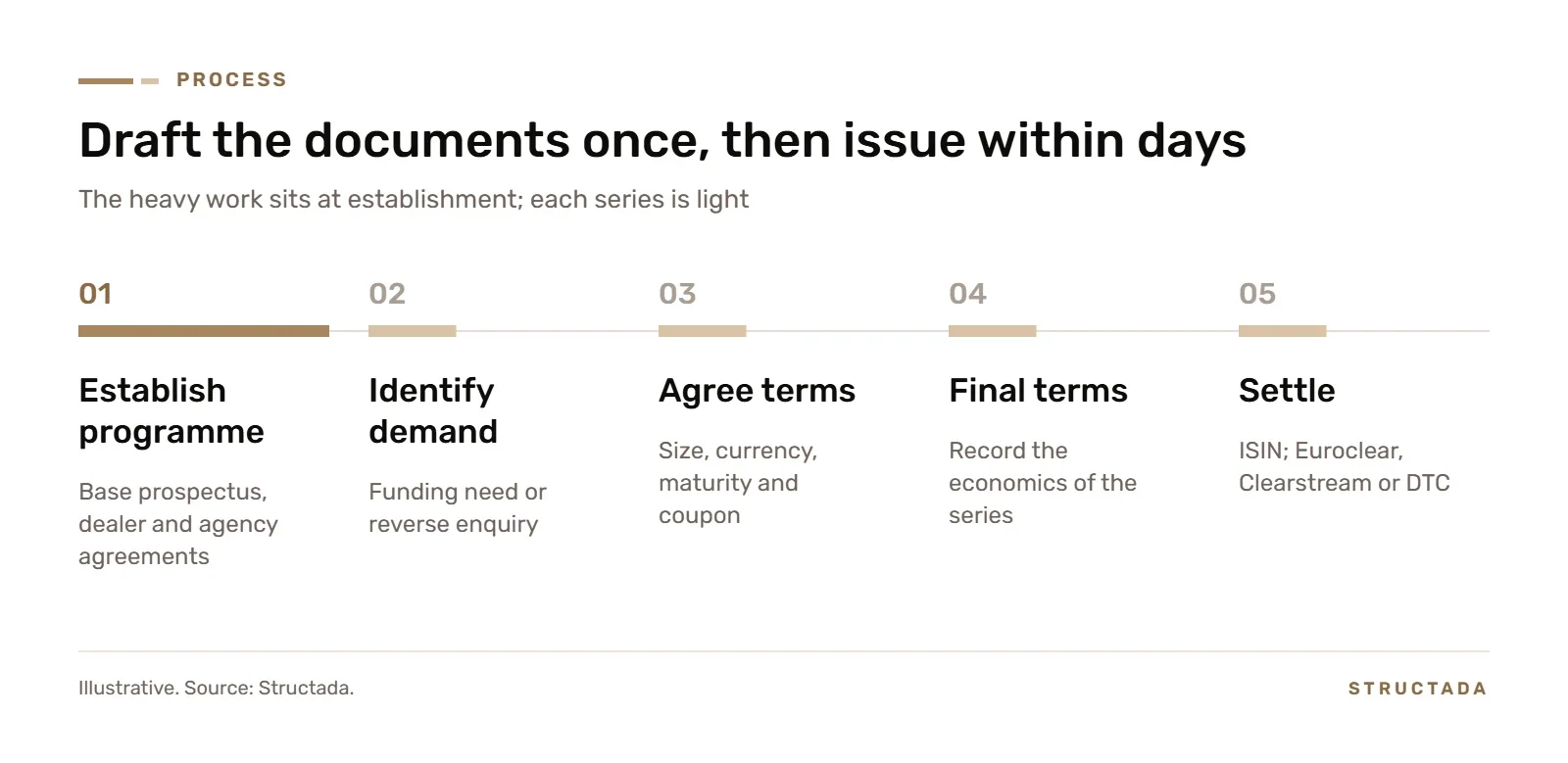
The life of a programme has two distinct phases. The first is establishment. The issuer, its lawyers and an arranger agree the base prospectus or offering circular, the dealer agreement, the agency agreement and the terms and conditions that will govern every note. This is where most of the legal and disclosure effort sits, and where a credit rating is often obtained.
The second phase is issuance, and it is deliberately light. Once the programme is in place, each new series follows the same short sequence:
- Demand is identified, either from a planned funding need or from a reverse enquiry, where an investor asks a dealer for a note with specific terms.
- The issuer and dealer agree size, currency, maturity, coupon and any special features.
- Final terms or a pricing supplement record the economics of that series and refer back to the base documents.
- The notes receive an ISIN, settle through Euroclear and Clearstream or DTC, and may be listed.
Because the heavy drafting is done once, a new issue can often be priced and settled within days. Programme documents are usually refreshed once a year with updated financial information.
The documents in an MTN programme
At the centre of every programme sits the base prospectus or offering circular. It describes the issuer, its business and its risks, and sets out the general terms that apply to all notes issued under the programme. The terms and conditions of the notes are incorporated into every issue, so investors in the fifth series hold notes on the same legal footing as those in the first.
Each issue then carries its own final terms or pricing supplement, a short document that fixes the size, currency, coupon, maturity and any special features of that series.
Around these sit the contractual agreements that make the programme operate. The dealer agreement appoints the banks that sell the notes and records the issuer's representations to them. The agency agreement appoints the issuing and paying agent, the calculation agent and the registrar. Finally, a trust deed or deed of covenant sets out investors' rights, either through a trustee who acts on their behalf or directly against the issuer.
EMTN vs US MTN programmes
International issuance is dominated by the Euro medium term note, or EMTN, programme; US programmes follow a different route shaped by US securities law.
| Euro MTN (EMTN) programme | US MTN programme | |
|---|---|---|
| Main investors | International, outside the US | US investors, with or without others |
| Legal basis | Prospectus Regulation or listing rules of the chosen exchange | SEC registration, or exemptions such as Rule 144A or Section 3(a)(2) for banks |
| Issue document | Final terms | Pricing supplement |
| Settlement | Euroclear and Clearstream | DTC |
| Common listing venues | Luxembourg, Dublin, London, Vienna | Usually unlisted |
US programmes are typically registered on a shelf registration statement or rely on private placement exemptions. As Mayer Brown explains, exempt US programmes may use Rule 144A, Regulation S or Section 4(a)(2) instead. Our guides to Rule 144A and US private placements cover these routes in more detail.
Why issuers use MTN programmes
Speed is the obvious advantage. With documents pre-agreed, an issuer can respond to a funding need or an investor request within days, rather than mobilising a full transaction team each time. Cost follows from the same logic: legal and documentation expenses are incurred largely at establishment and then spread across every issue that follows.
Flexibility matters as much. Notes under a single programme can vary in size, currency, maturity and structure, from a small private placement for one investor to a large syndicated deal. Reverse enquiry is a significant source of issuance for many programmes, because investors can ask for notes shaped to their own requirements and the issuer can respond quickly.
That flexibility also explains why MTN programmes are the main platform for structured products. Notes can be linked to equities, indices, rates, commodities or credit, all documented under the same base terms with the payoff set out in the final terms.
The drawbacks of an MTN programme
The model has real costs. Establishing a programme requires legal work, full disclosure and often a rating, and it makes economic sense only for issuers that expect to issue repeatedly. Annual updates and continuing disclosure obligations add a running cost that persists whether or not the programme is used.
There is also a structural limit. Investors in a standard MTN take the issuer's own credit risk, so the programme is only as attractive as the balance sheet behind it. An issuer without an established credit profile will find that the documentation is the easy part and investor appetite the harder one.
MTNs, structured notes and credit linked notes
Many structured notes and credit linked notes are issued under programmes that work in the same way as an MTN programme. The difference lies in what the investor is exposed to. In a standard MTN, repayment depends on the issuer's balance sheet. In a credit linked note issued from a securitisation vehicle, repayment depends on a defined loan, portfolio or reference credit held in a ring-fenced compartment.
For issuers without the size or credit profile to run their own programme, a compartment on an existing securitisation platform offers several of the same advantages: pre-agreed documents, fast issuance, an ISIN and international clearing. Our comparison of medium term notes and credit linked notes and our guide to how to issue a credit linked note explain the differences in detail.
What this means for issuers
For a regular issuer with a recognised credit, an MTN programme remains the most efficient route to the debt markets. The upfront investment buys speed, flexibility and a lower cost on every subsequent issue, and it allows the issuer to meet investor demand as it arises rather than on its own timetable alone.
For a first-time or occasional issuer, the arithmetic usually points the other way. A standalone note or an issue from an existing platform avoids the fixed cost of a programme that may be used only once or twice. The decision turns on how often the issuer expects to come to market, in what size and to which investors, and it is worth answering honestly before the first set of programme documents is drafted.
Frequently Asked Questions
What is a medium term note?
A debt security issued under a medium term note programme, typically with a maturity between about nine months and ten years, although longer maturities are common.
What is an MTN programme?
A standing framework of documents that lets an issuer issue notes repeatedly, in different sizes, currencies and structures, without preparing a new prospectus each time.
What is the difference between an MTN and a bond?
An MTN is a bond issued under a programme. A standalone bond is documented on its own, while MTNs share programme documents and need only short final terms for each issue.
What is an EMTN programme?
A Euro medium term note programme, used to issue notes to international investors outside the US, usually settled through Euroclear and Clearstream and often listed in Europe.
What are final terms?
The short document that sets out the specific economic terms of each issue under an MTN programme, read together with the base prospectus.
Who issues medium term notes?
Banks, corporates, supranationals, sovereigns and financial institutions, as well as issuers of structured notes and credit linked notes.