- A base private placement memorandum (base PPM) is the master offering document for a programme of privately placed notes, describing the issuer, the programme, the general terms of the notes and the risks once.
- Each individual issue is documented in a short supplement, variously called issue terms, final terms, a pricing supplement or a series memorandum, which sets out the specific assets, amounts, dates and returns.
- A base PPM is the private placement counterpart of a base prospectus. Because the notes are offered only to professional or qualified investors, it does not need approval from a regulator under the EU Prospectus Regulation.
- Base PPMs are especially well suited to Luxembourg securitisation vehicles, where one vehicle issues many series of notes from separate, ring-fenced compartments.
- The result is faster, cheaper and more consistent repeat issuance, with investors reviewing the core document once and each new deal on its specific terms.
Every note issue needs an offering document: a memorandum that tells investors who the issuer is, how the notes work, what they are linked to and what can go wrong. Drafting one from scratch is slow and expensive, and for a single transaction that cost is simply part of the deal.
The economics change once an issuer expects to come back to the market. Most of what a memorandum says stays the same from one issue to the next: the issuer, the vehicle, the legal framework, the general terms and most of the risk factors. Only the deal-specific details move. Rewriting the whole document each time wastes money and invites inconsistency.
The base private placement memorandum is the market's answer. It holds everything that does not change, while a short supplement covers each new series. It is the document on which repeat issuance rests.
What is a base private placement memorandum?
A base private placement memorandum is the core offering document for a programme of notes sold by private placement. It sets out the information that applies to every issue under the programme, so that each new series needs only a short document covering its own terms.
A private placement memorandum, or PPM, is the document given to investors in a private placement. The word "base" signals that it is built to support many issues over time, in the same way a base prospectus supports a public programme such as a medium term note programme.
How a base PPM works
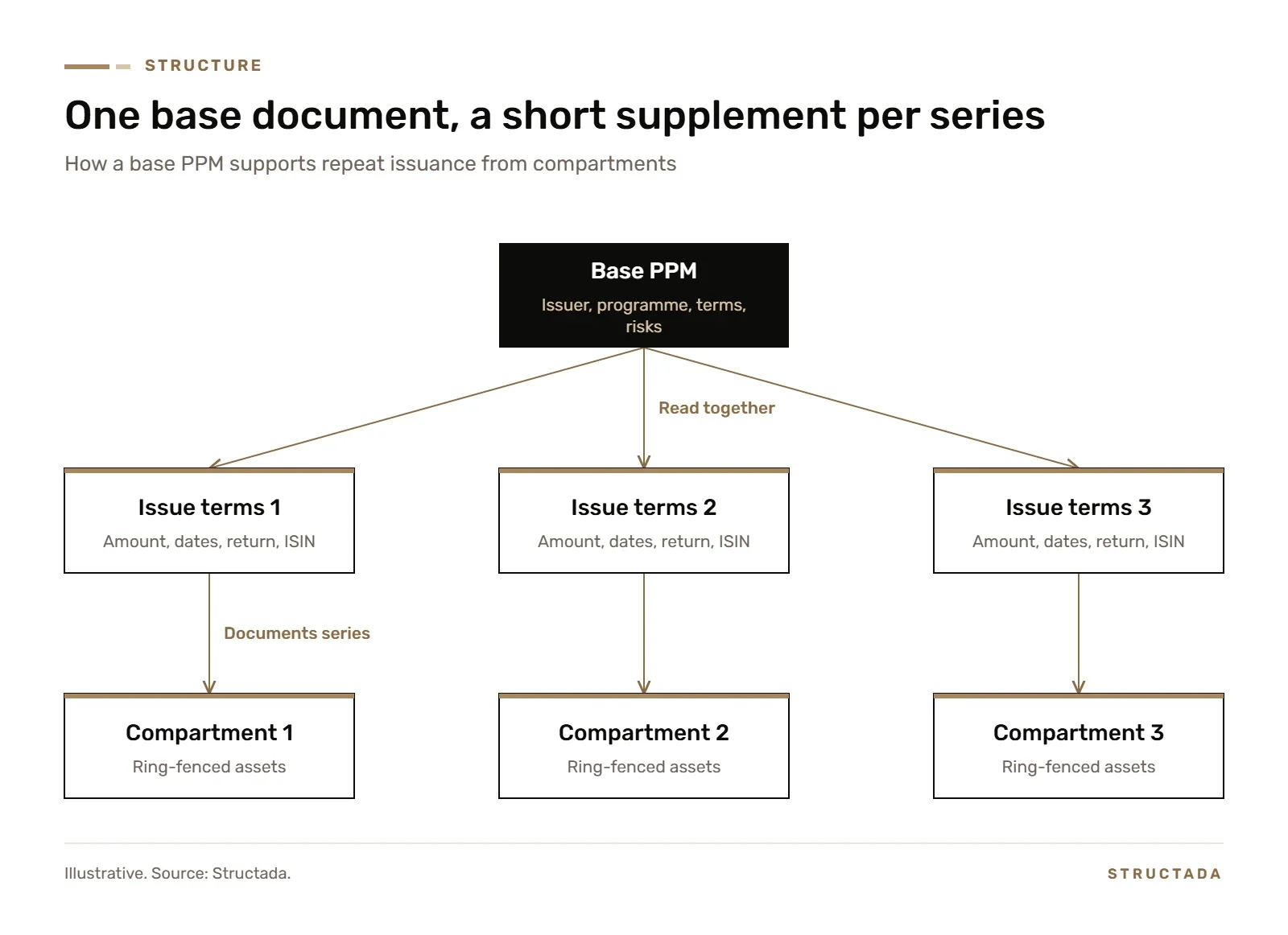
The structure has two layers. The base PPM describes the issuer, the programme and the general terms and conditions of the notes. It is prepared once and refreshed periodically. For each series, a set of issue terms fills in the specifics: amount, currency, issue and maturity dates, interest or return, the underlying assets, fees and the ISIN.
Read together, the base PPM and the issue terms form the complete offering document for that series. Investors receive both. In practice they review the base PPM thoroughly once, and thereafter focus their diligence on each new set of issue terms as deals arise.
What a base PPM contains
A well-drafted base PPM opens with important notices and selling restrictions, which define who may receive the document and in which countries the notes may be offered. A summary of the programme follows, identifying the issuer, the parties, the types of notes and how issues are made.
The risk factors carry most of the disclosure weight. They cover the general risks of the issuer, the structure and the notes, and the asset types the programme may hold. Drafting them broadly enough to cover future deals, without making them so generic that they inform no one, is one of the harder judgements in the document.
The memorandum then describes the issuer itself, and the terms and conditions set out the general rules of the notes, including payments, limited recourse, events of default, meetings of noteholders and governing law. A section on the form of the notes and clearing explains the global notes, settlement through Euroclear and Clearstream and the role of the paying agent. A general summary of taxation and a template form of issue terms complete the document.
What the issue terms contain
The issue terms are deliberately short. They identify the series number and the compartment, the principal amount, currency and denomination, and the issue price, issue date and maturity date. They state the interest rate or return formula and describe the underlying assets, loans or reference obligations. Fees and expenses specific to the series appear here, along with any risk factors peculiar to the deal, and the ISIN, common code and listing details.
The discipline lies in keeping deal-specific material out of the base document and general material out of the issue terms. When the two are blurred, each new series starts to reopen questions investors thought were settled.
Base PPM vs base prospectus vs standalone PPM
| Base PPM | Base prospectus | Standalone PPM | |
|---|---|---|---|
| Investors | Professional or qualified investors only | Can include retail | Professional or qualified investors only |
| Regulatory approval | Not required where an exemption applies | Approved by a regulator, such as the CSSF | Not required where an exemption applies |
| Number of issues | Many, each with issue terms | Many, each with final terms | One |
| Cost per issue | Low after the first | Low after the first, but approval and updates add cost | Full cost each time |
| Typical use | Private note programmes and securitisation platforms | Public bond and MTN programmes | One-off private deals |
A base prospectus opens the door to retail investors at the price of regulatory review; a standalone PPM avoids review but carries the full drafting cost every time. The base PPM combines the economics of a programme with the lighter regime of private placement.
Why base PPMs suit Luxembourg securitisation vehicles
A Luxembourg securitisation vehicle can create any number of compartments, each ring-fenced by law, and issue notes from each one. Many vehicles are run as platforms, with dozens or hundreds of compartments created over time for different issuers and assets. A base PPM maps onto that model closely.
The vehicle is described once: its legal form, board, service providers, the securitisation law and the compartment structure. Each compartment then receives its own issue terms setting out the assets, investors, returns and specific risks of the deal. The base PPM explains limited recourse and compartment segregation a single time, so investors understand from the outset that their recourse runs only to the assets of their own compartment.
The format also supports the regulatory position. Under the Luxembourg securitisation law, a vehicle needs CSSF authorisation only if it issues to the public on a continuous basis. A base PPM used for professional investors under private placement exemptions supports issuance without that authorisation. Private banks, family offices and wealth managers who have reviewed the base PPM can also approve new series faster, because only the issue terms are new.
For issuers using an existing platform, a new deal can therefore be documented with issue terms rather than a full memorandum. Our guide to how to issue a credit linked note shows how this fits into the issuance process, and our article on syndicated securitisation in Luxembourg explains how compartments are used for multi-investor deals.
Keeping a base PPM up to date
A base PPM is a living document. It needs review at least once a year and whenever something material changes, such as new service providers, changes in law or tax, or new asset types. Updates can be made through a supplement or by issuing a new version of the base PPM. Each set of issue terms should refer to the version in force when its series was issued.
What this means for issuers
For any issuer planning more than one note issue, a base private placement memorandum turns documentation from a recurring project into a routine step. New series can be documented in days rather than weeks, and legal work on the core document is paid for once. Combined with a Luxembourg securitisation vehicle and its compartments, it allows each deal to be issued on short issue terms within a framework that scales with the business.
The return on that efficiency depends on the work done at the start. A base PPM drafted narrowly around the first deal will need rewriting by the third. The base document should anticipate the full range of assets, structures and investor types the programme may cover, and that scope is worth settling with counsel before the first series is priced.
Frequently Asked Questions
What is a base private placement memorandum?
The master offering document for a programme of privately placed notes, describing the issuer, the programme, the general terms and the risks, used with issue terms for each series.
What is the difference between a PPM and a base PPM?
A PPM usually covers a single offering. A base PPM is designed to support many issues over time, each with its own short supplement.
Does a base PPM need regulatory approval?
Not where the notes are offered only to professional or qualified investors under private placement exemptions. A base prospectus for public offers does need approval.
What are issue terms?
The short document for each series that sets out its specific terms, such as amount, dates, return, underlying assets and ISIN.
Why do Luxembourg securitisation vehicles use base PPMs?
Because one vehicle can issue many series from separate compartments, and a base PPM lets the vehicle be described once, with each compartment documented in its own issue terms.
How often is a base PPM updated?
Usually at least annually, and whenever material changes occur, such as new service providers or changes in law.