

- A Luxembourg securitisation vehicle (SV) is a special purpose company or fund that acquires assets or risks and finances them by issuing notes or, since 2022, taking loans.
- It is governed by the Securitisation Law of 22 March 2004, modernised in 2022, and around 1,590 SVs existed by March 2025.
- An SV can be split into ring-fenced compartments, each with its own assets, investors and creditors, so one vehicle can host many deals.
- Most SVs are unregulated. CSSF authorisation is only needed when a vehicle issues securities to the public on a continuous basis.
- Issuers use Luxembourg for its legal certainty, near tax neutrality, flexible forms and direct access to Euroclear, Clearstream and European listing venues.
A Luxembourg securitisation vehicle, often shortened to SV, is a special purpose entity set up under Luxembourg law to buy assets or take on risks and fund them by issuing securities to investors. It is the legal wrapper behind a large share of Europe's private credit notes, credit linked notes, repackagings and asset-backed deals.
Luxembourg created its framework with the Securitisation Law of 22 March 2004, and it has become one of the two leading European jurisdictions for issuing vehicles. According to PwC Luxembourg, 190 new SVs were set up in 2024, taking the total to around 1,590 by March 2025.
What the Securitisation Law allows
The law defines securitisation broadly. An SV can acquire, or assume the risks of, almost any asset that generates cash flows or has a value: loans, receivables, mortgages, bonds, shares, real estate, commodities, intellectual property or the performance of another business. It can take on those risks by buying the assets outright or synthetically, through derivatives or credit linked notes, and pay investors from the returns.
A 2022 reform modernised the regime. The main changes were:
- Loan financing. SVs can now be funded wholly or partly by borrowing, not only by issuing securities.
- Active management. Vehicles that do not issue to the public on a continuous basis can actively manage portfolios of loans, bonds and other debt, which opened the door to CLO-style structures.
- More legal forms. Partnerships such as the SCS, the SCSp and the SNC joined the list of permitted forms.
- Clearer regulation. The law clarified when a vehicle issues to the public and therefore needs authorisation.
For the wider legal background, see Luxembourg Securitisation Law Explained: The 2004 Law and 2022 Reform.
Company or fund, and the role of compartments
An SV can take one of two shapes.
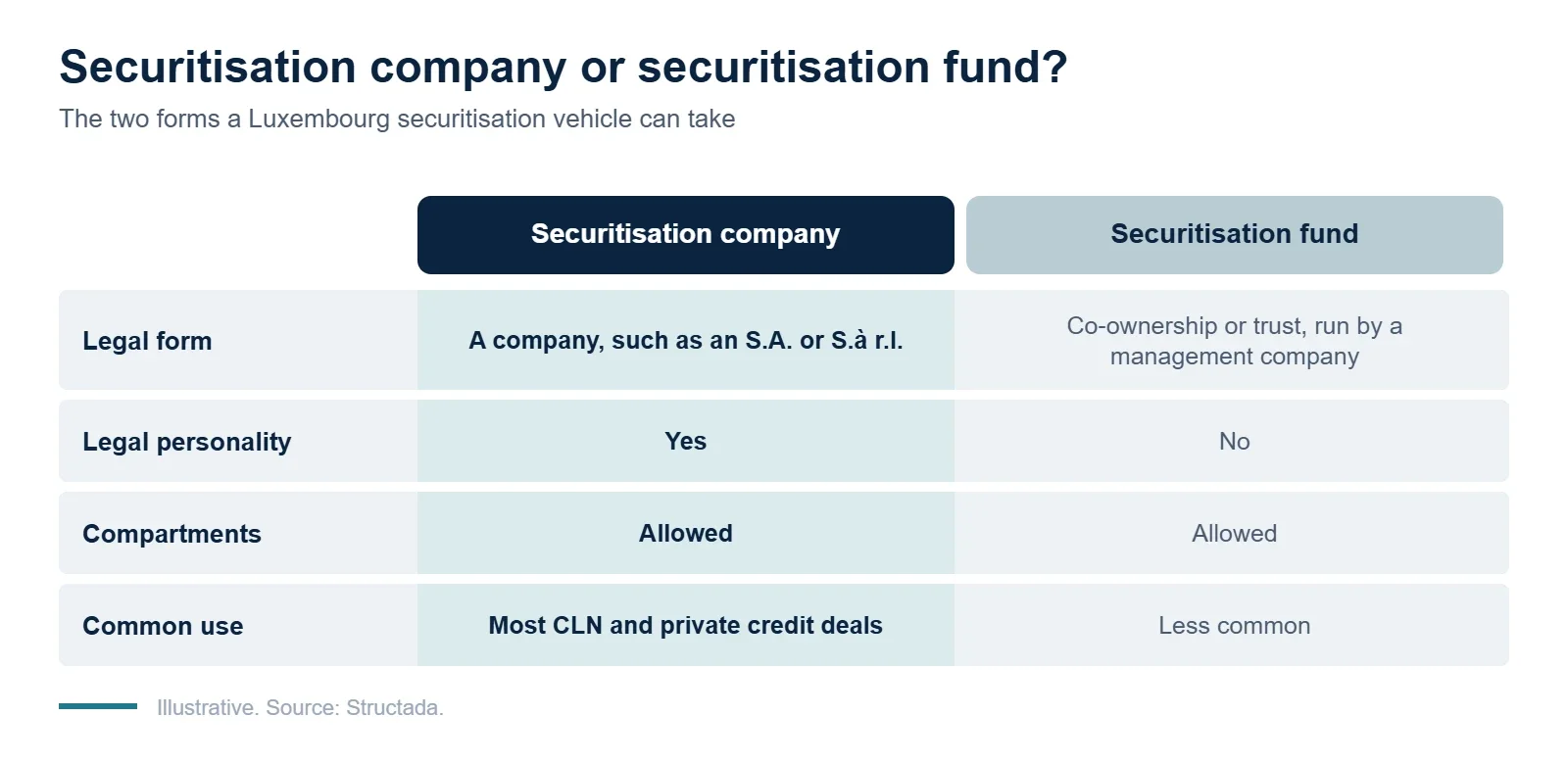
| Securitisation company | Securitisation fund | |
|---|---|---|
| Legal nature | A company with its own legal personality | A co-ownership or fiduciary estate with no legal personality |
| Common forms | SA, SARL, SCA, cooperative company, and since 2022 SCS, SCSp and SNC | Managed by a Luxembourg management company |
| Governance | Board of directors or managers | Management company acting under fund rules |
| Typical use | Most private credit, CLN and repackaging programmes | Structures where a fund format suits the investors |
Most SVs are companies, usually an SA or a SARL. Whatever the form, the vehicle can be divided into compartments. Each compartment holds its own assets and issues its own notes, and the law ring-fences it: investors and creditors in one compartment have recourse only to that compartment's assets. One vehicle can therefore host many separate deals, each bankruptcy-remote from the others and from the sponsor. That is how platform vehicles issue dozens of note series without setting up a new company each time.
Regulated or unregulated?
Most Luxembourg SVs are unregulated. A vehicle needs authorisation and supervision by the CSSF, Luxembourg's financial regulator, only when it issues securities to the public on a continuous basis. Placements with professional investors, and issues made in denominations of at least EUR 100,000, do not count as offers to the public for this test.
Unregulated vehicles still sit inside a framework of rules. They need audited accounts, they must comply with anti-money laundering and, where relevant, EU Securitisation Regulation requirements, and their notes are subject to the market rules of any venue they list on.
Why issuers use Luxembourg
The reasons are covered in depth in Why Issue Credit Linked Notes in Luxembourg?. In short:
- Legal certainty. A dedicated statute recognises compartment segregation, subordination, non-petition and limited recourse clauses.
- Near tax neutrality. An SV is a fully taxable company, but payments to investors are generally deductible, so taxable profit stays small. There is no subscription tax and no Luxembourg withholding tax on interest paid to noteholders, and management services can be VAT-exempt.
- Flexibility. Almost any asset or risk can be securitised, in almost any currency, through companies, partnerships or funds.
- Market access. Notes from Luxembourg vehicles are routinely made eligible in Euroclear and Clearstream, carry an ISIN, and can be listed on the Luxembourg Stock Exchange or on venues such as the Vienna MTF.
- An established ecosystem. Corporate service providers, auditors, paying agents, trustees and counsel all work with SVs every day.
What a Luxembourg SV means for issuers
For an originator or a borrower, the question is rarely whether to build a new vehicle from scratch. Setting up a standalone SV takes time and carries fixed costs for directors, administration, audit and legal work. Many issuers instead use a compartment of an existing platform vehicle, which can cut the timetable to weeks and spread the fixed costs across many deals.
Either way, the vehicle is only the wrapper. The work that decides the outcome is the same: defining the assets, setting the waterfall and the protections for noteholders, choosing the agents, and preparing the documents investors will rely on. For how those pieces fit together, see How Securitisation Works: The Mechanics for Issuers and our guide to securitised credit.
Frequently asked questions
What is an SPV in Luxembourg?
A special purpose vehicle set up to hold specific assets or carry out a specific transaction. In securitisation, it is usually a Luxembourg SV formed under the 2004 Securitisation Law.
What is a special purpose vehicle in securitisation?
A separate, bankruptcy-remote entity that buys the assets or takes on the risks being securitised and issues notes to fund them, so that noteholders are protected if the originator fails.
What are the different types of legal entities for a Luxembourg SV?
Companies such as the SA, SARL, SCA and cooperative company, partnerships such as the SCS, SCSp and SNC, and securitisation funds managed by a management company.
Does a Luxembourg securitisation vehicle need to be regulated?
Only if it issues securities to the public on a continuous basis. Most SVs place notes with professional investors and are unregulated.
What is a compartment in a Luxembourg securitisation vehicle?
A ring-fenced part of the vehicle with its own assets and investors. Creditors of one compartment cannot reach the assets of another.
What changed with the 2022 Securitisation Law reform?
SVs can now be financed by loans, can actively manage debt portfolios when not issuing to the public, and can be set up as partnerships.