

- Euroclear is a Brussels-based financial market infrastructure group that settles and holds securities for banks, brokers and other institutions in more than 120 countries, with around €31 trillion of assets held.
- Euroclear Bank is one of the world's two international central securities depositories (ICSDs). The group also runs six domestic CSDs, including CREST in the UK.
- It is a bank and a custodian, but not a clearing house in the central counterparty sense.
- No single shareholder controls it. Owners include market users, the Belgian state and sovereign and pension funds.
- For issuers, Euroclear eligibility is the gateway to international investors. It shapes the form of the note, the agents and the timetable.
Euroclear is a financial market infrastructure group, headquartered in Brussels, that settles securities transactions and holds securities in custody for financial institutions around the world. It holds around €31 trillion of client assets, making it one of the largest securities depositories anywhere. It covers bonds, equities, exchange-traded funds and investment funds, and sits behind most international bond deals in Europe.
It started in 1968, when the Brussels office of Morgan Guaranty Trust Company launched a service to settle the young Eurobond market. Trading was growing, paper certificates were piling up and deliveries were failing. Euroclear replaced paper with book entries, and Morgan Guaranty ran it until 2000, when its users set up Euroclear Bank to operate the system themselves.
Today most investors never deal with Euroclear directly. Yet when a bond changes hands across borders, there is a good chance the transfer is recorded on its books.
How Euroclear works
Euroclear holds securities in dematerialised or immobilised form and records who owns them by book entry. Its clients are banks, brokers, custodians and central banks, each with an account at Euroclear. When two clients trade, Euroclear moves the securities from the seller's account to the buyer's and the cash the other way, at the same moment, on a delivery versus payment basis. Once settled, the transfer is final and cannot be unwound.
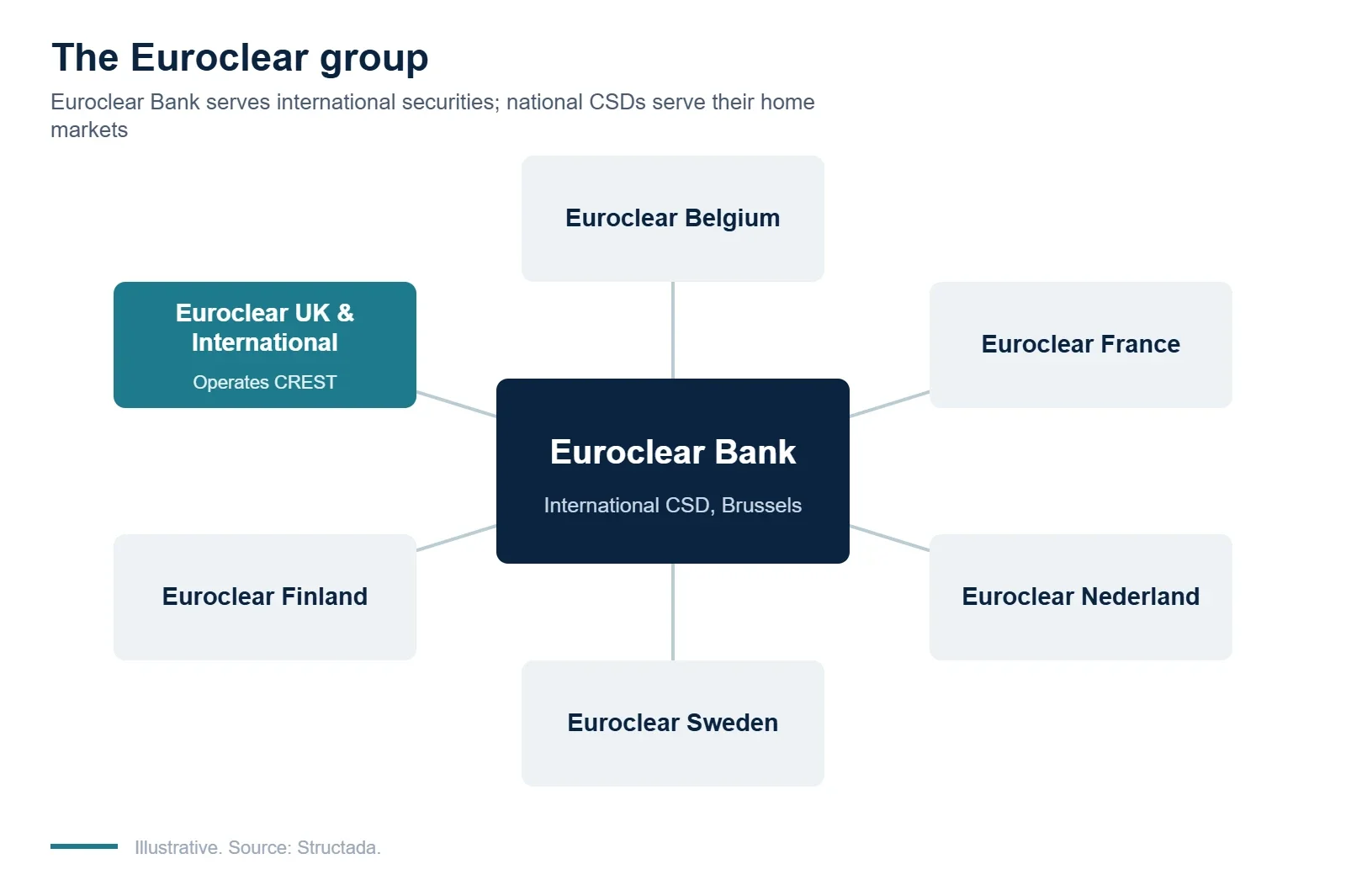
Around that core sit the services that keep a portfolio running: collecting coupons and redemptions, processing corporate actions, lending securities, and managing collateral for repo and central bank funding. The group works through two kinds of entity:
- Euroclear Bank, the international central securities depository (ICSD), which settles Eurobonds and other cross-border securities in dozens of currencies.
- Six domestic CSDs: Euroclear Belgium, Euroclear Finland, Euroclear France, Euroclear Nederland, Euroclear Sweden and Euroclear UK & International, which operates CREST.
Euroclear Bank also connects to Clearstream through an electronic link known as the Bridge, so a client of one can settle with a client of the other.
Who owns Euroclear?
The group's parent is Euroclear Holding SA/NV in Brussels. No single shareholder controls it. Its largest owners include Sicovam Holding, a vehicle of market participants, France's Caisse des Dépôts et Consignations, the Belgian state's investment arm SFPI-FPIM, a Belgian shareholder consortium, the New Zealand Superannuation Fund, China's State Administration of Foreign Exchange and Singapore's GIC.
That spread of owners reflects Euroclear's role. It is systemically important to European markets and regulated as such, so its shareholders are long-term holders rather than any one bank or exchange.
Is Euroclear a bank, a clearing house or a custodian?
A bank: yes. Euroclear Bank is a Belgian credit institution supervised by the National Bank of Belgium. Its banking licence lets it extend intraday credit to clients so that settlement does not stall for lack of cash. It does not take retail deposits or lend in the ordinary sense.
A custodian: yes. Euroclear holds securities on behalf of its clients and services them through to maturity.
A clearing house: no, despite the name. A clearing house, or central counterparty, stands between buyer and seller and guarantees the trade. Euroclear settles the transfer and records ownership, but it does not take on either side's risk. For more on the difference, see our article What is a clearing system?
Euroclear vs Clearstream
Euroclear Bank and Clearstream Banking S.A. are the two ICSDs, and most international bond issues are eligible in both. The differences lie in ownership, home market and group structure rather than in what an issuer receives.
| Euroclear Bank | Clearstream Banking S.A. | |
|---|---|---|
| Headquarters | Brussels, Belgium | Luxembourg |
| Founded | 1968, by Morgan Guaranty | 1970, as Cedel |
| Owner | Euroclear Holding SA/NV, a spread of users and long-term investors | Deutsche Börse Group |
| Domestic CSDs in the group | Belgium, Finland, France, Netherlands, Sweden, UK (CREST) | Germany (Clearstream Banking AG), plus Luxembourg's LuxCSD |
| Regulator | National Bank of Belgium | CSSF and the Banque centrale du Luxembourg |
| Link | The Bridge | The Bridge |
For an issuer, the choice is rarely either-or. A global note held by a common depositary or common safekeeper serves both ICSDs at once, so investors can hold the bond through whichever their custodian uses.
What Euroclear means for issuers
For an issuer of bonds, structured notes or private placement notes, Euroclear eligibility is the gateway to international investors. Private banks, wealth managers and institutions often cannot hold a security their custodian cannot book, and most custodians book international debt through Euroclear or Clearstream. The same route applies to credit linked notes issued through a Luxembourg securitisation vehicle.
Getting a note accepted follows a set path:
- Appoint the agents. An issuing and paying agent applies to the ICSDs for eligibility and handles payments to holders.
- Obtain an ISIN. For international debt, the ICSDs allocate an XS-prefixed ISIN and a common code.
- Choose the note form. A classic global note is held by a common depositary; a new global note is held by a common safekeeper and can support Eurosystem collateral eligibility.
- Document it. The terms and conditions define "Euroclear" as Euroclear Bank SA/NV, as operator of the Euroclear system, and set out how holdings and transfers work through the clearing systems.
- Pass the ICSD review. Euroclear assesses the legal and operational features of the security before it accepts it.
Eligibility confirms that a note can be settled and safekept. It says nothing about credit quality, which remains the investor's judgement. Because it shapes the note form, the agents and the closing timetable, it belongs at the start of structuring. For how the vehicle itself is put together, see How Securitisation Works: The Mechanics for Issuers.
Frequently asked questions
What does Euroclear do?
It settles securities transactions on a delivery versus payment basis, holds securities in custody, and services them through coupons, redemptions, corporate actions, securities lending and collateral management.
Who owns Euroclear Bank?
Euroclear Bank is owned by Euroclear Holding SA/NV, whose shareholders include market users, the Belgian state's investment arm, France's Caisse des Dépôts and sovereign and pension funds. No single shareholder controls it.
Is Euroclear a bank?
Yes. Euroclear Bank is a Belgian credit institution supervised by the National Bank of Belgium. It provides credit to support settlement rather than ordinary lending.
Is Euroclear a clearing house?
No. It is a central securities depository. It settles and records transfers but does not act as a central counterparty.
Is Euroclear a custodian?
Yes. It holds and services securities on behalf of the financial institutions that are its clients.
Which countries are covered by Euroclear?
Euroclear serves clients in more than 120 countries and settles securities issued in many markets and currencies. Its domestic CSDs cover Belgium, Finland, France, the Netherlands, Sweden and the UK.
What is the difference between Euroclear and Clearstream?
Both are international central securities depositories. Euroclear is based in Brussels with a broad shareholder base; Clearstream is based in Luxembourg and owned by Deutsche Börse. They are linked by the Bridge, so trades settle between them.
Can retail investors use Euroclear directly?
No. Retail investors hold securities through a bank or broker, which holds them through Euroclear.