

- A paying agent is a bank appointed by an issuer to pay interest and principal to the holders of its bonds or notes.
- In international debt, the principal paying agent receives funds from the issuer and passes them through Euroclear and Clearstream to investors' custodians.
- The paying agent acts for the issuer, not the investors. Unlike a trustee, it owes noteholders no fiduciary duty and pays only what it receives.
- The role is often combined with the issuing agent, calculation agent, registrar and listing agent, and set out in a single agency agreement.
- For issuers, the choice of paying agent affects how quickly a note can close, how cleanly it settles and how much each payment date costs.
A paying agent is the bank an issuer appoints to make payments on its bonds or notes. When a coupon falls due or a note matures, the issuer does not pay hundreds of investors one by one. It pays one amount to the paying agent, and the paying agent makes sure the money reaches every holder.
It is one of the least visible roles in a debt issue, and one of the most practical. A note can be well structured and well placed, but if the cash does not arrive on the right day, in the right currency, through the right channels, investors notice.
What does a paying agent do?
The core of the job is moving money from the issuer to the noteholders on each payment date. In practice that covers several tasks:
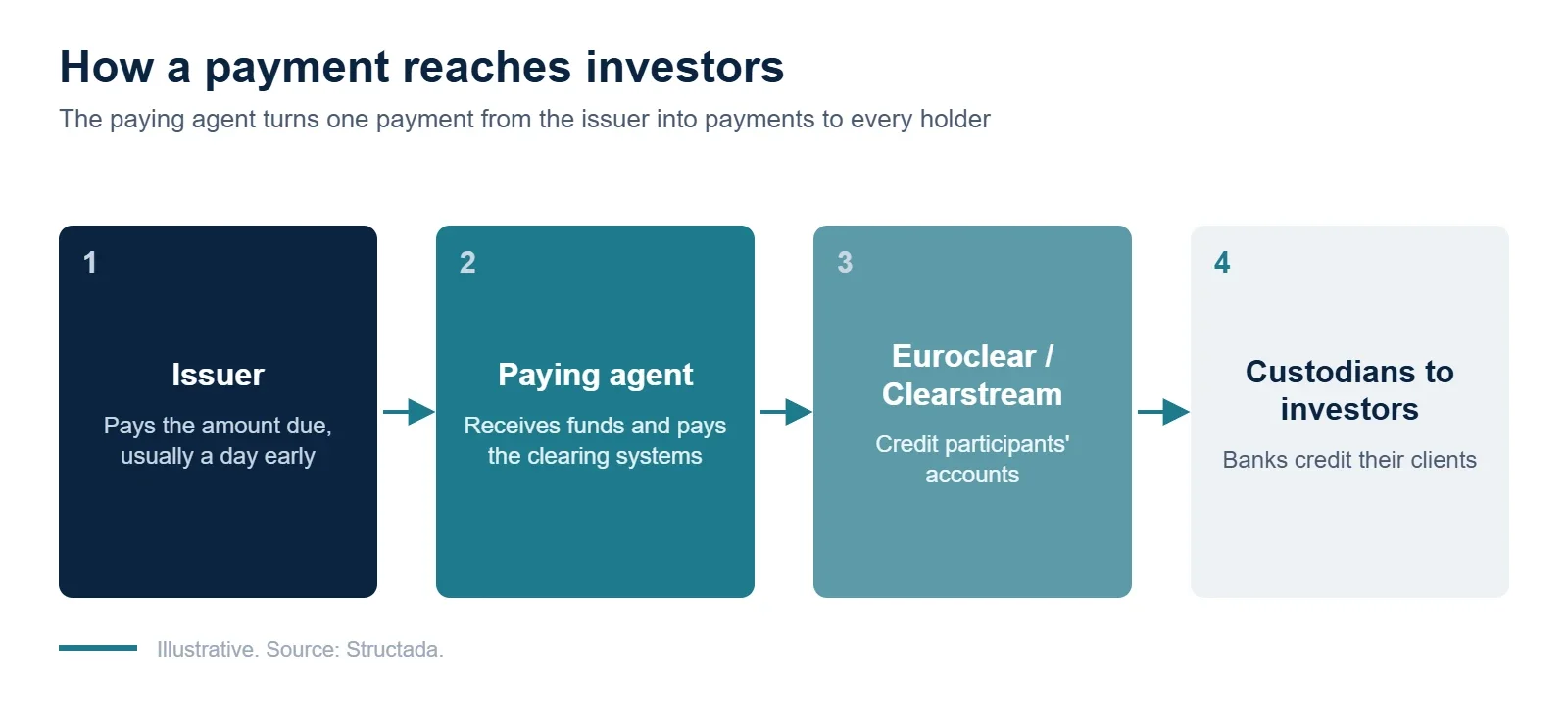
- Collecting funds. The issuer pays the amount due to the paying agent, usually one business day before the payment date, in same-day funds.
- Paying holders. For notes held through Euroclear and Clearstream, the paying agent pays the clearing systems, which credit the accounts of the banks and custodians holding the notes for investors.
- Handling redemptions. At maturity, or on an early redemption, the paying agent pays out principal and arranges for the notes to be cancelled.
- Sending notices. It passes notices from the issuer to holders through the clearing systems: interest rates, redemptions, amendments and meetings.
- Keeping records. It records payments made, notes cancelled and amounts outstanding, and supplies them to the issuer, the auditors and any listing venue.
The paying agent pays only what it receives. If the issuer does not fund a payment, the paying agent has no obligation to pay holders from its own money.
The roles that sit alongside it
On most international issues the paying agent wears several hats, often all at the same bank and under one agency agreement.
| Role | What it does |
|---|---|
| Principal paying agent | Receives funds from the issuer and makes payments to holders through the clearing systems |
| Issuing agent | Prepares and authenticates the global note, obtains the ISIN and common code, and arranges eligibility with the clearing systems |
| Issuing and paying agent (IPA) | The combined issuing and paying role, common on note programmes |
| Fiscal agent | Paying agent on a deal with no trustee, carrying some extra administrative duties for the issuer |
| Calculation agent | Sets floating interest rates and calculates the amounts due each period |
| Registrar | Keeps the register of holders for notes issued in registered form |
| Listing agent | Handles the listing application where the notes are admitted to an exchange, such as the Vienna MTF |
On securitisations there is usually a cash manager or calculation agent too. It works out each payment under the waterfall and instructs the paying agent, which then makes the payments.
Paying agent vs trustee
The two roles are easy to confuse and very different in law.
| Paying agent | Trustee | |
|---|---|---|
| Acts for | The issuer | The noteholders |
| Duty to holders | None beyond the agency agreement | Fiduciary duty to act in their interest |
| Main job | Making payments and administering the notes | Monitoring the issuer, holding security and enforcing on default |
| On default | Stops paying if it has not been funded | Can accelerate the notes and enforce on behalf of holders |
Many deals have both: a trustee, or a security trustee, looking after investors' rights, and a paying agent handling the money. Smaller issues often use a fiscal agent structure with no trustee, leaving holders to enforce individually.
Why the paying agent matters to issuers
For an issuer, the paying agent is one of the first appointments to make, because so much depends on it. It obtains the ISIN, sets up the note with the clearing systems and authenticates the global note. Without those steps the deal cannot close.
Three things are worth weighing when choosing one:
- Connectivity. Direct, established links with Euroclear and Clearstream, and with any other clearing system the investors use.
- Onboarding. Know-your-customer checks on a new issuer or a new securitisation vehicle can take weeks. A paying agent that already knows the vehicle shortens the timetable.
- Cost and currency. Fees are usually an acceptance fee, an annual fee and a charge per payment date, and multi-currency issues need an agent comfortable paying in each currency.
For credit linked notes issued from a platform vehicle, the paying agent is often already in place across many compartments. Each new note then plugs into an existing set-up rather than starting from scratch, which is one reason platform issuance closes faster.
Frequently asked questions
What is a paying agent?
A bank appointed by an issuer to pay interest and principal to the holders of its bonds or notes on its behalf.
What is the role of a paying agent in bonds?
To collect funds from the issuer before each payment date and pass them to investors, usually through Euroclear and Clearstream, as well as handling redemptions, notices and records.
Who appoints the paying agent?
The issuer, under an agency agreement signed at issuance.
What is the difference between a paying agent and a trustee?
A paying agent acts for the issuer and handles payments. A trustee acts for the noteholders, owes them a fiduciary duty and can enforce their rights if the issuer defaults.
What is the difference between a paying agent and a fiscal agent?
A fiscal agent is a paying agent used on a deal with no trustee, taking on some extra administrative duties for the issuer. It still acts for the issuer, not the holders.
What is an issuing and paying agent?
A bank that combines the issuing role (preparing the global note, obtaining the ISIN and arranging clearing) with the paying role. The term is most common on note programmes.
Is the paying agent liable if the issuer does not pay?
No. The paying agent pays only what it receives from the issuer. Holders' claims remain against the issuer, or are enforced through a trustee where there is one.