

- A Wiener Börse listing means admitting bonds, notes or shares to the Vienna Stock Exchange, Austria's only securities exchange, founded in 1771.
- Debt can be listed on the Official Market, an EU regulated market, or on the Vienna MTF, a multilateral trading facility built for fast, low-cost debt listings.
- The Vienna MTF needs no approved prospectus and no listing agent, and a listing usually completes within a week.
- Ongoing obligations on the Vienna MTF are mostly limited to the Market Abuse Regulation, with no requirement to file financial statements.
- The Vienna Stock Exchange is a recognised stock exchange for the UK and Irish quoted Eurobond exemptions, which makes it a practical venue for private placement notes and credit linked notes.
A Vienna Stock Exchange listing, or Wiener Börse listing, is the admission of a security to one of the markets run by Wiener Börse AG in Vienna. Once listed, the security has a public reference point: a recognised venue, published terms and a price that investors, custodians and tax authorities can point to.
The exchange was founded in 1771, under Empress Maria Theresa, to give the Habsburg state a market for its bonds. Two and a half centuries later it is Austria's only securities exchange, supervised by the Financial Market Authority (FMA), and the owner of the Prague Stock Exchange. Its equity market is known for the ATX index, but its debt business is far larger by number of securities, with tens of thousands of bonds, notes and certificates admitted.
For an issuer, listing means something narrower than an IPO. A bond or note is admitted to a market, but most trading still happens over the counter between banks and investors. What the listing buys is status: a security that counts as listed for tax rules, investment mandates and custody platforms.
Official Market vs Vienna MTF
Wiener Börse runs two markets, and the choice between them shapes the cost, the documents and the obligations that follow.
| Official Market (Amtlicher Handel) | Vienna MTF | |
|---|---|---|
| Legal status | EU regulated market | Multilateral trading facility under MiFID, authorised by the FMA |
| Prospectus | Prospectus Regulation-approved prospectus, from the FMA or passported from another EU regulator | No approved prospectus needed: an offering memorandum, base prospectus or Wiener Börse's information memorandum template |
| Listing agent | Typically appointed | Not required |
| Ongoing obligations | Transparency Directive reporting, including annual and half-year financial statements, plus MAR | Mostly limited to MAR; no ongoing financial statements |
| Typical use | Public offers, retail-facing bonds, issuers wanting regulated market status | Private placements, CLNs, structured notes, CLOs and programmes sold to professional investors |
For debt, the exchange also offers a Qualified Investor Segment for securities sold only to professional investors, and a Vienna ESG Segment for green, social and sustainability-linked bonds.
So is the Vienna MTF a regulated market? No, and that is the point. It sits outside the EU's regulated market regime, which is what removes the approved prospectus and periodic reporting, while still offering a listing on a recognised exchange.
Why issuers list debt in Vienna
The Vienna MTF, which traces its history back to 1992 as the Third Market, has become one of Europe's main venues for debt listings. Issuers choose it for four practical reasons:
- Tax. HMRC recognises the Vienna Stock Exchange for the UK quoted Eurobond exemption, and Irish Revenue treats it as a recognised exchange too. A listed note can pay interest without UK or Irish withholding tax.
- Investor mandates. Many funds, insurers and private banks may only hold, or prefer to hold, listed securities. A listing turns an unlisted note into an eligible one.
- Speed. Listings usually complete within a week of first submission, with first comments inside two days.
- Light ongoing burden. With no periodic financial reporting, the cost of staying listed stays low for the life of the note.
A listing does not create a liquid market on its own. Almost all bond trading in Vienna, as on most exchanges, happens over the counter. Settlement still runs through the clearing systems, such as Euroclear and Clearstream.
How the Vienna MTF listing process works
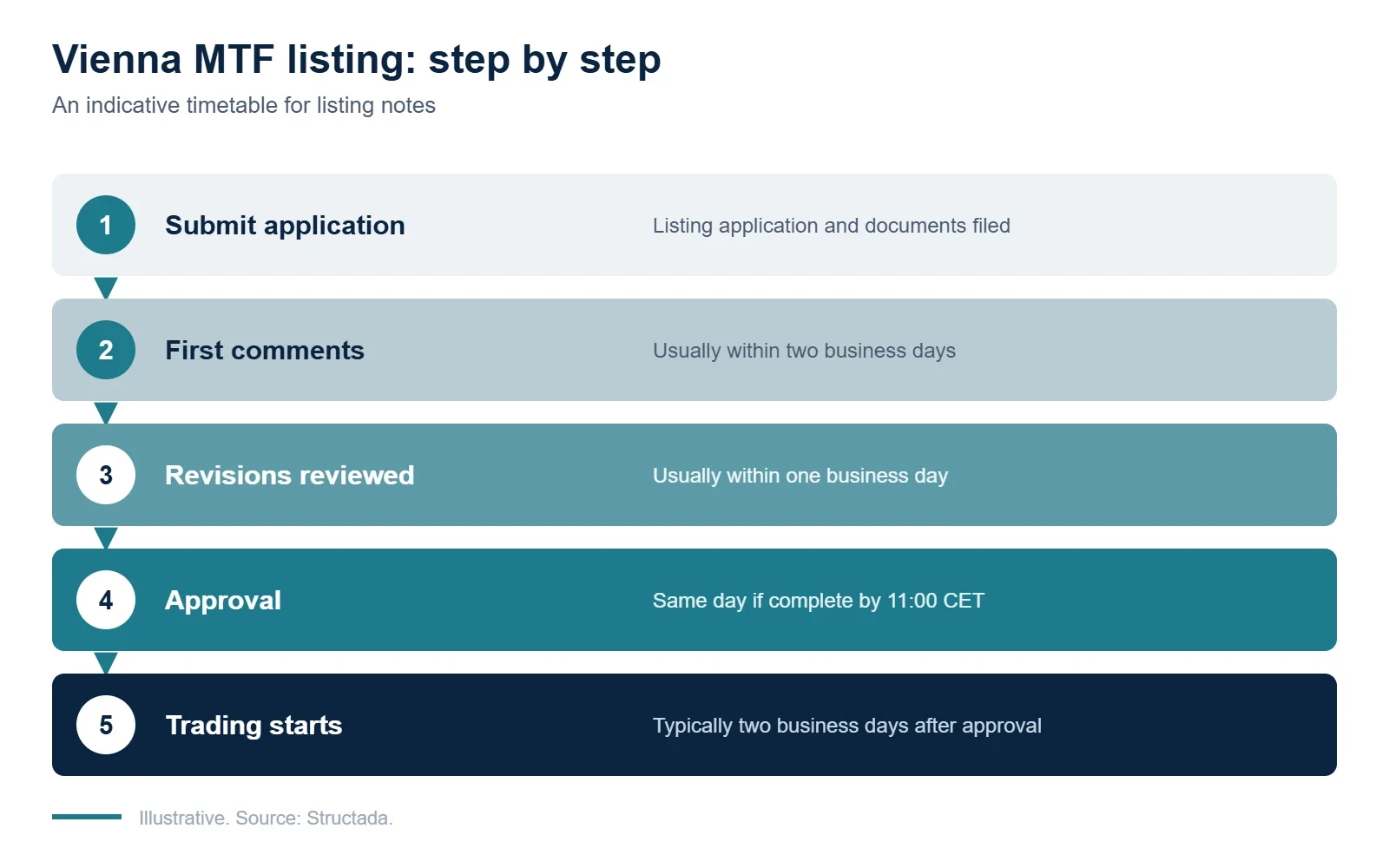
- Prepare the document. Submit an offering memorandum or base prospectus, or complete Wiener Börse's information memorandum template if the deal has none.
- Submit the application. The issuer, its paying agent or its counsel can apply directly; no listing agent is needed.
- Review. The exchange returns first comments within two business days and later comments within one.
- Approval. If final documents arrive by 11:00 CET, approval comes the same day.
- Admission. Trading can start two trading days after approval.
After listing, the issuer complies with MAR and tells the exchange about material events: a change of issuer or name, a risk to principal, a missed or postponed coupon, or an early redemption. Notes are delisted automatically at maturity.
Vienna vs other debt listing venues
Vienna competes with a handful of European venues that serve the same issuers. Each offers an exchange-regulated market alongside its EU regulated market.
| Venue | Exchange-regulated market | Location | Known for |
|---|---|---|---|
| Wiener Börse | Vienna MTF | Austria, EU | Speed, low fees, no listing agent, light ongoing obligations |
| Luxembourg Stock Exchange | Euro MTF | Luxembourg, EU | Depth in Eurobonds and a natural home for Luxembourg securitisation vehicles |
| Euronext Dublin | Global Exchange Market (GEM) | Ireland, EU | Large professional debt market, popular for programmes and structured finance |
| The International Stock Exchange (TISE) | Official List | Guernsey, outside the EU | Private placements and UK-focused issuers |
All four are recognised by HMRC for the quoted Eurobond exemption. The choice usually comes down to cost, timetable, where the rest of the issuer's paperwork sits and what its investors already know. For a note issued by a Luxembourg vehicle, Vienna is often chosen for speed even when Luxembourg would be the obvious home.
What a Vienna listing means for issuers
For an issuer of private placement notes or credit linked notes, a Vienna MTF listing is often the cheapest way to tick three boxes at once: a listed security for investor mandates, a recognised exchange for withholding tax, and a public record of the terms. It does not replace clearing. A listed note still needs an ISIN and eligibility in Euroclear or Clearstream before investors can hold it through their custodians.
The decision belongs early in the timetable. The choice between the Official Market and the Vienna MTF determines whether the deal needs an approved prospectus, which in turn drives cost, counsel's scope and the closing date. For most private placements sold to professional investors, the Vienna MTF does the job with far less weight. For how the issuing vehicle itself is built, see How Securitisation Works: The Mechanics for Issuers.
Frequently asked questions
What does listing on a stock exchange mean?
Admitting a security to trading on an exchange's market. For a bond or note, it gives the security a recognised venue and published terms, even if most trading happens over the counter.
What are the benefits of listing debt on the Vienna Stock Exchange?
Access to investors who can only hold listed securities, the UK and Irish quoted Eurobond exemptions, fast admission and, on the Vienna MTF, low ongoing obligations.
Is the Vienna MTF a regulated market?
No. It is a multilateral trading facility under MiFID, operated by Wiener Börse and authorised by the FMA. The Official Market is the EU regulated market.
Do I need a prospectus to list on the Vienna MTF?
No approved prospectus is needed. An offering memorandum, base prospectus or the exchange's information memorandum template is accepted.
Do I need a listing agent for the Vienna MTF?
No. Issuers, paying agents or counsel can apply directly.
How long does a Vienna MTF listing take?
Usually within a week of first submission. Trading can start two trading days after approval.
Is the Vienna Stock Exchange a recognised stock exchange?
Yes. HMRC recognises it for the UK quoted Eurobond exemption, and Irish Revenue treats it as recognised for Irish withholding tax purposes.