

- A clearing system confirms, settles and records the transfer of securities on a delivery versus payment basis, removing settlement risk between buyer and seller.
- Euroclear (Brussels) and Clearstream (Luxembourg) are the two international central securities depositories, linked by the Bridge. CREST in the UK and DTC in the US are domestic CSDs.
- Bonds, structured products and private placement notes issued with an ISIN can all be cleared and held through the ICSDs.
- ICSD eligibility opens an issue to investors who rely on their custodian, such as private banks and family offices. It says nothing about credit quality.
- Clearing shapes the form of the note, the agents and the timetable, so it is a decision for the start of structuring.
A clearing system is the infrastructure that confirms, settles and records the transfer of securities between buyers and sellers. It makes sure the investor receives the security and the seller receives the cash, at the same moment and without either side taking the other's credit risk.
For most investors it sits out of sight. Yet without it, a bond is little more than a legal promise held in a drawer. A clearing system turns that promise into an asset that can be bought, sold, pledged and valued by banks, brokers and custodians across the world.
In international debt markets, two institutions dominate this role: Euroclear in Brussels and Clearstream in Luxembourg.
Clearing, settlement and custody
The three terms are often used together, but each describes a distinct step.
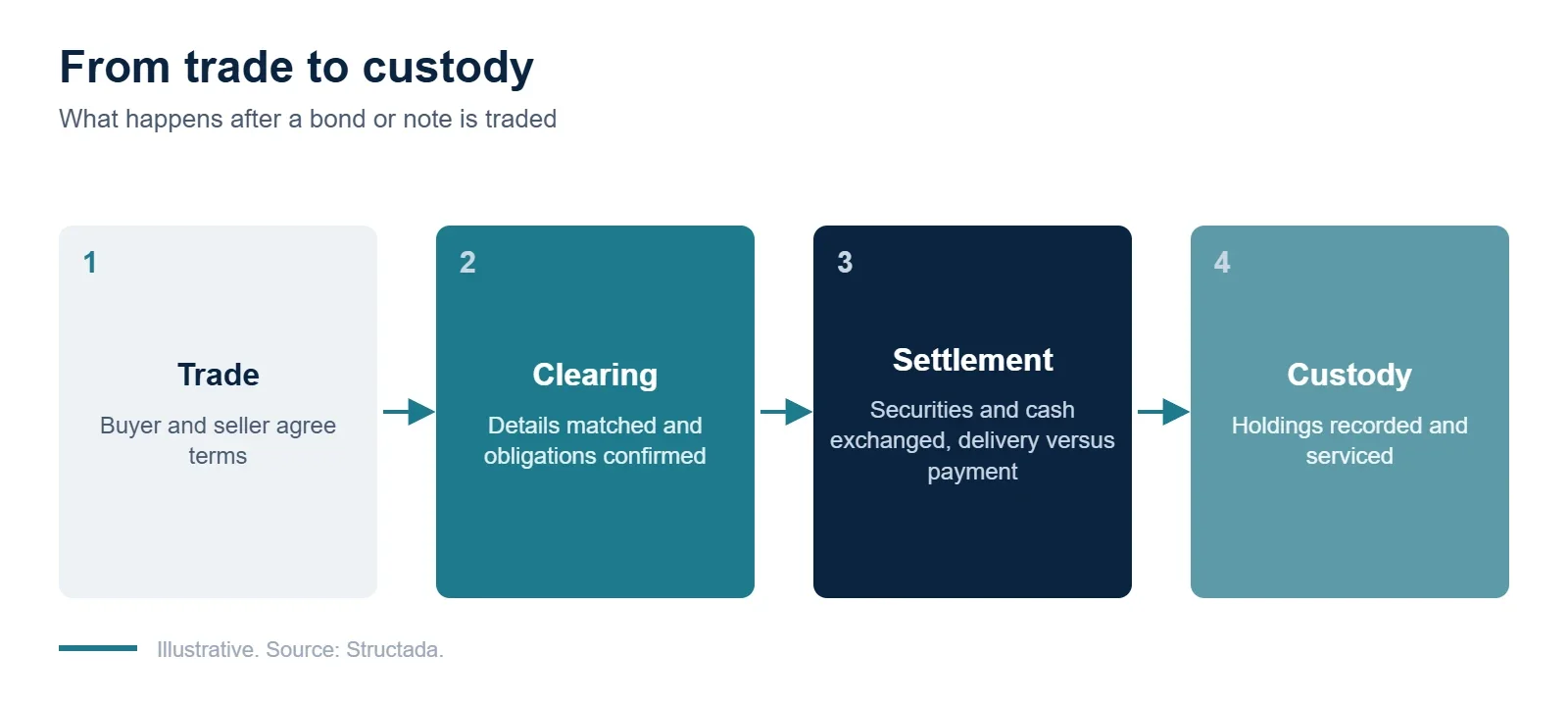
- Clearing matches and confirms the trade details agreed between counterparties: security, quantity, price and settlement date.
- Settlement is the exchange itself. Securities move from seller to buyer and cash moves the other way, on a delivery versus payment (DVP) basis.
- Custody is the safekeeping of the security afterwards, along with the servicing of coupons, redemptions and corporate actions.
A clearing system for securities, properly called a central securities depository (CSD), performs all three. Ownership is recorded electronically through book entries, so no paper changes hands. The investor's bank or broker holds an account with the CSD, and the investor's holding sits within that chain of accounts.
Euroclear and Clearstream: the international CSDs
Euroclear Bank and Clearstream Banking S.A. are the two international central securities depositories (ICSDs). Unlike a domestic CSD, which serves one national market, an ICSD settles securities issued under many legal systems, in dozens of currencies, for participants around the world.
Euroclear was founded in 1968 to settle the then-young Eurobond market. Clearstream, part of Deutsche Börse Group, began life as Cedel in 1970 for the same purpose. Between them they hold tens of trillions of euros of assets in custody.
The two are connected by an electronic link known as the Bridge. A participant of Euroclear can settle a trade with a participant of Clearstream as though both sat on the same system. For issuers, this means one listing reaches the full international investor base, whichever ICSD a buyer's bank happens to use.
Domestic CSDs: CREST and the UK market
Not every central securities depository is international. A domestic CSD settles securities issued into one national market, usually in its home currency. In the UK, that role belongs to CREST, operated by Euroclear UK & International, part of the Euroclear group since 2002.
CREST settles UK shares, gilts, sterling corporate bonds and money market instruments on a delivery versus payment basis. Most UK listed shares are held and transferred electronically through it. Other examples of domestic CSDs include DTC in the United States and Clearstream Banking AG in Frankfurt, which is separate from the Luxembourg ICSD.
CREST reaches beyond the UK through CREST Depository Interests (CDIs). A CDI is a UK-law instrument representing an underlying foreign security, which lets CREST members hold and settle overseas shares or bonds as though they were UK securities.
The practical distinction for issuers is reach. A sterling equity or gilt sits naturally in CREST. A Eurobond, structured note or cross-border private placement aimed at international investors is normally issued into Euroclear Bank and Clearstream.
How clearing applies to bonds
Most international bonds, including Eurobonds and the Regulation S tranches of global offerings, are issued into Euroclear and Clearstream. The bond is represented by a single global note, held by a common depositary or, for new global notes, a common safekeeper acting for both ICSDs.
The ICSDs assign or record the ISIN, distribute coupon payments to holders and process redemption at maturity. Secondary trades typically settle on T+2. Bonds held in new global note form and meeting the relevant criteria can also be eligible as collateral with the Eurosystem, which widens the pool of bank buyers.
For a US offering under Rule 144A, the tranche usually settles through the Depository Trust Company (DTC) instead, with Euroclear and Clearstream reaching it through their own links.
How clearing applies to structured products
Structured products include structured notes, credit-linked notes (CLNs), asset-backed securities and other securitisation notes. Their economics are complex, but their settlement need not be. Once issued as a note with an ISIN and accepted by an ICSD, a structured product settles, pays and is held in custody in the same way as a plain bond.
This matters most for securitisation vehicles, such as Luxembourg compartments issuing notes against a defined pool of assets. Clearing allows the notes to sit in an investor's existing custody account alongside listed holdings. Interest and principal from the underlying assets flow through the paying agent and the ICSD to each holder, with a clean record of ownership at every step.
The ICSDs do not assess the credit quality of what they accept. Eligibility confirms that a note can be settled and safekept, and nothing more. Due diligence remains the investor's task.
How clearing applies to structured products
Structured products include structured notes, credit-linked notes (CLNs), asset-backed securities and other securitisation notes. Their economics are complex, but their settlement need not be. Once issued as a note with an ISIN and accepted by an ICSD, a structured product settles, pays and is held in custody in the same way as a plain bond.
This matters most for securitisation vehicles, such as Luxembourg compartments issuing notes against a defined pool of assets. Clearing allows the notes to sit in an investor's existing custody account alongside listed holdings. Interest and principal from the underlying assets flow through the paying agent and the ICSD to each holder, with a clean record of ownership at every step.
The ICSDs do not assess the credit quality of what they accept. Eligibility confirms that a note can be settled and safekept, and nothing more. Due diligence remains the investor's task.
How clearing applies to private placements
A private placement is a sale of securities to a limited group of professional investors without a public offer. Many are bilateral loan-style agreements and never touch a clearing system. Those issued as notes, however, can be made Euroclear or Clearstream eligible, and the benefits are practical:
- Access: Private banks, wealth managers and family offices often cannot hold an instrument that their custodian cannot book. ICSD eligibility removes that barrier.
- Transferability: Holders can sell to other eligible investors through standard settlement rather than a paper transfer process.
- Servicing: Coupons, redemptions and notices run through the same channel as the rest of the portfolio.
- Valuation and reporting: A cleared ISIN can be priced, reported and, in some cases, pledged as collateral.
Clearing: a structuring decision
Clearing does not make a private placement a public security. Selling restrictions, investor eligibility and any minimum denomination still apply and are set out in the offering documents.
For an issuer, clearing is often the difference between a note that a handful of institutions can hold and one the wider professional market can buy. It shortens the route to the wealth channel, where investors rely on their custodian's platform to hold and report every position.
Clearing also gives an issue settlement certainty and a record of title held by a regulated institution. Buyers can treat a private credit note in the same way as a government bond, which widens the pool willing to take part and supports pricing. With settlement risk off the table, investors judge the issue on credit, structure and liquidity, the points an issuer can shape.
Frequently asked questions
What is the difference between Euroclear and Clearstream?
Both are international central securities depositories. Euroclear Bank is based in Brussels; Clearstream Banking S.A. is based in Luxembourg and owned by Deutsche Börse. They are linked by the Bridge, so trades settle between them.
Is Euroclear a clearing house?
Not in the central counterparty sense. Euroclear settles and safekeeps securities; it does not stand between buyer and seller as a CCP does for derivatives.
Can private placement notes be held in Euroclear or Clearstream?
Yes, if they are issued as notes with an ISIN and accepted by the ICSD. Selling restrictions still apply.
Is CREST a central securities depository?
Yes. CREST is the UK's CSD, operated by Euroclear UK & International. It settles UK shares, gilts and sterling bonds, while Euroclear Bank and Clearstream serve as the international CSDs.
What is the difference between a CSD and an ICSD?
A CSD serves one national market, such as CREST in the UK or DTC in the US. An ICSD, such as Euroclear Bank or Clearstream, settles securities across many markets and currencies.
Does ICSD eligibility mean a security is safe?
No. Eligibility confirms the note can be settled and held in custody. It says nothing about credit quality.