

- CREST is the UK's central securities depository, the system that settles and holds UK shares, gilts, exchange-traded funds and many sterling bonds in electronic form.
- It is run by Euroclear UK & International, part of the Euroclear group since 2002.
- CREST settles trades on a delivery versus payment basis in central bank money and collects stamp duty reserve tax on UK share purchases for HMRC.
- CREST Depository Interests (CDIs) let investors hold and settle foreign securities, including international bonds, within CREST.
- For most international bond and note issuers, Euroclear Bank and Clearstream are the main clearing systems; CREST matters most for UK listings, UK retail bonds and gilts.
CREST is the electronic system that settles and holds UK securities. When a UK share, gilt or sterling bond changes hands, the transfer of ownership and the payment almost always run through CREST. It is the UK's central securities depository, or CSD, and it sits at the centre of the country's capital markets, even though most investors never see it.
CREST was launched in 1996, replacing a paper-based system in which share certificates and transfer forms changed hands after every trade. It was built by CRESTCo, a company backed by the Bank of England and the market, and became part of the Euroclear group in 2002. Today it is operated by Euroclear UK & International, regulated as a CSD and supervised by the Bank of England.
What does CREST do?
CREST performs the core jobs of any clearing system:
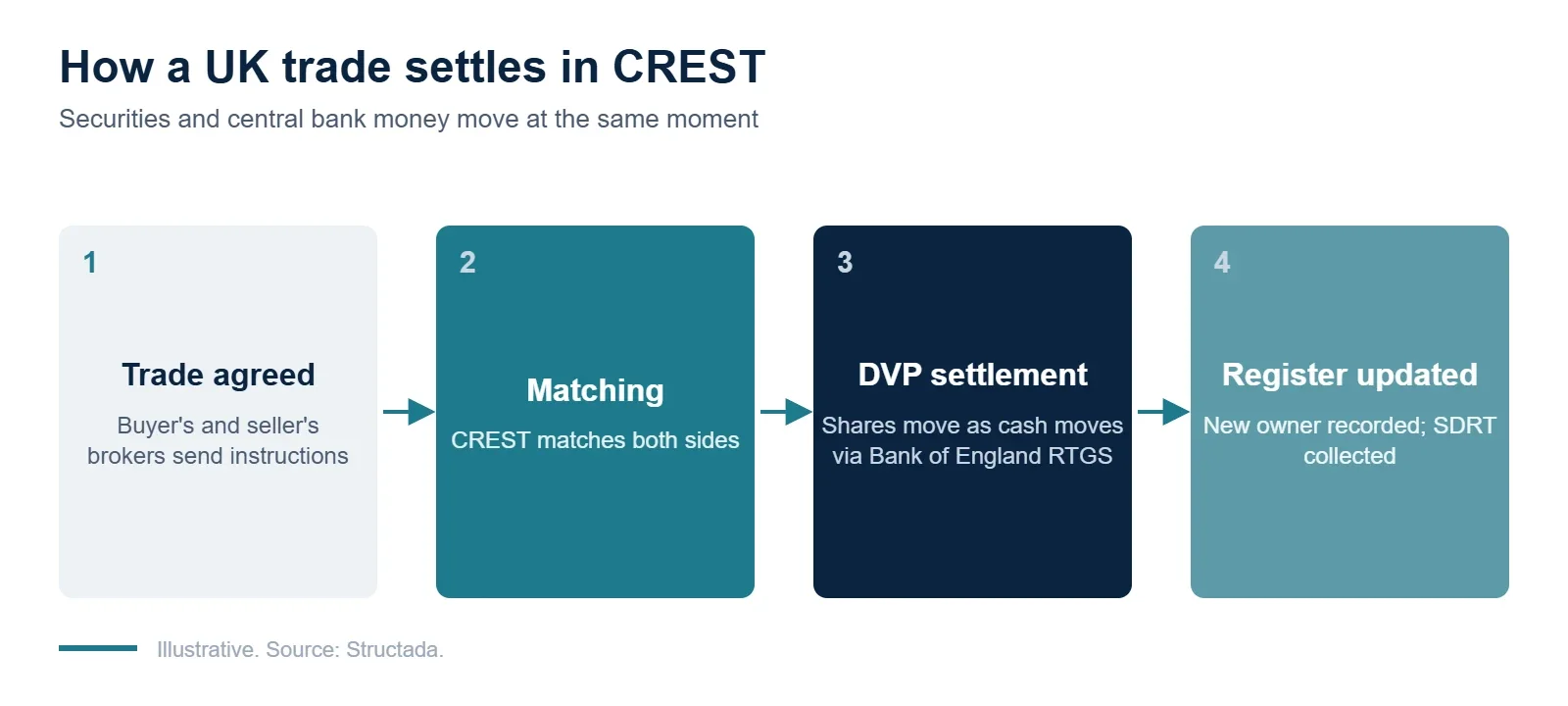
- Settlement. It moves securities from seller to buyer and cash from buyer to seller at the same moment, on a delivery versus payment basis.
- Safekeeping. It records ownership of dematerialised securities by book entry, so most UK shares and gilts exist only as electronic records.
- Asset servicing. It processes dividends, coupons, redemptions and corporate actions for the securities it holds.
- Collateral and repo. It supports the sterling money markets, including delivery-by-value transfers that move baskets of gilts as collateral.
- Tax collection. It collects stamp duty reserve tax on UK share purchases and passes it to HMRC.
Cash settles in central bank money: sterling through the Bank of England's real-time gross settlement system, with euro and US dollar settlement also available.
What does CREST settle?
| Security | Settled in CREST? |
|---|---|
| UK listed shares | Yes, almost all |
| Gilts (UK government bonds) | Yes |
| UK-listed ETFs and investment trusts | Yes |
| Sterling corporate and retail bonds | Many, especially UK-issued and London-listed |
| Money market instruments | Yes |
| Eurobonds and most international notes | Usually through Euroclear Bank and Clearstream, reachable in CREST via CDIs |
| Foreign shares | Via CREST Depository Interests |
Irish securities used to settle in CREST as well. In March 2021, after Brexit, they moved to Euroclear Bank, and the operator changed its name from Euroclear UK & Ireland to Euroclear UK & International.
How CREST membership works
Only CREST members hold accounts directly. There are two main kinds:
- Direct members, typically banks, brokers and custodians, who connect to the system themselves.
- Sponsored members, usually individuals or smaller firms, who hold securities in their own name in CREST but rely on a sponsor, such as a broker, to operate the account.
Most private investors never become members. Their shares sit in a nominee account run by their broker or platform, which is a CREST member.
CREST Depository Interests (CDIs)
A CREST Depository Interest is a UK-law instrument that represents an interest in an underlying foreign security. It lets CREST members hold and settle securities that are not themselves eligible in CREST, such as US or European shares, or bonds held in Euroclear Bank, in the same way as UK securities. CDIs are how many UK platforms give clients access to international bonds and shares without leaving the UK system.
CREST vs Euroclear Bank and Clearstream
| CREST | Euroclear Bank and Clearstream | |
|---|---|---|
| Type | Domestic CSD | International CSDs (ICSDs) |
| Main market | UK securities, mostly in sterling | International bonds and cross-border securities in many currencies |
| Operator | Euroclear UK & International | Euroclear Bank (Brussels), Clearstream Banking S.A. (Luxembourg) |
| Typical instruments | UK shares, gilts, sterling bonds, ETFs | Eurobonds, private placement notes, structured products |
| Link | CDIs give access to ICSD-held securities | The Bridge links the two ICSDs |
The move to T+1
UK settlement is moving from two business days after the trade (T+2) to one (T+1). The UK government's Accelerated Settlement Taskforce set 11 October 2027 as the date for the switch, aligning the UK more closely with the US, which moved to T+1 in 2024. CREST is at the centre of the change.
What CREST means for issuers
For a UK company listing its shares, CREST is unavoidable: its shares need to be CREST-eligible to trade on the London Stock Exchange. The same applies to sterling bonds aimed at UK retail investors through the London Stock Exchange's retail bond market.
For most international debt issuers, including those issuing private placement notes or credit linked notes through a Luxembourg securitisation vehicle, the natural home is Euroclear Bank and Clearstream. The notes carry an XS ISIN and settle in the ICSDs. UK investors can still reach them through CDIs, so a note does not need to be issued into CREST for UK wealth managers to hold it.
Frequently asked questions
What is CREST?
The UK's central securities depository, which settles and holds UK shares, gilts, ETFs and many sterling bonds in electronic form.
Who owns CREST?
It is operated by Euroclear UK & International, part of the Euroclear group, which acquired CREST's original operator, CRESTCo, in 2002.
What is a CREST account?
An account held directly in CREST by a member, such as a bank or broker, or by a sponsored member through a sponsor. Most investors hold their shares through their broker's CREST nominee account instead.
What is a CREST Depository Interest?
A UK-law instrument representing an interest in a foreign security, which lets that security be held and settled in CREST.
Is CREST the same as Euroclear?
CREST is part of the Euroclear group, but it is a separate system. Euroclear Bank is the group's international CSD, while CREST is the UK domestic CSD.
When is the UK moving to T+1 settlement?
The UK has set 11 October 2027 as the date to move from T+2 to T+1 settlement.