

- An ISIN (International Securities Identification Number) is a 12-character code that uniquely identifies a security anywhere in the world.
- It has three parts: a two-letter country prefix, a nine-character national number and a single check digit.
- ISINs are issued by national numbering agencies under the ISO 6166 standard, coordinated by ANNA. International bonds settled through Euroclear and Clearstream carry the XS prefix.
- An ISIN identifies the security; tickers, CUSIPs and SEDOLs are national or exchange-level codes that often sit inside it.
- For issuers, an ISIN is the first practical step to clearing, custody, listing and reporting. Without one, most institutional investors cannot hold a note.
An ISIN, or International Securities Identification Number, is a 12-character code that uniquely identifies a security. Shares, bonds, notes, warrants, fund units and many other instruments carry one. It is how banks, custodians, exchanges, clearing systems and regulators make sure they are all talking about the same thing.
ISINs were first used in 1981 and became a global standard when ISO adopted ISO 6166 in 1990, following a recommendation from the Group of Thirty. Today they underpin settlement, custody and regulatory reporting across almost every market.
How an ISIN is structured
Every ISIN has the same three parts.
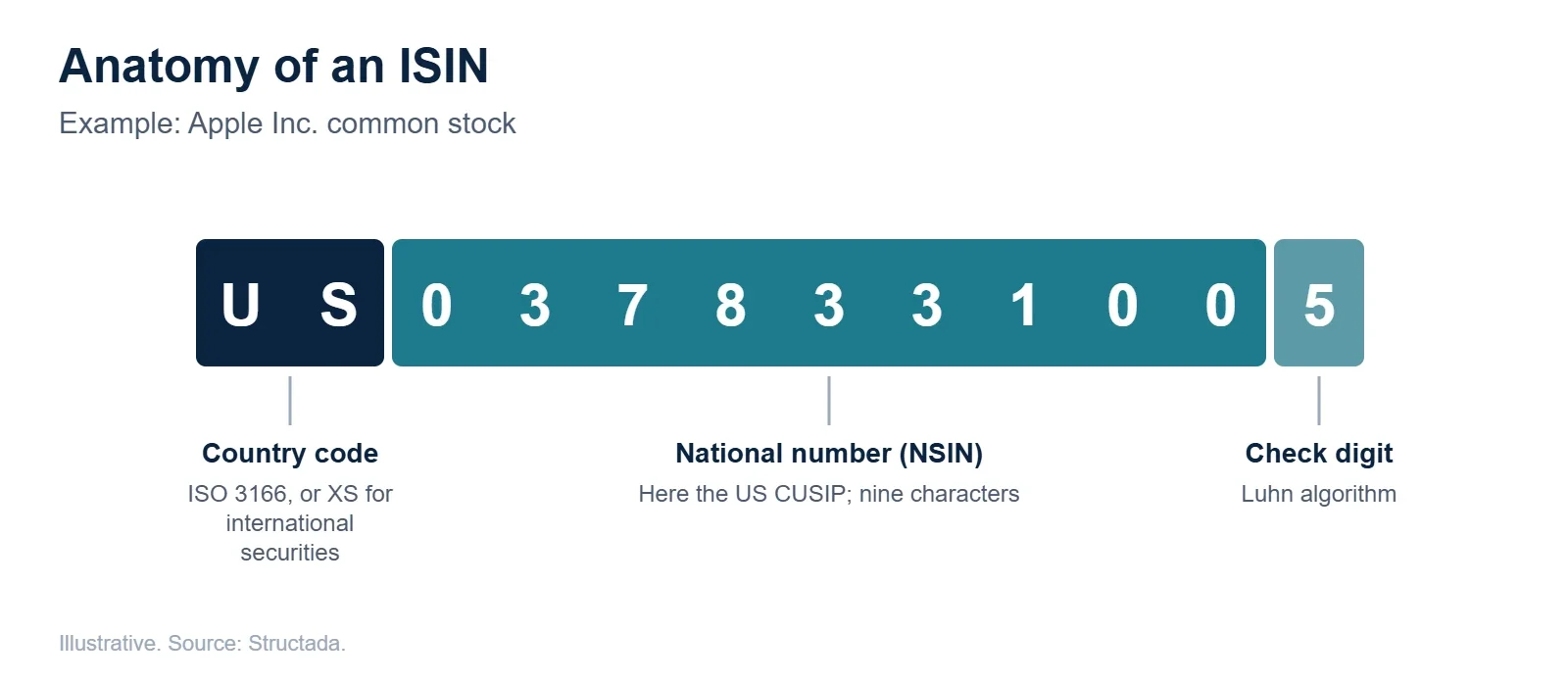
| Part | Length | What it shows |
|---|---|---|
| Prefix | 2 letters | The country of the numbering agency that issued the code, using ISO 3166 country codes, or XS for international securities |
| National Securities Identifying Number (NSIN) | 9 characters | The security's national code, padded with zeros where needed |
| Check digit | 1 digit | A digit calculated with the Luhn algorithm to catch typing errors |
Take Apple's shares, ISIN US0378331005. "US" is the country prefix, "037833100" is the US national code (its CUSIP), and "5" is the check digit. A UK share works the same way: BAE Systems is GB0002634946, built from its SEDOL with two leading zeros.
International bonds issued into Euroclear and Clearstream carry an XS prefix. The nine middle characters are built from a common code allocated jointly by the two clearing systems, which is why Eurobond and private placement documents often quote both an ISIN and a common code.
Who issues ISINs?
ISINs are allocated by national numbering agencies (NNAs), one for each market. They are usually the national central securities depository, the stock exchange or the central bank. In the UK the London Stock Exchange acts as the numbering agency; in the US it is CUSIP Global Services. For XS ISINs, Euroclear and Clearstream allocate the code together.
The agencies are coordinated by the Association of National Numbering Agencies (ANNA), which maintains the standard and a global database of ISINs. An ISIN is allocated when a security is created and stays with it until it matures or is cancelled. A new tranche that is not fungible with the first gets its own ISIN.
ISIN vs CUSIP, SEDOL, common code and ticker
| Identifier | Scope | Length | Used for |
|---|---|---|---|
| ISIN | Global | 12 characters | Identifying a security across all markets |
| CUSIP | US and Canada | 9 characters | US clearing and settlement, including DTC |
| SEDOL | UK and Ireland | 7 characters | UK trading and settlement |
| Common code | Euroclear and Clearstream | 9 digits | International debt settled through the ICSDs |
| Ticker | One exchange | Varies | Trading screens and quotes |
The key difference is scope. A ticker identifies a listing on one exchange, and a CUSIP or SEDOL identifies a security in one country. An ISIN identifies the security itself everywhere. For a US offering, the Rule 144A tranche settles in DTC under its CUSIP while the Regulation S tranche settles in the ICSDs under an XS ISIN.
What an ISIN means for issuers
For an issuer, the ISIN is the first practical step in making a note investable. Custodians book holdings by ISIN, clearing systems settle by ISIN, exchanges such as the Vienna MTF list by ISIN, and regulators expect it in MiFID transaction reports. A private placement note without one can usually only be held by a handful of investors on bilateral terms.
Getting one is straightforward. For a note issued by a Luxembourg securitisation vehicle and settled internationally, the issuing and paying agent requests an XS ISIN and common code from Euroclear and Clearstream as part of the eligibility process. For a domestic issue, the request goes to the local numbering agency. Either way, the code is usually in place well before closing, and it travels with the note for its whole life.
Frequently asked questions
What is the ISIN number in the UK?
A UK ISIN starts with GB, followed by nine characters built from the security's SEDOL and a check digit. The London Stock Exchange is the UK's numbering agency.
How do I find my ISIN code?
It appears on the term sheet, prospectus or offering memorandum, on contract notes and statements from your broker or custodian, and on exchange and data provider websites.
Can you give me an example of an ISIN number?
Apple's shares carry US0378331005: US for the country, 037833100 for the CUSIP and 5 as the check digit.
Who gives the ISIN number?
The national numbering agency for the market where the security is issued. For international bonds, Euroclear and Clearstream allocate XS ISINs jointly.
What is the difference between an ISIN and a CUSIP?
A CUSIP is a nine-character US and Canadian identifier. A US ISIN contains the CUSIP, with a US prefix and a check digit added.
Is an ISIN the same as a ticker?
No. A ticker identifies a listing on one exchange and can change. An ISIN identifies the security itself and stays fixed.