

- A CUSIP is a nine-character code that identifies a security in the United States and Canada.
- It has three parts: a six-character issuer code, a two-character issue code and a check digit.
- CUSIPs are allocated by CUSIP Global Services on behalf of the American Bankers Association, which owns the system.
- A US ISIN is built from the CUSIP, with a US prefix and an extra check digit. Non-US securities get a CINS, a CUSIP-style code starting with a country letter.
- For issuers, a CUSIP is needed whenever a security settles through DTC, which includes most Rule 144A tranches and many US private placements.
A CUSIP is the nine-character code used to identify a security in the United States and Canada. Every US share, corporate bond, municipal bond, Treasury and fund unit carries one, and it is how brokers, custodians, the Depository Trust Company (DTC) and regulators keep track of what is being bought, sold and held.
The name comes from the Committee on Uniform Securities Identification Procedures, set up by the American Bankers Association in the 1960s to bring order to a paper-heavy market. The system is still owned by the ABA and run day to day by CUSIP Global Services.
How a CUSIP is structured
Every CUSIP has nine characters in three parts.
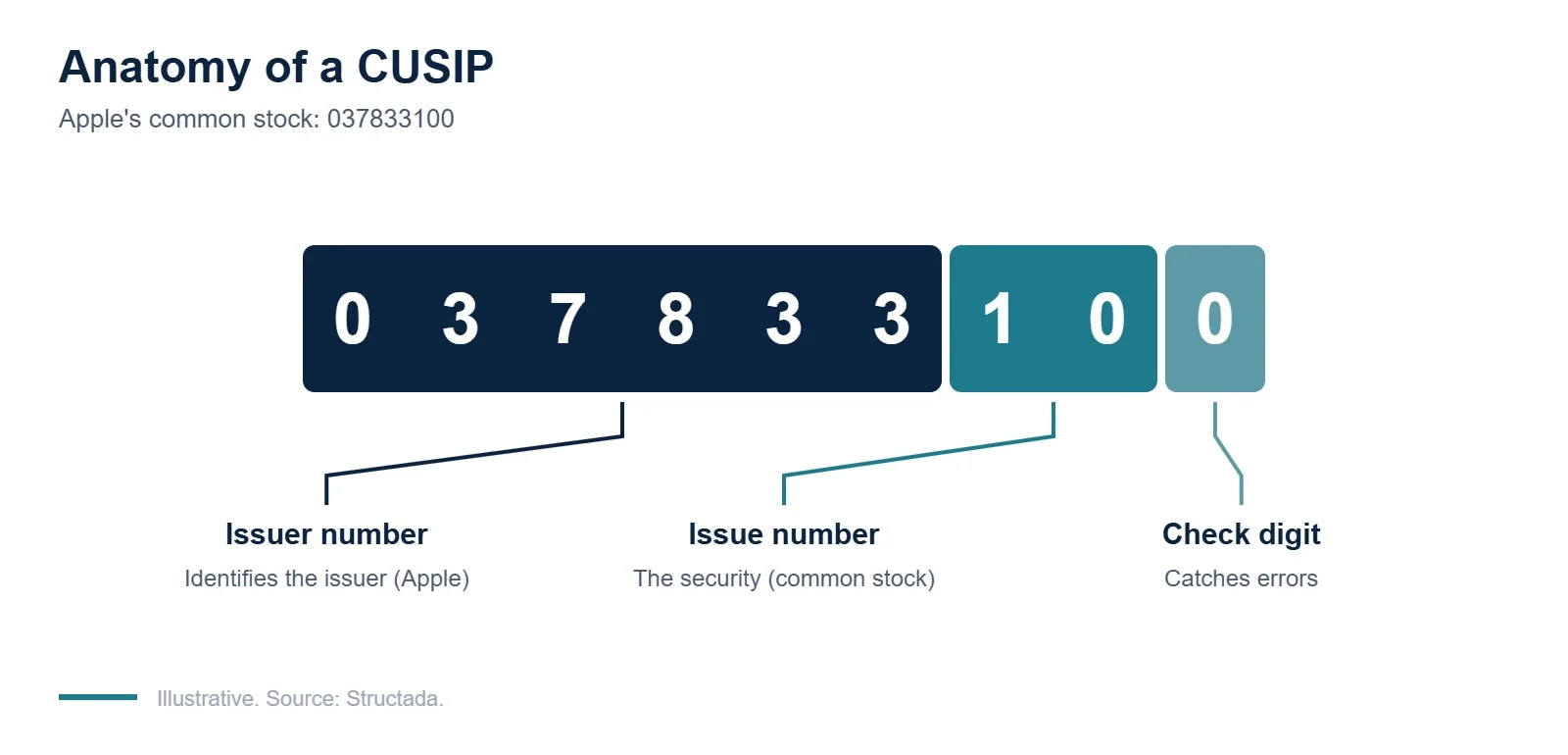
| Part | Characters | What it shows |
|---|---|---|
| Issuer number | 1 to 6 | The issuer, such as a company, municipality or fund |
| Issue number | 7 to 8 | The specific security from that issuer: a share class, a bond series or a note |
| Check digit | 9 | A digit calculated from the first eight characters to catch errors |
Apple's common stock, for example, carries the CUSIP 037833100. The first six characters, 037833, identify Apple; 10 identifies the common stock; and 0 is the check digit. Each new bond or note series the same issuer sells gets a different issue number under the same issuer code.
Who issues CUSIPs?
CUSIP Global Services allocates CUSIPs on behalf of the American Bankers Association. A CUSIP is usually requested by the underwriter, placement agent, issuing agent or the issuer's counsel before closing, and there is a fee for each allocation.
For securities issued outside the United States that trade or settle in the US, CUSIP Global Services allocates a CINS (CUSIP International Numbering System) code instead. It has the same nine-character format, but the first character is a letter that identifies the issuer's country or region.
CUSIP vs ISIN
| CUSIP | ISIN | |
|---|---|---|
| Scope | United States and Canada | Global |
| Length | 9 characters | 12 characters |
| Issued by | CUSIP Global Services | National numbering agencies; for international bonds, Euroclear and Clearstream |
| Relationship | The core of a US ISIN | A US ISIN is "US" + the CUSIP + a check digit |
Apple's ISIN, US0378331005, shows the link: the US prefix, the nine-character CUSIP and a final check digit. Our article What is an ISIN? covers the global standard in more detail.
When a non-US issuer needs a CUSIP
Most international bonds and private placement notes settle through Euroclear and Clearstream under an XS ISIN and a common code. A CUSIP becomes necessary when the security also settles in the United States:
- Rule 144A tranches. Notes sold to US qualified institutional buyers under Rule 144A settle through DTC, which identifies them by CUSIP. A deal with both a Rule 144A and a Regulation S tranche usually carries a CUSIP for the US tranche and an XS ISIN for the international one.
- US private placements. Notes sold to US insurance companies and other institutions in a private placement are typically given a CUSIP, so that investors can hold and report them, even when the notes are not traded.
- US-listed or US-traded securities. Any security that trades on a US venue or settles through DTC needs one.
For the different ways non-US issuers raise money from US investors, see Types of US Private Placements.
What a CUSIP means for issuers
For an issuer, the CUSIP is a small administrative step with large consequences. Without it, US institutions cannot book the security, DTC cannot settle it and regulatory reports cannot reference it. It should be requested early in the timetable, alongside the ISIN and clearing system eligibility, so that it is in place well before closing.
Frequently asked questions
What is a CUSIP number?
A nine-character code that identifies a security in the United States and Canada, made up of an issuer code, an issue code and a check digit.
What does CUSIP stand for?
Committee on Uniform Securities Identification Procedures, the body set up by the American Bankers Association to create the system.
Who assigns CUSIP numbers?
CUSIP Global Services, on behalf of the American Bankers Association.
What is the difference between a CUSIP and an ISIN?
A CUSIP identifies a security in the US and Canada. An ISIN identifies it globally. A US ISIN contains the CUSIP, with a US prefix and a check digit added.
What is a CINS number?
A CUSIP-format code for a security issued outside the US and Canada, where the first character is a letter showing the issuer's country or region.
How do I find a CUSIP?
It appears on the offering document, trade confirmations and custody statements, and in data services such as Bloomberg.
Do I need a CUSIP to sell notes to US investors?
Usually yes, if the notes will settle through DTC or be held by US institutions, as with Rule 144A tranches and most US private placements.