

- A US private placement is a sale of securities that is exempt from SEC registration because it is made only to eligible investors and without a public offer.
- The main routes are Section 4(a)(2) placements, including the institutional USPP market, Regulation D offerings under Rule 506(b) or 506(c), and Rule 144A offerings to qualified institutional buyers.
- Regulation S covers sales outside the United States and is often paired with a US placement in one deal.
- Each route sets who can buy, whether the offer can be marketed publicly, what must be filed and how freely the securities can be resold.
- Non-US vehicles, including securitisation vehicles, also need to stay outside the Investment Company Act, which shapes which investors they can accept.
The United States has the deepest pool of institutional and private capital in the world, but selling securities there normally means registering the offering with the Securities and Exchange Commission. Registration is slow, expensive and brings years of reporting. A US private placement avoids it by relying on an exemption: the securities are sold only to investors the law considers able to look after themselves, and without a public offer.
For non-US issuers, private placements are the main way into US capital. Choosing the right type decides who the buyers can be, how the deal can be marketed and what happens if an investor later wants to sell.
The main types of US private placement
| Type | Who can buy | Marketing | Typical use |
|---|---|---|---|
| Section 4(a)(2) private placement | Sophisticated investors able to bear the risk, in practice institutions | No general solicitation | Negotiated deals with a small number of institutions |
| USPP market (under 4(a)(2)) | Mainly US insurance companies and other long-term institutions | Arranged by placement agents | Fixed-rate senior notes, often 7 to 15 years, for corporates and infrastructure |
| Regulation D, Rule 506(b) | Unlimited accredited investors and up to 35 sophisticated non-accredited investors | No general solicitation | Private funds, growth companies, structured notes |
| Regulation D, Rule 506(c) | Accredited investors only, with verified status | General solicitation allowed | Offerings marketed openly, online or through events |
| Rule 144A offering | Qualified institutional buyers (QIBs) | Through banks to QIBs | Larger bond issues, often with a Regulation S tranche |
| Regulation S | Investors outside the United States | No directed selling into the US | The offshore side of a global deal |
Section 4(a)(2) and the USPP market
Section 4(a)(2) of the Securities Act exempts "transactions by an issuer not involving any public offering". It is the oldest and most flexible route, used for negotiated sales to a handful of institutions.
The best-known use is the US private placement market, often called the USPP market. Issuers from the US, the UK, Europe and Australia sell senior notes directly to US insurance companies and other long-term investors under a note purchase agreement. Deals are typically fixed-rate, long-dated and unrated by public agencies, with investors relying instead on their own analysis and NAIC designations. Placement agents arrange the deal, and the notes are given a CUSIP even though they are rarely traded.
Regulation D: Rule 506(b) and Rule 506(c)
Regulation D gives issuers a safe harbour that is clearer than Section 4(a)(2) alone. Two versions of Rule 506 are used most:
- Rule 506(b) allows sales to any number of accredited investors and up to 35 sophisticated non-accredited investors, but bans general solicitation. Investors usually self-certify that they are accredited.
- Rule 506(c) allows general solicitation, so the offer can be advertised, but every buyer must be an accredited investor and the issuer must take reasonable steps to verify it.
Accredited investors include institutions above size thresholds and individuals meeting income or net worth tests. Issuers relying on Rule 506 file a short notice, Form D, with the SEC within 15 days of the first sale. Rule 506 offerings also pre-empt most state securities registration requirements, although states can ask for notice filings and fees.
Rule 144A offerings
Rule 144A is a resale exemption. An issuer sells notes to one or more banks under Section 4(a)(2), and the banks immediately resell them to qualified institutional buyers, broadly institutions that own and invest at least US$100 million in securities. Rule 144A deals look and trade much like public bonds, settle through DTC and often sit alongside a Regulation S tranche settled through Euroclear and Clearstream.
Regulation S: the offshore side
Regulation S is not a US private placement, but it is part of most deals that include one. It confirms that securities offered and sold outside the United States, with no directed selling efforts into the US, do not need SEC registration. A global offering typically combines a Regulation S tranche for international investors with a Rule 144A or Regulation D tranche for US investors.
Resale restrictions
Securities bought in a private placement are restricted securities. Investors cannot freely sell them to the public; they can resell to other eligible investors under an exemption such as Rule 144A, or into the public market after a holding period under Rule 144. Offering documents and note legends set out these restrictions, and issuers need a paying agent or transfer agent that can enforce them.
What this means for non-US issuers
For a non-US issuer, three questions decide the route:
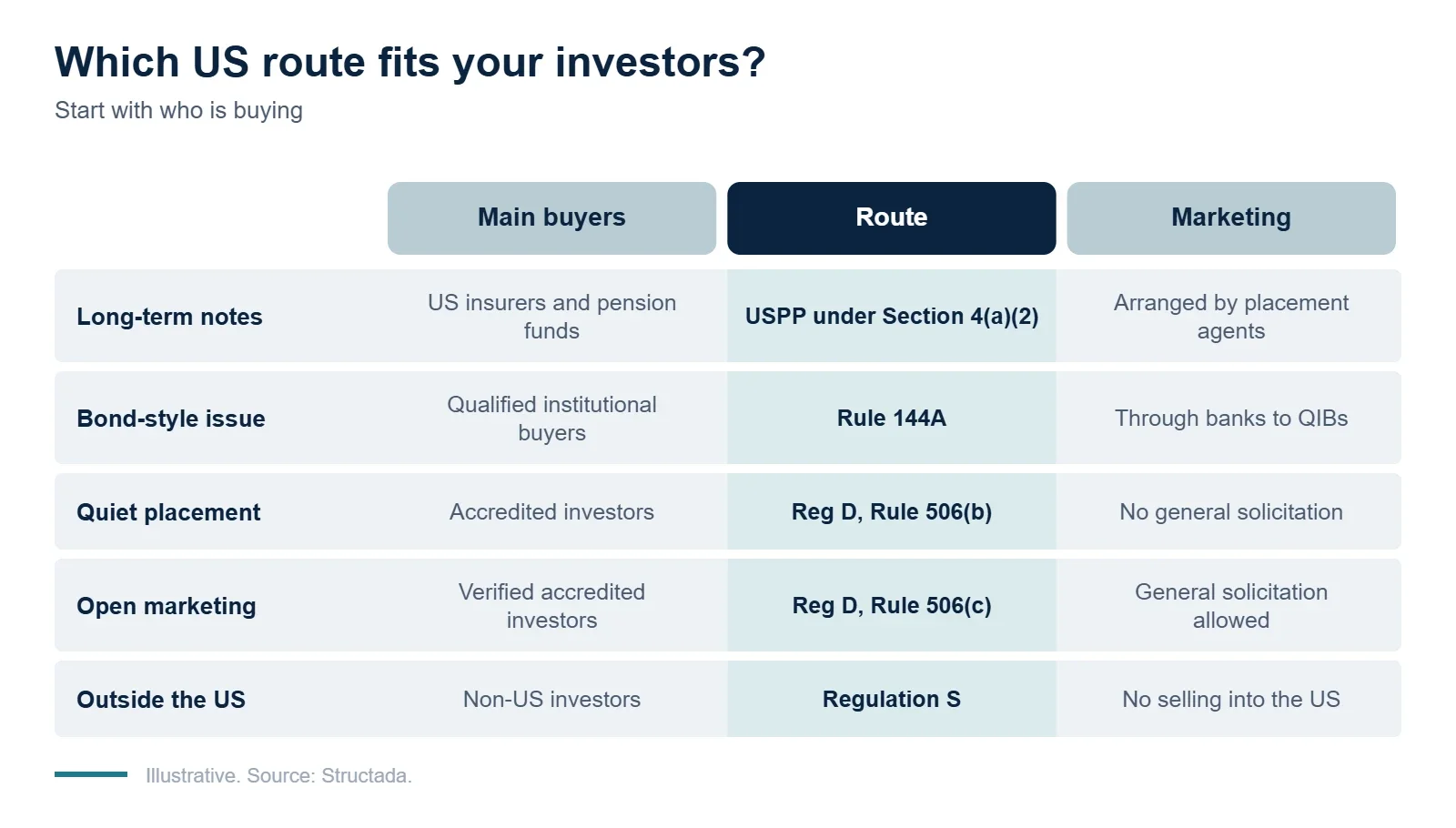
- Who are the investors? Insurance companies point to the USPP market; QIBs to Rule 144A; family offices and high-net-worth individuals to Regulation D.
- How will the deal be marketed? Open marketing needs Rule 506(c); a quiet, arranged placement fits 506(b) or 4(a)(2).
- What kind of issuer is it? A securitisation vehicle or other special purpose issuer must also stay outside the Investment Company Act of 1940. That usually means relying on an exemption such as Section 3(c)(7), which limits US buyers to qualified purchasers, or Rule 3a-7 for qualifying securitisations.
For issuers using a Luxembourg securitisation vehicle to issue credit linked notes, adding US investors is usually done through a Regulation D or Rule 144A tranche alongside the Regulation S offering, with US counsel confirming the Investment Company Act position. The decision belongs at the start of structuring, because it shapes the documents, the transfer restrictions and the clearing set-up.
Frequently asked questions
What is a US private placement?
A sale of securities to eligible investors that is exempt from SEC registration because it does not involve a public offering.
What is the USPP market?
The market in which US insurance companies and other long-term institutions buy privately placed senior notes directly from corporate and infrastructure issuers, including many from outside the US.
What is the difference between Rule 506(b) and Rule 506(c)?
Rule 506(b) bans general solicitation but allows up to 35 sophisticated non-accredited investors. Rule 506(c) allows general solicitation but only accredited investors, whose status must be verified.
What is the difference between Regulation D and Rule 144A?
Regulation D governs the issuer's own sale to accredited investors. Rule 144A governs the resale of securities to qualified institutional buyers, usually through banks, and is used for larger, bond-style offerings.
Do private placements need to be filed with the SEC?
Regulation D offerings require a short Form D notice within 15 days of the first sale. Section 4(a)(2) and Rule 144A offerings have no SEC filing of their own.
Can a non-US company do a US private placement?
Yes. Non-US issuers use all of these routes, and many combine a US tranche with a Regulation S tranche for investors elsewhere.
Can private placement securities be resold?
Only under an exemption, such as Rule 144A to qualified institutional buyers, or after the holding period set out in Rule 144.