

- Rule 144A is an SEC safe harbour that lets restricted securities be resold to qualified institutional buyers (QIBs) in the United States without registration.
- A QIB is broadly an institution that owns and invests at least US$100 million in securities of unaffiliated issuers; registered dealers qualify at US$10 million.
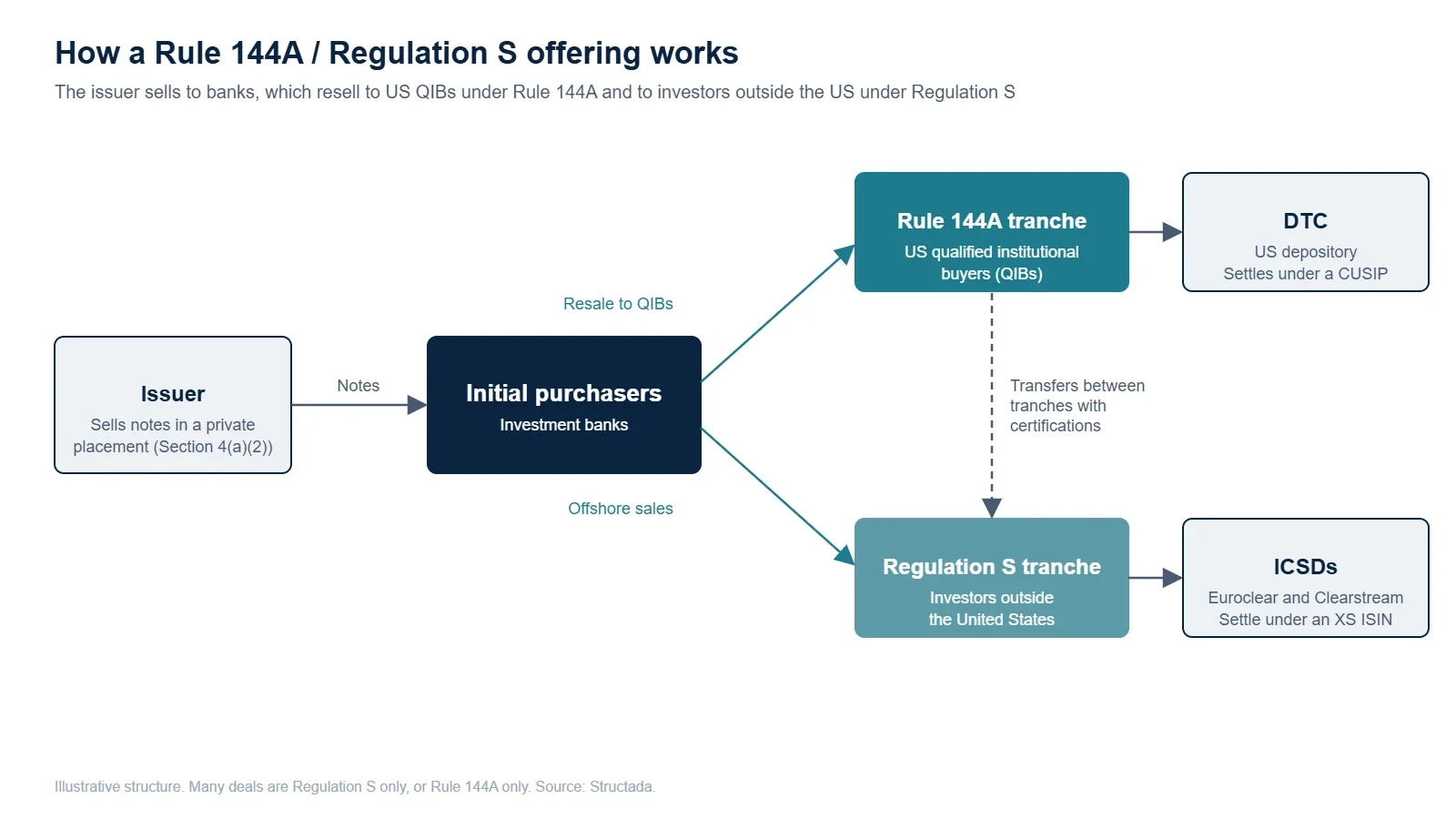
- Most international deals pair a Rule 144A tranche for US QIBs with a Regulation S tranche for investors outside the US.
- 144A notes settle through DTC under a CUSIP; Reg S notes settle through Euroclear and Clearstream under an XS ISIN.
- Rule 144A differs from Rule 144, which sets the holding periods before restricted securities can be sold to the public.
Rule 144A is a rule of the US Securities and Exchange Commission (SEC) that lets securities be resold to large institutional investors in the United States without registering the offering. Adopted in 1990, it is the main route by which non-US issuers reach American institutional money without a full public listing.
Registration is slow, costly and carries years of reporting. Rule 144A offers a safe harbour from it, provided the buyers are sophisticated institutions able to look after themselves. The result is a deep private market that carries a large share of high-yield bonds, emerging market debt and securitisation notes sold into the US.
How a Rule 144A offering works
Rule 144A is a resale exemption. In practice, the issuer sells the notes to one or more investment banks, the initial purchasers, in a private placement under Section 4(a)(2) of the Securities Act. The banks then immediately resell the notes to QIBs under Rule 144A. Because the initial sale and the resale happen together, a 144A deal looks and trades much like a public bond issue.
Who can buy: qualified institutional buyers
Rule 144A securities can only be sold to qualified institutional buyers, or QIBs, or to buyers the seller reasonably believes are QIBs. In broad terms, a QIB is an institution that owns and invests at least US$100 million in securities of unaffiliated issuers. Registered broker-dealers qualify at US$10 million. Banks and savings institutions must also show audited net worth of at least US$25 million.
QIBs include insurance companies, pension funds, investment advisers, mutual funds and banks. Individuals cannot be QIBs, however wealthy.
Rule 144A requirements
A resale relies on Rule 144A only if four conditions are met:
- QIB buyers. The securities are sold only to QIBs, or to buyers reasonably believed to be QIBs.
- Notice. The buyer is told the seller may be relying on Rule 144A, which is why offering memoranda carry detailed transfer restriction language.
- Fungibility. The securities are not of the same class as securities listed on a US exchange.
- Information. If the issuer does not report to the SEC, holders and prospective buyers can request basic financial information about it.
Since the 2013 rule changes under the JOBS Act, a 144A offering can use general solicitation, provided the securities are only sold to QIBs. The exemption from registration does not remove anti-fraud liability, so the offering memorandum is held to a standard close to a public prospectus.
Rule 144A vs Regulation S
Rule 144A covers buyers inside the United States. Regulation S, adopted the same year, covers the rest of the world: securities offered and sold in offshore transactions, without directed selling efforts into the US, fall outside US registration. Most international bond deals with a US element use both.
| Rule 144A tranche | Regulation S tranche | |
|---|---|---|
| Buyers | Qualified institutional buyers in the US | Investors outside the US |
| Settlement | DTC | Euroclear and Clearstream |
| Identifier | CUSIP and US ISIN | XS ISIN and common code |
| Settlement cycle | T+1 | Typically T+2 |
| Resale | To other QIBs, or offshore under Regulation S | Offshore; restrictions on US sales during a distribution compliance period |
The two tranches share the same terms but sit in separate global notes. Euroclear and Clearstream hold accounts at DTC, so their participants can hold interests in the 144A note, and positions can move between tranches with the transfer certifications set out in the offering documents. A Regulation S-only deal avoids DTC and US transfer restrictions altogether, at the cost of leaving US institutions out of the book.
Rule 144 vs Rule 144A
The two rules are easily confused. Rule 144 sets the conditions, including holding periods, under which restricted securities can be sold into the public market: generally six months for securities of SEC-reporting issuers and one year for others. Rule 144A allows restricted securities to be resold at any time, but only to QIBs. A 144A note stays a restricted security for its whole life unless it is later registered.
144A for life
Some deals once came with registration rights: an undertaking to exchange the notes later for SEC-registered ones. Today most high-yield and emerging market issuers sell "144A for life", with no registration rights, and the notes remain in the 144A market until maturity.
What Rule 144A means for issuers
A 144A tranche opens the largest pool of institutional fixed income capital in the world. It also brings US counsel, a heavier disclosure process, DTC eligibility, a CUSIP and transfer restrictions that run for the life of the notes.
For smaller issuers and securitisation vehicles, the trade-off needs weighing early. Where the investor base is in Europe, the Gulf or Asia, a Regulation S-only issue settled through Euroclear and Clearstream is often simpler and cheaper. Where US institutions are the natural buyers, a 144A/Reg S structure is worth its cost. A vehicle such as a Luxembourg securitisation vehicle must also confirm its position under the US Investment Company Act before selling to US investors. For the other routes into US capital, see Types of US Private Placements.
Frequently asked questions
What is Rule 144A and what does it allow for?
An SEC safe harbour that allows restricted securities to be resold to qualified institutional buyers in the US without registering the offering.
What is the difference between Rule 144 and Rule 144A?
Rule 144 sets holding periods and conditions for selling restricted securities to the public. Rule 144A allows resales at any time, but only to QIBs.
What's the difference between Reg S and 144A?
Regulation S covers offers and sales made outside the United States. Rule 144A covers resales to QIBs inside the United States. Many deals use both.
What are 144A bonds?
Bonds sold to qualified institutional buyers under Rule 144A. They are not registered with the SEC, settle through DTC and can only be resold to other QIBs or offshore.
What is a qualified institutional buyer?
Broadly, an institution that owns and invests at least US$100 million in securities of unaffiliated issuers, or US$10 million for a registered broker-dealer.
What is the difference between Rule 144A and Section 4(a)(2)?
Section 4(a)(2) exempts the issuer's own private sale. Rule 144A exempts the resale by the initial purchasers to QIBs. A typical 144A deal uses both.
Do Rule 144A securities need a CUSIP?
Yes. They settle through DTC, which identifies securities by CUSIP.