

- A structured product is a debt security whose return is linked to the performance of something else: an index, a share basket, an interest rate, a credit or a managed portfolio.
- Industry bodies group them into five families: capital protection, yield enhancement, participation, leverage and credit-linked products, with actively managed certificates often treated as a sixth.
- The same payoff can be issued by a bank, carrying the bank's credit risk, or by a securitisation vehicle, carrying the risk of the assets it holds.
- Most structured products are issued as notes or certificates with an ISIN, settled through Euroclear and Clearstream and often listed on an exchange.
- For an issuer, choosing the type is a product decision; choosing the wrapper, jurisdiction and distribution route decides cost, speed and who can buy it.
A structured product is a debt security whose return depends on the performance of something other than the issuer alone. It might track a stock index, pay a high coupon unless a share falls too far, return capital at maturity whatever happens, or follow the credit of a loan pool. Underneath the payoff, almost every structured product is the same thing: a note or certificate, with an ISIN, that combines a bond-like instrument with one or more derivatives.
Structured products are widely used in Europe, Switzerland and Asia, sold to private banks, wealth managers and institutions. For issuers, they are a way to package an exposure or a strategy into a single security that investors can buy through their existing custodian.
The main types of structured products
European and Swiss industry bodies, EUSIPA and the SSPA, classify products by what they are designed to do for the investor. The same families are used across most markets.
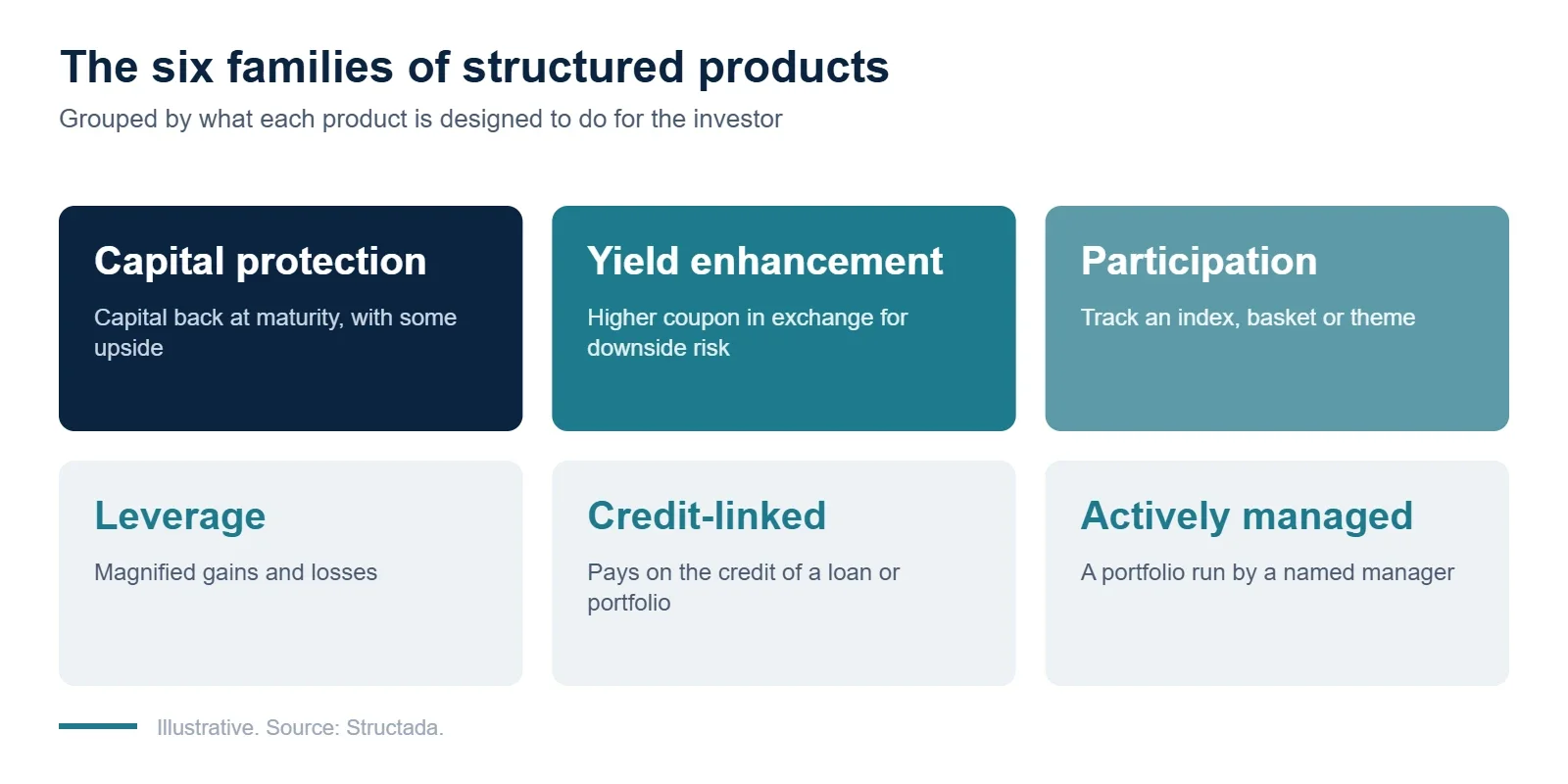
| Type | What it aims to do | Common examples |
|---|---|---|
| Capital protection | Return all or most of the capital at maturity, with some upside | Capital protected notes, notes with a capped or uncapped participation |
| Yield enhancement | Pay an above-market coupon in exchange for downside risk | Reverse convertibles, barrier reverse convertibles, discount certificates, autocallables |
| Participation | Track an underlying, sometimes with extra features | Tracker certificates, bonus certificates, outperformance certificates |
| Leverage | Magnify gains and losses on an underlying | Warrants, knock-out warrants, mini-futures |
| Credit-linked | Pay according to the credit performance of a loan, bond or portfolio | Credit linked notes |
| Actively managed | Follow a portfolio a named manager runs at their discretion | Actively managed certificates (AMCs) |
Capital protection products
These combine a zero-coupon bond, which grows back to the full nominal by maturity, with an option that provides the upside. The investor gives up some return, or accepts a cap, in exchange for getting their capital back. The protection is only as good as the issuer's ability to repay.
Yield enhancement products
The investor sells an option to the issuer and is paid for it through a higher coupon. A reverse convertible, for example, pays a fixed coupon but repays in shares if the underlying falls below a set level. Autocallables redeem early, with a coupon, if the underlying is above a trigger on an observation date. These are among the most widely sold products in Europe and Asia.
Participation products
Trackers give straightforward exposure to an index, basket or theme in a single security. Bonus and outperformance certificates add features such as a minimum payout if a barrier is not breached, or extra upside above a level.
Leverage products
Warrants and knock-outs give a geared exposure for a small outlay. They are mostly short-dated, exchange-traded and aimed at active traders rather than long-term portfolios.
Credit-linked products
A credit linked note pays coupons and principal according to how a defined credit performs, whether that is a single borrower, a loan portfolio or a pool of receivables. Banks have used them since the 1990s to transfer risk; in private credit they are now a mainstream way to fund lending books and real assets.
Actively managed certificates
An AMC wraps a portfolio run by an asset manager or adviser into one certificate, giving investors access to a strategy without a fund. The manager can change the holdings within agreed rules.
Who issues structured products?
There are two main routes, and the choice shapes the risk investors take.
| Bank-issued | SPV-issued | |
|---|---|---|
| Issuer | An investment bank, under its note programme | A securitisation vehicle, often a compartment of a Luxembourg securitisation vehicle |
| Credit risk | The bank's own creditworthiness | The assets and collateral in the compartment |
| Typical products | Capital protection, yield enhancement, participation, leverage | Credit linked notes, AMCs, repackagings, private credit notes |
| Who brings it to market | The bank's structuring desk | A manager, lender or sponsor working with an arranger |
Bank issuance dominates retail-facing payoffs. SPV issuance suits issuers who want the investor's risk tied to specific assets rather than to a bank, and who want to bring their own strategy or loan book to market. For how the vehicle itself is built, see How Securitisation Works: The Mechanics for Issuers.
How structured products reach investors
Whatever the type, the plumbing is much the same. The product is issued as a note or certificate, usually under a programme with standard documentation, similar to a medium term note programme. It gets an ISIN, is made eligible in Euroclear and Clearstream or SIX SIS, and is often listed on a venue such as the Vienna MTF or the Luxembourg Stock Exchange.
Products sold to retail investors in the EU and UK also need a key information document under the PRIIPs rules. Products sold only to professional investors avoid that requirement, which is why most SPV-issued credit and actively managed products are placed with professionals.
What this means for issuers
For an issuer, the product type follows from what investors want and what the issuer is bringing to market: a view on markets, a managed strategy or a pool of credit. The harder decisions come next. Should the product sit on a bank's balance sheet or in a dedicated compartment? Which jurisdiction, clearing system and listing venue? Professional investors only, or a wider audience?
Those choices set the cost, the timetable and the investor base. Getting them right at the start is what turns a payoff on a term sheet into a security people can actually buy.
Frequently asked questions
What is a structured product?
A note or certificate whose return is linked to the performance of an underlying asset, index, rate, credit or managed portfolio, usually combining a bond with one or more derivatives.
What are the main types of structured products?
Capital protection, yield enhancement, participation, leverage and credit-linked products, with actively managed certificates often counted as a separate type.
What are examples of structured products?
Capital protected notes, reverse convertibles, autocallables, tracker certificates, warrants, credit linked notes and actively managed certificates.
Are structured products the same as derivatives?
No. A structured product is a security that contains one or more derivatives. Investors buy a note or certificate, not the derivative itself.
Who issues structured products?
Mainly investment banks under their note programmes, and securitisation vehicles used by asset managers, lenders and sponsors.
What is the risk of a structured product?
The risk of the underlying, as set out in the payoff, plus the credit risk of the issuer or, for SPV-issued products, of the assets and collateral behind the note.