

- Securitised credit is debt backed by a defined pool of loans or receivables, with investors paid from the cash those assets produce rather than from a company's general earnings.
- The pool is sold to a bankruptcy-remote securitisation vehicle, which issues notes in tranches that share losses in a set order.
- The main types are asset-backed securities (ABS), residential and commercial mortgage-backed securities (RMBS and CMBS) and collateralised loan obligations (CLOs), alongside private asset-based finance.
- Investors look at the collateral, the structure and the servicer before they look at the originator's own balance sheet.
- For lenders and other originators, securitisation turns a loan book into a repeatable source of funding that grows with the book.
Securitised credit is debt backed by a specific pool of loans or receivables. Investors are repaid from the cash those assets generate, such as mortgage payments, consumer loan instalments or invoices, rather than from the general earnings of a company. It is one of the largest parts of the fixed income market, and it is how much of the real economy's lending is funded.
The idea is old and simple. A lender holds loans that will pay out over years. Securitisation lets it sell those future cash flows today, to investors who want a steady, asset-backed return. The lender gets cash to lend again; the investor gets exposure to a diversified pool of borrowers it could never reach on its own.
How securitisation turns loans into securities
Every securitisation follows the same basic path, described in more detail in How Securitisation Works: The Mechanics for Issuers.
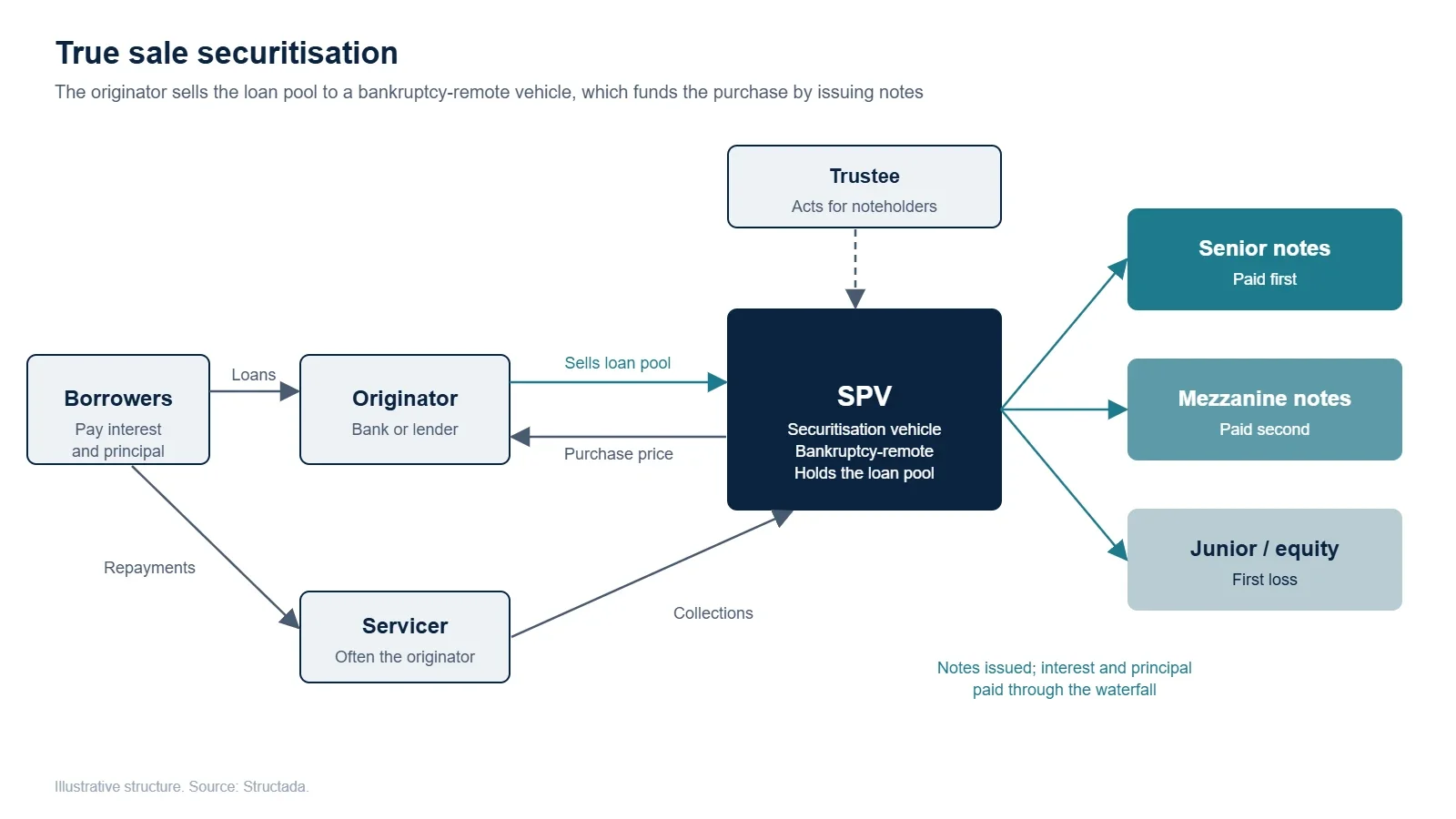
- Origination. A bank, specialty lender or business creates loans or receivables in the ordinary course.
- Transfer. It sells a defined pool of those assets to a securitisation vehicle, a separate, bankruptcy-remote company created for the deal.
- Issuance. The vehicle issues notes to investors and uses the proceeds to pay for the assets.
- Servicing. A servicer, often the originator, collects payments from borrowers and passes them through the vehicle.
- Payment. Cash flows to noteholders in a fixed order set out in the documents, known as the waterfall.
Two features make the structure work. The first is bankruptcy remoteness: if the originator fails, the assets sit in the vehicle and stay out of reach of its creditors. The second is credit enhancement. Notes are issued in tranches, with junior tranches absorbing losses before senior ones, and further protection can come from overcollateralisation, excess spread and reserve accounts.
Types of securitised credit
| Type | Backed by | Typical originators |
|---|---|---|
| Asset-backed securities (ABS) | Consumer loans, auto loans, credit cards, SME loans, trade receivables | Banks, consumer and specialty lenders, corporates |
| Residential mortgage-backed securities (RMBS) | Residential mortgages | Banks, building societies, non-bank mortgage lenders |
| Commercial mortgage-backed securities (CMBS) | Loans on offices, retail, logistics and other commercial property | Banks and real estate lenders |
| Collateralised loan obligations (CLOs) | Portfolios of leveraged corporate loans, actively managed | Asset managers |
| Asset-based finance (ABF) and private securitisation | Any cash-generating pool, often placed privately with a few investors | Specialty lenders, fintechs, growth-stage businesses |
Public deals are rated, listed and broadly syndicated. A growing share of the market is private: warehouse facilities, forward-flow arrangements and bilateral notes placed with a handful of professional investors. Credit linked notes issued through a Luxembourg securitisation vehicle are one common route for these private deals.
Securitised credit vs corporate credit
| Securitised credit | Corporate credit | |
|---|---|---|
| Source of repayment | Cash flows from a defined pool of assets | The issuer's overall earnings and balance sheet |
| What investors analyse | Collateral performance, structure, servicer | Company fundamentals, sector, management |
| Protection | Tranching, overcollateralisation, excess spread, reserves | Covenants and seniority in the capital structure |
| Exposure | Thousands of underlying borrowers | One company |
| Typical yield | Often higher than similarly rated corporate bonds | Benchmark for the rating |
That pickup in yield is part of why asset managers promote the asset class. It reflects the extra complexity investors take on, and the work involved in analysing collateral and structure.
What securitised credit means for issuers
For a lender, securitisation is a funding tool before it is anything else. A specialty lender funded by its own balance sheet or a single bank line can only grow as fast as that capital allows. Selling pools of loans into a securitisation vehicle, or funding them through notes issued against the book, lets the lending grow with demand. We look at this problem in more depth in How Non-Bank Lenders Use Credit Linked Notes for Funding.
The trade-off is preparation. Investors will want loan-level data, a performance history, a clear servicing set-up and documents that hold up to scrutiny. Notes need an ISIN and eligibility in Euroclear or Clearstream, and many issuers add a listing on a recognised venue such as the Vienna MTF. Getting those foundations right early decides how fast the first deal closes and how easily the second one follows.
Frequently asked questions
What does securitised credit mean?
Debt whose repayment comes from a defined pool of loans or receivables held in a separate vehicle, rather than from a company's general earnings.
What is securitisation in simple terms?
Turning loans that pay out over time into securities that investors can buy today. The lender gets cash now; investors receive the loan payments as they come in.
What are examples of securitised products?
Asset-backed securities, residential and commercial mortgage-backed securities, collateralised loan obligations and privately placed asset-backed notes.
How risky are securitised bonds?
It depends on the collateral and the tranche. Senior tranches are protected by the tranches below them and by other credit enhancement; junior tranches take the first losses and pay more for it.
Who issues securitised credit?
Banks, building societies, specialty and non-bank lenders, fintechs, asset managers running CLOs and businesses with steady receivables.