

- Syndicated securitisation places a single transaction with several investors, each of whom may want a different risk profile, return and set of terms.
- Luxembourg's Securitisation Law of 2004, strengthened by the 2022 reform, lets one vehicle create ring-fenced compartments, so several investor groups can be served without a separate vehicle for each.
- A Luxembourg Sàrl needs only one shareholder and €12,000 in share capital, and securities issued by private placement to institutional or high-net-worth investors fall outside CSSF supervision.
- Standard documentation and AML and KYC frameworks that meet international expectations shorten negotiation and onboarding across a syndicate.
- Tokenisation and digital onboarding are beginning to speed up syndication, though most transactions still run through conventional processes.
Syndication is one of the harder problems in securitisation. Bringing several investors into one transaction means reconciling different risk appetites, return expectations and compliance requirements, and doing so without the process turning into a separate negotiation with every participant. A pension fund, an insurer and a family office may all like the same pool of assets and still want very different notes.
The structure has to accommodate that from the outset. A vehicle designed for a single investor and then stretched to fit a syndicate tends to show the strain in its documents, its reporting and its timetable.
Luxembourg has become the natural home for syndicated securitisation in Europe largely because its law anticipates the problem. The Securitisation Law of 2004, strengthened by the 2022 reform, gives issuers a framework that makes multi-investor structures straightforward to establish, economical to run and credible to institutional investors wherever they are based.
What is syndicated securitisation?
In a syndicated securitisation, a vehicle acquires or finances a pool of assets and issues notes to a group of investors rather than to one. The investors share the exposure, so no single lender has to carry the whole transaction, and the issuer gains access to a deeper pool of funding than any one relationship could provide.
The difficulty lies in the differences between those investors. Some want senior, lower-risk paper and a predictable coupon. Others will take subordinated risk for a higher return. Each brings its own regulatory constraints, currency preferences and reporting needs. The art of syndication is giving each of them a security that fits, while keeping the underlying structure single, coherent and manageable. For the mechanics that sit beneath any such deal, our guide to how securitisation works is a useful starting point.
How compartments make syndication work
The feature that does most of the work in Luxembourg is the compartment. A Luxembourg securitisation vehicle can create multiple compartments, each a ring-fenced unit with its own assets, liabilities and investors. The rights of investors in one compartment extend only to the assets of that compartment, so a problem in one series does not reach the others.
For a syndicate, that segregation is the practical answer to divergent requirements. Separate investor groups can sit in their own compartments, or in different tranches within one, with notes carrying different maturities, coupons or currencies. Each investor receives an exposure designed for it, while administration, accounting and reporting remain centralised in one vehicle rather than duplicated across several.
The entity itself is also light to establish. A securitisation vehicle can take the form of a company, most commonly a Sàrl or an SA, or a fund. A Sàrl needs only one shareholder and €12,000 in share capital, a low threshold by the standards of competing jurisdictions. And where securities are issued by private placement to institutional or high-net-worth investors, the vehicle falls outside CSSF supervision, avoiding the time and cost that direct regulatory oversight would add to each new issue.
Documentation and investor onboarding
Structure is only half of the matter. A syndicate is assembled through documents and onboarding, and here Luxembourg's maturity as a market counts for a great deal.
The market has well-established templates for note issuance, subscription agreements and private placement memoranda. Investors and their counsel have seen them many times, which shortens negotiation considerably when several parties are reviewing the same terms. For an issuer planning repeat transactions, a base private placement memorandum with final terms for each series fits this model well.
Onboarding is the other common source of delay. Luxembourg's AML and KYC frameworks already meet the standards global investors expect, so bringing in participants from the United States, Asia or the Middle East does not require additional layers of compliance beyond what the jurisdiction provides. Reputation reinforces the point: allocators already regard Luxembourg structures as institutionally credible, which tends to make a syndicate easier to assemble than the same transaction in a newer or less familiar jurisdiction. Our guide to how credit linked notes reach investors covers the distribution side in more detail.
Technology and digital settlement
Digital tools are beginning to make syndication faster, though this remains a developing part of the market rather than the way most transactions are run.
The most visible change is the tokenisation of asset-backed notes. Where notes are issued as tokenised securities, investors can gain faster tradeability and settlement, which can widen a syndicate to include digital-native allocators and family offices alongside conventional participants. Where issuance runs on a distributed ledger, investors can also follow assets and payments as they occur, a meaningful reassurance on a complex, multi-party transaction.
Less visible, but more widely adopted, is digital onboarding. A growing number of Luxembourg providers offer digital KYC and AML checks, electronic subscription agreements and secure data rooms, which remove much of the manual work involved in bringing a large syndicate together. For most issuers today, conventional settlement through the international clearing systems, as set out in our Euroclear-ready checklist, remains the standard route.
Outsourcing the execution
An issuer does not need to build in-house infrastructure to run a syndicated transaction well. Luxembourg's ecosystem of administrators, auditors, trustees and legal advisers already knows how to structure and operate these vehicles, and drawing on it, rather than replicating it internally, is usually what keeps a syndication both economical and quick to close. In a market where the ability to close on time can decide whether a transaction happens at all, that matters as much as the legal structure. Our guide to Luxembourg securitisation costs sets out what that ecosystem typically charges.
A multi-investor real estate securitisation
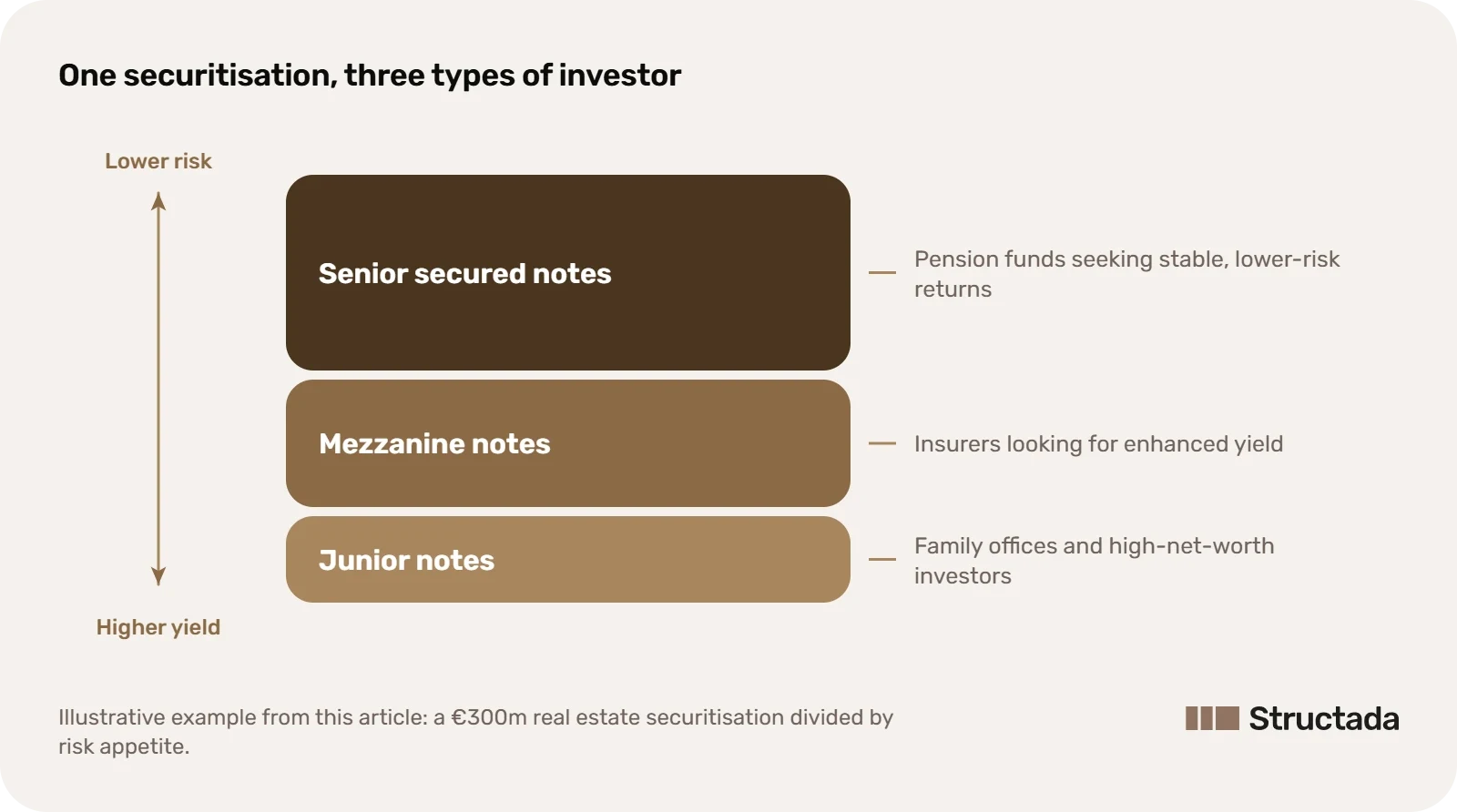
Consider a real estate fund seeking €300 million of funding from a mix of pension funds, insurers and private investors. Structured through a Luxembourg securitisation vehicle with several compartments, the transaction could be divided by risk appetite.
Senior secured notes would sit in one compartment, aimed at pension funds seeking stable, lower-risk returns. Mezzanine notes in a second compartment would be designed for insurers looking for enhanced yield. A third compartment would hold higher-yielding junior notes placed with family offices and high-net-worth investors.
All three groups would participate in the same underlying portfolio of property-backed assets, while each holds a security matched to its own risk appetite. The fund avoids the cost and complexity of three separate vehicles, and still benefits from centralised reporting, custody and compliance across the whole structure.
What this means for issuers
Syndicating a securitisation across several investors is inherently complex, and no jurisdiction removes that complexity entirely. Luxembourg does as much as any to keep it manageable. Compartments, familiar documentation and a deep service ecosystem allow an issuer to bring in several investor groups on different terms without multiplying the legal and administrative work behind the scenes.
The issuers who handle syndication best design for it from the start. The allocation of investors to compartments and tranches, the documentation and the settlement arrangements are interlocking decisions, and settling them before the first investor conversation, rather than after the order book has formed, avoids rework and protects the timetable.