- A Guernsey protected cell company (PCC) is a single company divided into a core and any number of cells, each with its own assets and liabilities legally ring-fenced from the others.
- Guernsey introduced the PCC in 1997, the first jurisdiction to do so, originally for insurance, and it is now widely used for investment funds and dedicated investment structures.
- Cells do not have separate legal personality: the PCC contracts on behalf of each cell, which is why counterparties must be told which cell they are dealing with.
- An incorporated cell company (ICC) is the alternative: each cell is its own company, which gives stronger separation at a higher administrative cost.
- For note issuance and securitisation, a PCC offers similar ring-fencing to a Luxembourg compartment, but Luxembourg's securitisation law, EU status and clearing infrastructure make it the more common choice for issuers targeting European investors.
Any sponsor running several programmes, funds or insured risks faces the same structural choice. A separate company for each keeps the risks apart but multiplies boards, filings and running costs. A single company is cheaper to operate, but it allows a loss in one programme to reach the assets supporting the others.
The Guernsey protected cell company, or Guernsey PCC, was the first statutory answer to that problem. Guernsey introduced the structure in 1997, originally so that insurers could rent space in a single licensed company rather than build their own. Nearly three decades on, the PCC is used for captive insurance, insurance-linked securities, investment funds and dedicated investment vehicles, and the concept has been adopted in many other jurisdictions.
For issuers, the PCC sits alongside the Luxembourg compartment and the Irish DAC as one of the established ways to ring-fence separate transactions. Its strengths are real, and so is the limit on how far its protection reaches.
What is a Guernsey PCC?
A protected cell company is a single legal entity made up of a core and one or more cells. Each cell has its own assets, its own liabilities and usually its own shareholders or investors. The law ring-fences each cell from every other cell and from the core, so the creditors of one cell can claim only against that cell's assets.
The PCC has one board of directors, one set of constitutional documents and one registration number. As Walkers describes it, the structure replicates the liability separation of a group of companies within a single company. That combination of segregation and administrative economy is the reason the structure has lasted.
How a Guernsey PCC works
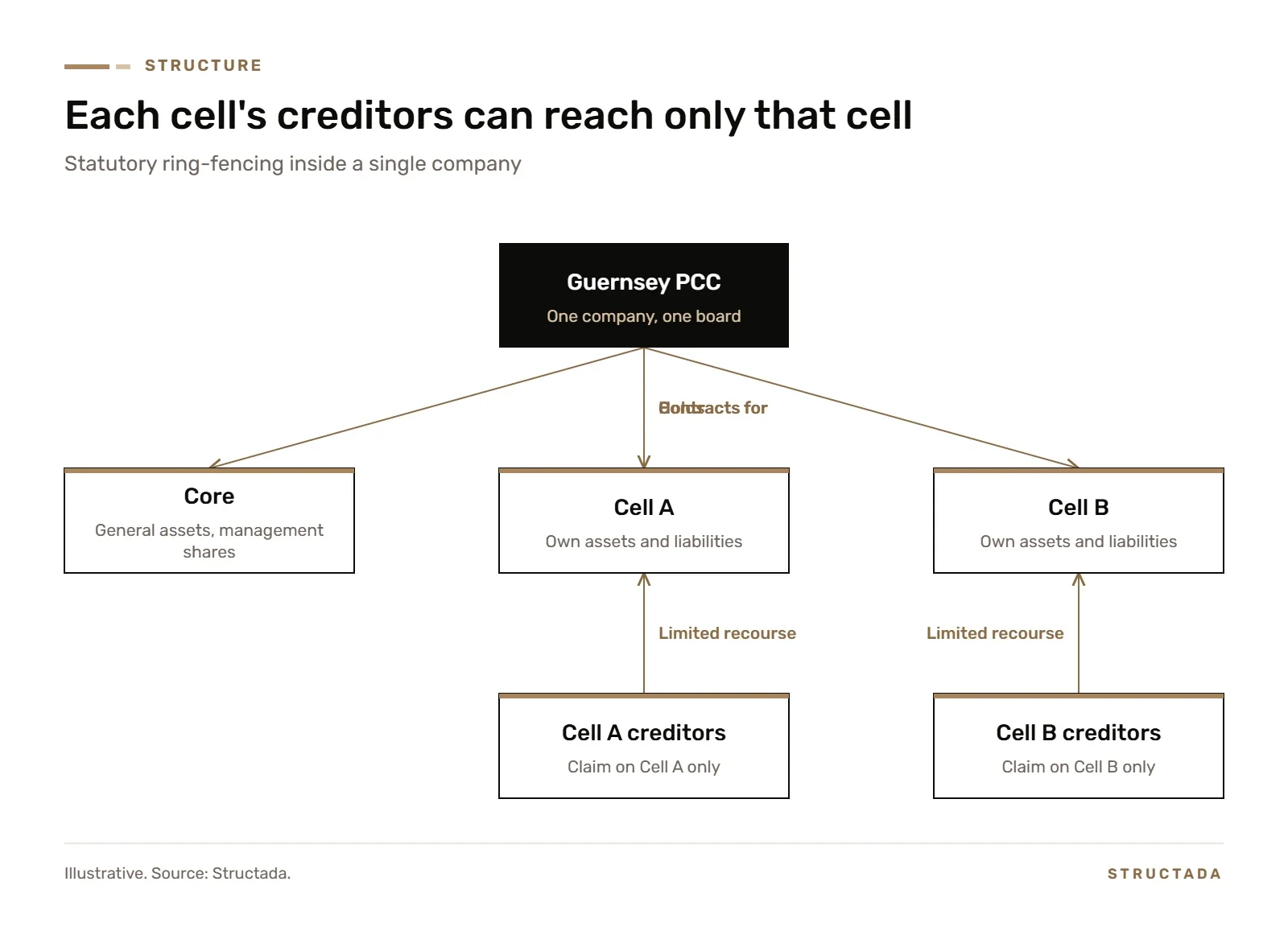
The core holds the company's general, non-cellular assets, and often the management shares that carry voting control. Each cell holds the assets for a single programme, fund, insured risk or transaction, funded by its own investors or shareholders. New cells can be added as new programmes or transactions arise, with consent from the Guernsey Financial Services Commission (GFSC) where required.
Because the cells have no legal personality of their own, the PCC contracts on behalf of a named cell. It must disclose its status as a cell company and identify the relevant cell, so that counterparties know their recourse is limited to that cell's assets. This duty carries real weight in practice: careful attribution of every asset and liability to the correct cell, or to the core, is what allows the statutory protection to operate.
The result is that liabilities stay where they arise. A loss in one cell cannot be met from another cell's assets, and investors in one programme take no exposure to the performance of another. For a sponsor with many cells, that separation is achieved without the cost of a separate company for each.
Guernsey PCC vs ICC
Guernsey also offers the incorporated cell company, or ICC, and the choice between the two structures matters.
| Protected cell company (PCC) | Incorporated cell company (ICC) | |
|---|---|---|
| Legal status of cells | Not separate legal persons; the PCC acts for each cell | Each cell is a separate company with its own legal personality |
| Contracting | The PCC contracts on behalf of a cell | Each cell contracts in its own name |
| Strength of separation | Statutory ring-fencing within one company | Separate companies, so separation is easier to recognise abroad |
| Administration | Simpler, one company | More involved, each cell has its own filings |
| Typical use | Insurance, funds, programmes with many cells | Structures needing stronger separation or cells that may later stand alone |
The PCC's main weakness is that a cell's protection is created by Guernsey law. A court in another jurisdiction, asked to enforce a claim against the PCC, may not apply that segregation and could treat the company as a single pool of assets. Where assets are held, or counterparties are located, outside Guernsey, that risk deserves attention at the structuring stage. The ICC was introduced largely to address it, at the price of more administration for each cell.
What are Guernsey PCCs used for?
Captive insurance and reinsurance remain the original and best-known use. Businesses rent a cell to insure their own risks without forming a full insurer, and Guernsey remains one of Europe's leading captive domiciles. The same logic extends to insurance-linked securities, where cells hold collateral for reinsurance contracts and catastrophe risk transactions, with each transaction in its own cell.
Investment funds are the second major application. Umbrella funds use a cell for each strategy, share class or investor group, while dedicated investment structures use a cell for each investment or each investor, with the manager holding the management shares in the core.
Cells can also issue notes linked to the assets they hold. This is less common than in Luxembourg or Ireland, where the legal and market infrastructure is built around note issuance, but it remains an option for sponsors already established in the Channel Islands, whose notes may be listed on The International Stock Exchange.
Guernsey PCC vs Luxembourg securitisation vehicle
Both structures offer ring-fencing within a single entity, and the difference lies in what each was built for. A Luxembourg securitisation vehicle divides its assets into compartments under the 2004 securitisation law, reformed in 2022. It sits within the EU, its commitments to investors are deductible, so it is generally tax neutral, and it is the standard route for notes carrying an ISIN and held through Euroclear and Clearstream. It is widely used for credit linked notes, securitisation and structured products.
A Guernsey PCC operates under Guernsey companies law, outside the EU, and is tax neutral for most investment structures. Its notes can be cleared internationally, but that route is less standard, and the structure is strongest in insurance and funds. Our comparison of Guernsey and Luxembourg securitisation sets out the trade-offs in more detail.
When a Guernsey PCC makes sense
The PCC is a natural choice where the structure involves insurance or reinsurance risk, where the sponsor already operates in Guernsey or the Channel Islands, and where investors are comfortable with a non-EU vehicle or are mainly based outside the EU. It also suits programmes that need many cells, added quickly under a single company and board.
For issuers selling notes to European professional investors, particularly credit linked notes, a Luxembourg compartment is usually the better fit. Our article on syndicated securitisation in Luxembourg shows how compartments are used for multi-investor transactions, and Jersey's equivalent structure is covered in our guide to the Jersey PCC.
What this means for issuers
The Guernsey PCC is a proven way to keep separate programmes apart within one company, backed by nearly three decades of use in the jurisdiction that created it. It is the natural home for insurance-related and fund structures, especially where investors are comfortable outside the EU and the assets sit within reach of courts that recognise cell company law.
For note issuance aimed at European investors, the balance usually tips towards Luxembourg, because its securitisation law, EU status and clearing infrastructure are designed for exactly that purpose. The right answer depends on the assets, the investors and the jurisdictions in which the segregation may need to be recognised, and it is worth settling before the first cell is created.
Frequently Asked Questions
What is a protected cell company?
A single company divided into a core and separate cells, with each cell's assets and liabilities legally ring-fenced from the others and from the core.
When were PCCs introduced in Guernsey?
In 1997. Guernsey was the first jurisdiction to introduce protected cell companies.
Does a cell in a PCC have its own legal personality?
No. The PCC acts on behalf of each cell. In an incorporated cell company, by contrast, each cell is a company in its own right.
What is the difference between a PCC and an ICC?
In a PCC, cells are segregated parts of one company. In an ICC, each cell is a separate company, which gives stronger separation but more administration.
What are Guernsey PCCs used for?
Mainly captive insurance, reinsurance and insurance-linked securities, investment funds and dedicated investment structures.
Is a Guernsey PCC the same as a Luxembourg compartment?
Both ring-fence assets within one entity. A Luxembourg compartment sits within an EU securitisation framework designed for note issuance, while a Guernsey PCC is a companies law structure used mainly for insurance and funds.