- Guernsey and Luxembourg both let issuers ring-fence separate deals inside one structure: Guernsey through protected and incorporated cell companies, Luxembourg through statutory compartments under its securitisation law.
- Guernsey offers 0% corporate tax for most companies, fast incorporation, an insolvency regime close to English law and listing on The International Stock Exchange (TISE).
- Luxembourg offers a dedicated securitisation law, EU status, access to more than 80 tax treaties and a market of over 1,600 active vehicles that European investors know well.
- On cost, Guernsey is often cheaper for a single structure, particularly with UK-based sponsors, while Luxembourg becomes more efficient for repeat issuance through compartments on an existing platform.
- The deciding factor is usually the investor base: UK and Channel Islands investors are comfortable with Guernsey, while European private banks and institutions tend to prefer Luxembourg.
The choice of jurisdiction for a securitisation is usually made early and revisited late. Issuers settle on a vehicle for reasons of speed or cost, then discover in the final weeks before closing that a private bank's product committee wants an EU issuer, or that withholding tax on the underlying assets cannot be reduced. Guernsey vs Luxembourg securitisation is one of the comparisons where that happens most often, because both jurisdictions do the core job well and differ mainly at the edges.
Guernsey is a Crown Dependency off the coast of Normandy, with English-style law, a deep fund and insurance industry, and the cell company structure it pioneered in 1997. Luxembourg is the EU's leading securitisation centre, home to Clearstream and to a law written specifically for securitisation.
Both can issue notes, ring-fence deals and stay close to tax neutral. Where they part company is in law, regulation, investor perception and the way costs build up over the life of a programme.
How Guernsey and Luxembourg ring-fence deals
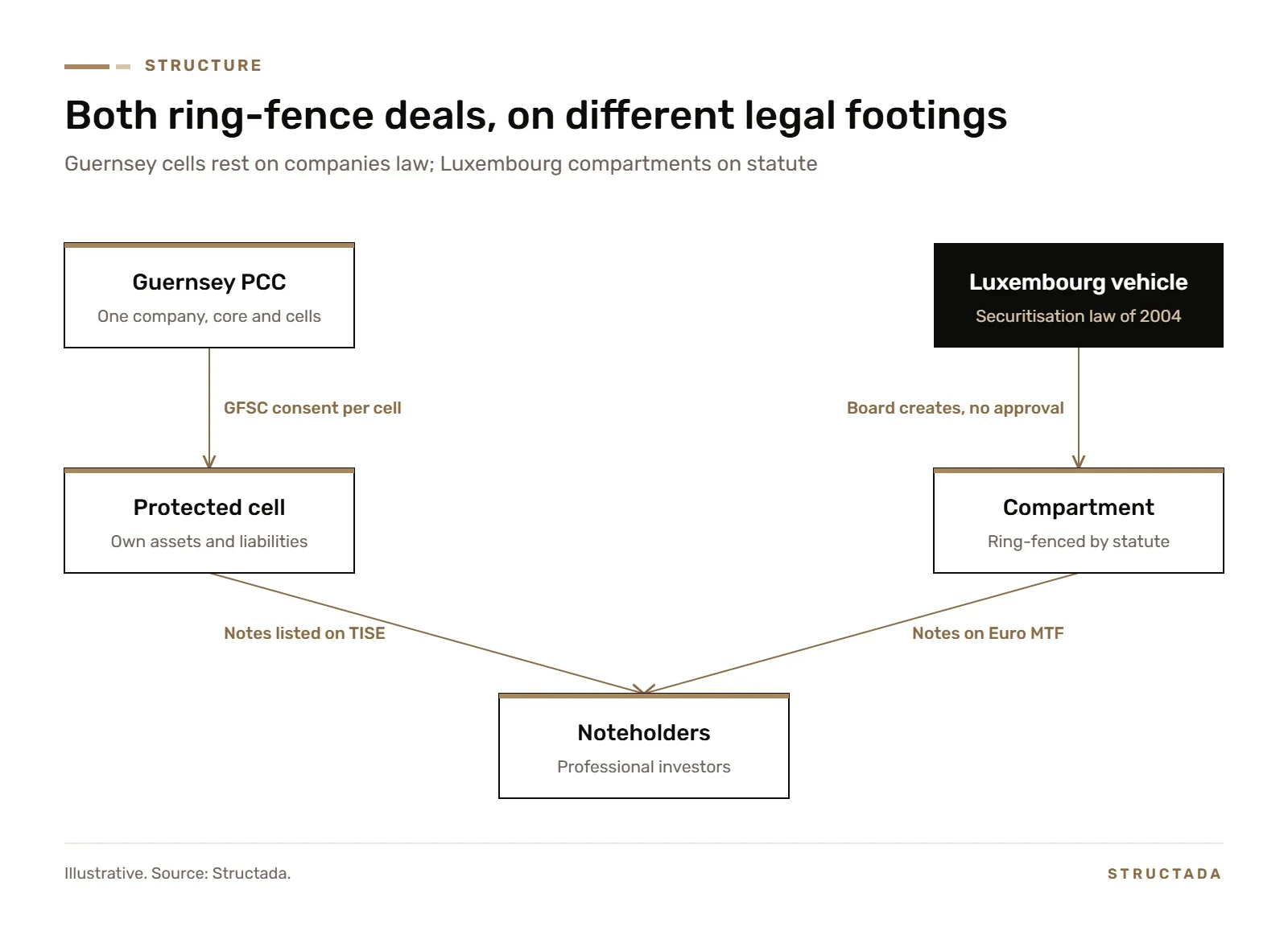
Guernsey uses cell companies under the Companies (Guernsey) Law, 2008. A protected cell company (PCC) is one legal entity divided into a core and cells, each with its own assets and liabilities. An incorporated cell company (ICC) goes further, making each cell a company in its own right. Guernsey also uses ordinary companies held on charitable or purpose trusts as orphan SPVs.
Luxembourg uses compartments under the securitisation law of 2004, reformed in 2022. A single securitisation vehicle can create any number of compartments, each ring-fenced by statute, and each can issue its own notes against its own assets. For tax purposes, the vehicle is treated as a single taxpayer.
The practical difference is where the segregation comes from. In Guernsey it rests on general companies law, with separate incorporation available where greater certainty is needed. In Luxembourg it rests on a statute designed for securitisation, which covers the transaction from asset transfer to the ranking of investors.
Guernsey vs Luxembourg at a glance
| Guernsey | Luxembourg | |
|---|---|---|
| Segregation | PCC cells, ICC cells (separate companies) or standalone orphan SPVs | Statutory compartments within one vehicle |
| Legal basis | General companies law | Dedicated securitisation law |
| EU status | Outside the EU; Crown Dependency | EU member state |
| Corporate tax | 0% for most companies | Taxable, but commitments to investors deductible |
| Withholding tax on interest | None | Generally none for non-residents |
| Tax treaties | Limited network | More than 80 treaties |
| Regulation | No regulatory consent needed to issue debt; GFSC consent to create cell companies and cells | Unregulated unless issuing continuously to the public |
| Listing | TISE | Luxembourg Stock Exchange, Euro MTF |
| Typical uses | Insurance-linked securities, funds, UK-linked deals, restructurings | Credit linked notes, repacks, trade receivables, private ABS |
Advantages of Guernsey for securitisation
Guernsey's appeal starts with tax and speed. Guernsey companies typically pay 0% income tax, with no withholding tax on interest and no stamp duty on issuing or transferring shares, according to Carey Olsen. Companies can sometimes be formed within hours, with no minimum capital, and a Guernsey company does not need regulatory consent simply to issue debt securities.
The legal environment is familiar to anyone used to English law. Guernsey's insolvency regime closely follows the UK's, and it recognises subordination, limited recourse, set-off and non-petition clauses. Having invented the PCC, the island also has long experience of cell companies. Notes can be listed on TISE, which offers fast document turnaround and streamlined rules for asset-backed securities, and is recognised in the UK, so listed debt can qualify for the quoted Eurobond exemption.
Drawbacks of Guernsey
Status outside the EU is the main constraint. Some European investors and their compliance teams prefer EU issuers, and non-EU status can slow product approval at private banks.
The PCC carries its own limitation. Its ring-fencing comes from Guernsey law, and a court in another country may not apply it to assets held outside Guernsey, which is one reason ICCs are used where separation must hold up internationally. Creating cell companies and new cells also needs GFSC consent, adding a step to each new deal.
Tax treaties matter less than they might. A 0% tax company gains little from treaties, so withholding tax on income from underlying assets in other countries may not be reduced. And Guernsey has fewer note issuance platforms and service providers specialising in securitisation than Luxembourg.
Advantages of Luxembourg for securitisation
Luxembourg's strength is a securitisation law built for the job. It covers asset transfer, compartments, subordination, limited recourse and non-petition, so less depends on contract drafting. New compartments can be created by the board, without regulatory approval, for unregulated vehicles.
Scale and recognition follow. Investors, regulators and private banks across Europe know the vehicle well, and Luxembourg had 1,682 active securitisation vehicles at the end of 2025, according to the PwC and LuxCMA survey. Clearstream is based in Luxembourg, and Luxembourg notes are routinely settled through Euroclear and Clearstream.
The tax position is neutral in practice rather than by headline rate. A corporate securitisation vehicle is Luxembourg tax resident and can generally claim benefits under more than 80 tax treaties. Payments to investors are generally deductible, management services are VAT-exempt, and there is no net wealth tax beyond a minimum charge.
Drawbacks of Luxembourg
The price of that framework is formality. Luxembourg vehicles need audited accounts, a Luxembourg-based board or administrator and careful tax structuring to stay neutral. Interest limitation and anti-hybrid rules can apply, particularly where investors are related to the originator. A brand-new vehicle also takes several weeks to set up, compared with hours or days in Guernsey.
Where the cost efficiencies lie
Costs depend less on the jurisdiction than on how the structure is used. For a single deal, Guernsey is often cheaper to form and run, particularly where the sponsor and advisers are UK-based, because low formation costs and 0% tax keep the overhead small. For repeat issuance, Luxembourg compartments become more efficient with each deal, because one vehicle, one board, one audit and one set of service providers support every compartment.
In either jurisdiction, the largest saving comes from issuing through an established platform rather than forming a new vehicle: the issuer avoids set-up costs and shares running costs with other users. Distribution costs belong in the calculation too. If European private banks need extra time or documents to approve a non-EU issuer, the saving at vehicle level can be lost in the sales process. Our analysis of Luxembourg securitisation costs sets out the main items.
Choosing between Guernsey and Luxembourg
Guernsey tends to suit insurance-linked and reinsurance structures, sponsors and investors based in the UK or Channel Islands, and restructurings or single transactions that need speed and English-style law. Luxembourg tends to suit notes sold to European investors through private banks, family offices and wealth managers, repeat issuance of credit linked notes and private ABS, and assets that earn income in treaty countries.
What this means for issuers
Guernsey and Luxembourg both offer reliable ring-fencing, near-neutral tax and experienced service providers. Guernsey's strengths are speed, simplicity and a 0% tax rate; Luxembourg's are its securitisation law, EU status and the scale of its market.
The decision should start with the investor, not the vehicle. For issuers selling notes to European investors on a repeat basis, a compartment on an existing Luxembourg platform usually gives the lowest cost per deal and the fewest questions at product approval. For a single UK-focused deal, Guernsey may well be the leaner choice. Settling who will buy the notes, and where the underlying income arises, before the vehicle is chosen avoids paying for the wrong structure twice.
Frequently Asked Questions
Is Guernsey in the EU?
No. Guernsey is a Crown Dependency and sits outside both the EU and the UK.
What is the difference between a Guernsey cell and a Luxembourg compartment?
Both ring-fence assets and liabilities within one structure. A Luxembourg compartment is created under a dedicated securitisation law, while Guernsey cells are created under companies law and need regulatory consent.
Does Guernsey tax note-issuing companies?
Most Guernsey companies pay 0% income tax, and there is no withholding tax on interest.
Do Luxembourg securitisation vehicles need a licence?
Only if they issue financial instruments to the public on a continuous basis. Most are unregulated.
Which is cheaper for note issuance?
Guernsey is often cheaper for a single structure. Luxembourg tends to be more efficient for repeat issuance through compartments.
Can Guernsey notes be cleared through Euroclear?
Yes. Guernsey notes can carry an ISIN and settle through Euroclear and Clearstream, although Luxembourg issuers are more common in that market.