

- A Guernsey incorporated cell company (ICC) is a company with any number of incorporated cells, each of which is a separate company with its own legal personality.
- Each cell can contract, sue and be sued in its own name, which gives stronger and more widely recognised segregation than the cells of a protected cell company (PCC).
- Cells are not subsidiaries of the ICC, though they share its registered office, and at least one cell director must also sit on the ICC's board.
- ICCs are used for umbrella funds, insurance-linked securities and longevity risk transactions, and for structures where cells may later be moved, merged or spun out.
- The trade-off is more administration than a PCC; for note issuance aimed at European investors, a Luxembourg compartment is usually the more natural route.
Guernsey gave the world the protected cell company in 1997: one company divided into ring-fenced cells, each with its own assets and liabilities. The idea worked well and was copied widely. It also carried a structural weakness. A protected cell has no legal personality of its own, so the protection it offers depends on Guernsey law being recognised wherever a dispute arises.
The Guernsey incorporated cell company, or ICC, was the island's answer to that weakness. It keeps the architecture of a single umbrella with many cells, but makes each cell a company in its own right. The result is the clearest separation a cell structure can offer, combined with shared administration across the whole arrangement.
For sponsors and issuers, the interesting question is when that additional separation is worth the additional administration it brings, and when a simpler or differently located vehicle would serve better.
What is a Guernsey ICC?
An incorporated cell company is a company that can create incorporated cells, each of which is itself a company. Both the ICC and its cells are governed by the Companies (Guernsey) Law, 2008, and creating them requires consent from the Guernsey Financial Services Commission (GFSC).
The legal character of the cells is what sets the structure apart. As Carey Olsen explains, each incorporated cell is a separate legal entity registered with the Guernsey Registry, with its own board of directors and its own constitutional documents. It can contract, sue and be sued in its own name. It is also not a subsidiary of the ICC, although the ICC may hold shares in it. The umbrella and the cells are therefore related by structure and administration rather than by ownership in the ordinary group sense.
How a Guernsey ICC works
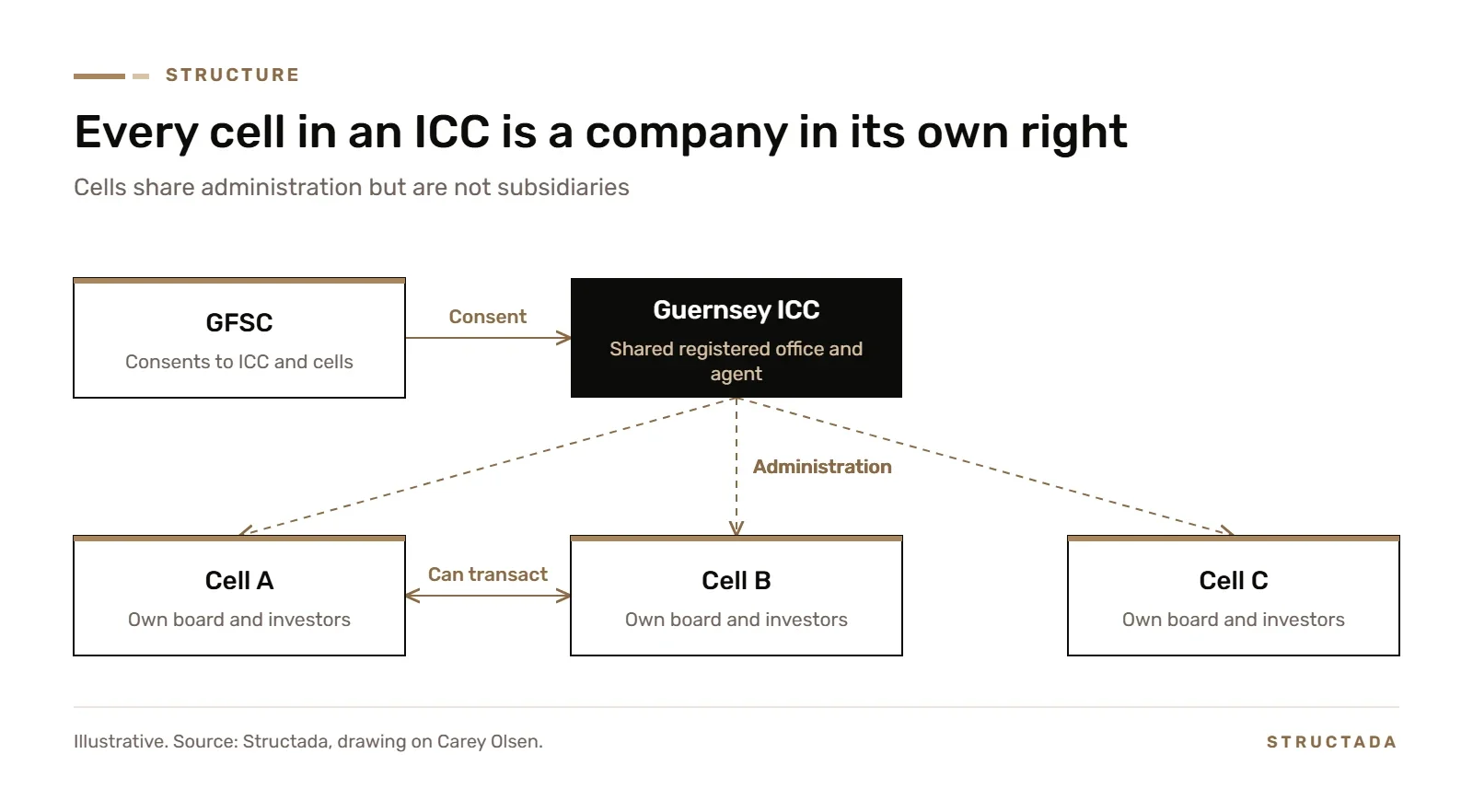
The ICC sits at the top as an umbrella company. It provides the registered office and resident agent shared by every cell, and it is the point through which the structure is administered. Beneath it, each incorporated cell holds its own assets and liabilities and has its own shareholders or investors.
Governance can vary from cell to cell. A cell's board need not mirror the ICC's board, provided at least one cell director also sits on the board of the ICC. That link keeps a line of oversight across the structure while allowing each cell to be run by people suited to its particular business.
Contracting follows from the cells' legal personality. The ICC cannot contract on behalf of its cells; each cell enters into its own agreements, and every document must identify which entity is acting. Because each cell is a separate legal person, cells can also transact with one another, something the cells of a protected cell company cannot do.
The structure is also mobile. With GFSC consent, an incorporated cell can be transferred to another ICC, converted into a standalone company or merged. That flexibility matters to sponsors who expect a transaction or portfolio to outgrow its original home, or who may wish to sell a cell as a going concern.
Guernsey ICC vs PCC
Guernsey offers both forms of cell company, and the choice between them is a choice about legal personality and the administrative burden that follows from it.
| Incorporated cell company (ICC) | Protected cell company (PCC) | |
|---|---|---|
| Legal status of cells | Each cell is a separate company | Cells are segregated parts of one company |
| Who contracts | Each cell in its own name | The PCC on behalf of a named cell |
| Transactions between cells | Possible | Not possible |
| Segregation abroad | Easier to recognise, as cells are separate companies | Relies on recognition of Guernsey cell law |
| Administration | More involved: each cell is registered and has its own board | Simpler: one company, one board |
| Flexibility | Cells can migrate, merge or become standalone companies | Cells can convert to standalone companies with consent |
| Typical use | Structures needing the strongest separation | Insurance, funds and programmes with many cells |
The decision usually turns on how much separation the structure needs and how much administration the sponsor is prepared to carry. A PCC remains attractive where many cells sit comfortably within jurisdictions familiar with cell company law. An ICC earns its keep where assets, counterparties or creditors are located elsewhere and the sponsor wants each cell to stand on its own without relying on a foreign court's understanding of Guernsey legislation. A PCC can convert into an ICC with GFSC consent, but an ICC cannot convert directly into a PCC. Our guide to the Guernsey PCC covers the protected cell side in detail.
What are Guernsey ICCs used for?
The ICC is most established in insurance and funds. Umbrella investment funds use incorporated cells to hold different strategies or asset classes, each with its own investors. In insurance-linked securities, each transaction sits in its own cell, so investors are exposed only to the risk of that cell.
Longevity and pension risk is a particularly natural fit. Cells insure pension liabilities and reinsure them with third parties, and Carey Olsen notes that incorporated cells are often preferred for this work because they are separately registered and can use Guernsey's migration and amalgamation rules.
The structure can also replicate a group of separate companies while sharing administration, at lower cost than establishing fully standalone entities. For a sponsor that needs several distinct legal persons but would rather not run several unconnected corporate housekeeping arrangements, that combination is the main attraction.
Guernsey ICC vs Luxembourg securitisation vehicle
Issuers comparing cell structures with EU alternatives will usually arrive at the Luxembourg securitisation vehicle. Both offer strong ring-fencing, but by different means and within different frameworks.
A Luxembourg compartment is created by board resolution within a single securitisation company, under the 2004 securitisation law as reformed in 2022. It sits inside the EU, in a framework designed for issuing notes that clear through Euroclear and Clearstream, and it is widely used for credit linked notes, securitisation and structured products. Adding a compartment is an administrative step rather than a new registration.
An ICC gives each cell full corporate separation, with a registered company for each unit, but sits outside the EU and is most established in insurance and funds. Our comparison of Guernsey and Luxembourg securitisation sets out the trade-offs, and the Irish DAC offers a further EU alternative.
Guernsey vs Jersey cell companies
Jersey offers the same two forms of cell company, with protected cells lacking separate legal personality and incorporated cells existing as companies in their own right. The concepts are closely aligned, and the choice between the islands usually reflects where a sponsor's directors, administrators and advisers are based. Our guide to the Jersey PCC compares the two Jersey structures.
What this means for issuers
The Guernsey ICC offers the separation of a group of companies with much of the efficiency of a single structure. It suits insurance, longevity and fund arrangements where each cell must stand clearly on its own, where cells may need to deal with one another, or where a cell may later need to be moved, merged or spun out. Where that level of separation is unnecessary, a PCC is simpler and cheaper to run.
For issuers distributing notes to European investors, particularly credit linked notes intended for international clearing, a Luxembourg compartment is usually the more natural home. The right structure follows from the assets, the investors and the jurisdictions in which the segregation may one day be tested, and those questions are best answered before the first cell is created.
Frequently Asked Questions
What is an incorporated cell company?
A company that can create incorporated cells, each of which is a separate company with its own legal personality, board and constitutional documents.
What is the difference between an ICC and a PCC?
In an ICC, each cell is its own company that contracts in its own name. In a PCC, cells are segregated parts of one company, and the PCC contracts on their behalf.
Is an incorporated cell a subsidiary of the ICC?
No. Incorporated cells are not subsidiaries of the ICC, although the ICC may hold shares in them.
Can a cell in an ICC be moved or sold?
Yes. With GFSC consent, an incorporated cell can transfer to another ICC, convert into a standalone company or be merged.
What are Guernsey ICCs used for?
Mainly umbrella investment funds, insurance-linked securities, longevity risk transactions and group-like structures needing strong separation.
Can a PCC be converted into an ICC?
Yes. A PCC can convert into an ICC with GFSC consent, but an ICC cannot convert directly into a PCC.