- A Jersey protected cell company (PCC) is a single company divided into separate cells, each with its own assets and liabilities, ring-fenced by statute from those of other cells.
- Cell companies were introduced in Jersey on 1 February 2006, under Part 18D of the Companies (Jersey) Law 1991.
- The cells of a PCC are not separate legal persons. The cells of an incorporated cell company (ICC) are companies in their own right, which can make segregation more robust where it is tested outside Jersey.
- Cell companies are normally required to appoint a Jersey-regulated administrator, and issuing shares or debt securities usually needs consent from the Jersey Financial Services Commission.
- Most Jersey companies pay corporate income tax at 0%, and Jersey charges no withholding tax, capital gains tax or capital duty, which suits note issuance.
Every issuer that plans more than one transaction meets the same problem sooner or later. Separate vehicles for each portfolio keep the risks apart, but they multiply the boards, accounts, audits and filings. A single vehicle is cheaper to run, but it lets a default in one portfolio reach the assets backing the others.
The Jersey protected cell company, or Jersey PCC, was designed for exactly this tension. It is one company with one board and one set of administrative arrangements, divided into cells whose assets and liabilities are kept apart by law. Jersey has offered the structure since 2006, and it is now widely used across funds, insurance and structured finance.
The question for an issuer is less whether the concept works in Jersey, where the statute is clear, and more how far its protection travels once assets, counterparties and creditors sit elsewhere. That is where the choice of structure is really made.
What is a Jersey PCC?
A Jersey PCC is a company incorporated under the Companies (Jersey) Law 1991 that can create any number of protected cells. Each cell has its own assets and liabilities, and usually its own class of shares or securities. Alongside the cells, the company holds non-cellular, or core, assets that belong to no cell.
The cell provisions sit in Part 18D of the law, introduced by an amendment that came into force on 1 February 2006, according to Appleby.
The defining feature of a PCC is that its cells have no separate legal personality. The PCC is the only legal person, and it contracts on behalf of each cell. For that reason the law places a clear duty on its directors to make plain to every counterparty which cell is acting.
How a Jersey PCC works
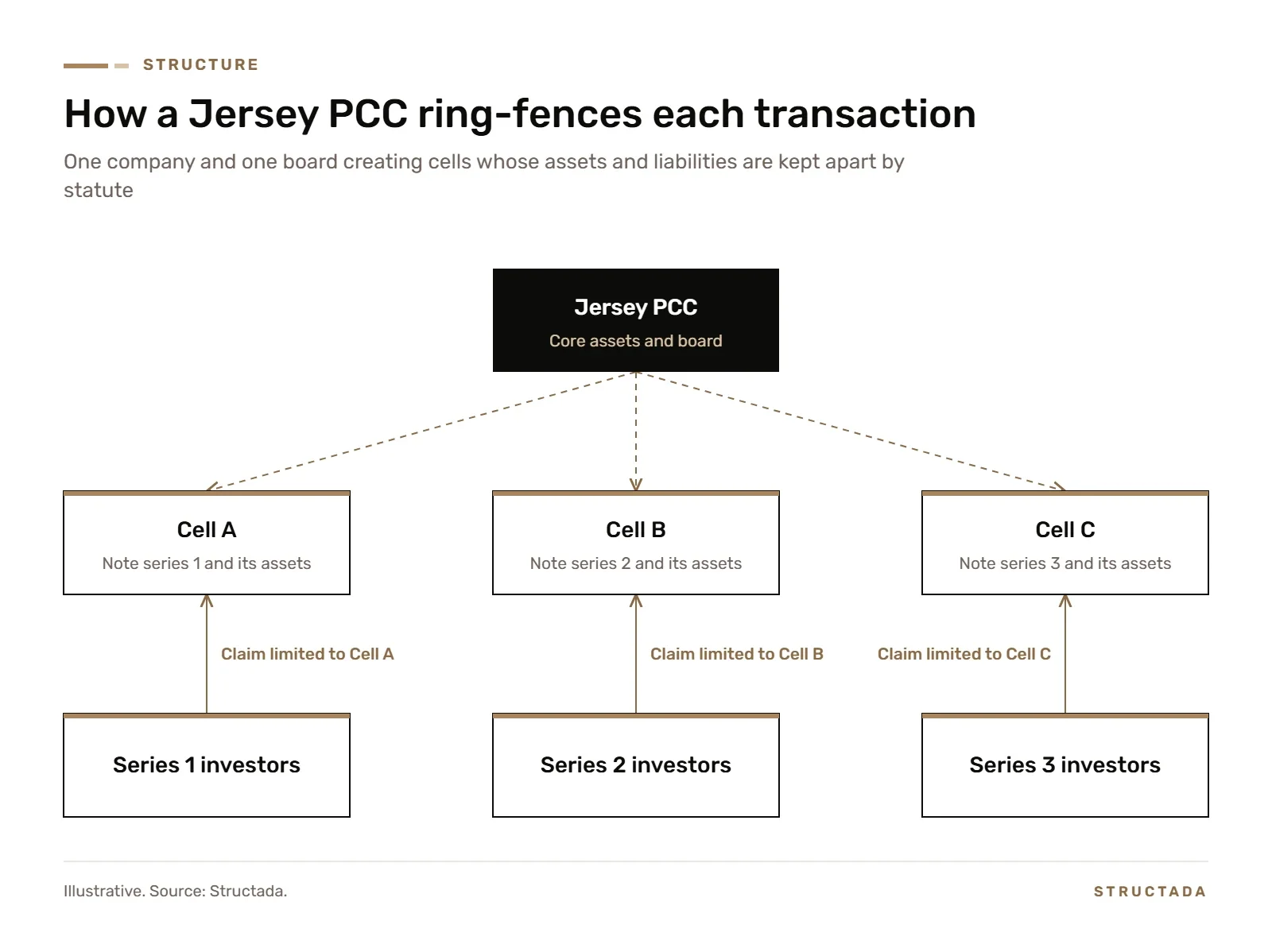
The mechanics are straightforward once the principle is understood. The PCC creates a cell for each transaction, fund or portfolio, and every asset and liability it acquires is attributed either to a specific cell or to the core. When it enters a contract, it does so for a named cell, and its directors must ensure that the counterparty knows, or ought reasonably to know, which cell it is dealing with.
The statutory ring-fence then does the work. Unless the company's constitution provides otherwise, a creditor of a cell can claim only against that cell's assets, and a creditor of the core only against core assets, as Mourant explains. If one cell fails, it can be wound up on its own, with the process limited to dealing with that cell's assets, while the other cells and the core carry on.
For a note issuer, this produces something close to a compartment: each series is backed by its own pool, and investors in one series take no exposure to the performance of another. Discipline in attribution therefore matters: a liability never properly allocated to a cell risks falling on the core.
Jersey PCC vs ICC
Jersey offers two kinds of cell company, and the difference between them is one of legal personality.
| Protected cell company (PCC) | Incorporated cell company (ICC) | |
|---|---|---|
| Legal status of cells | Not separate legal persons | Each cell is a company in its own right |
| Contracting | The PCC contracts on behalf of a cell | Each cell contracts in its own name |
| Segregation | By statute, within one company | By separate incorporation, reinforced by statute |
| Recognition outside Jersey | Foreign courts may not recognise segregation | Generally viewed as more robust |
| Administration procedures | Not available to PCCs or protected cells | Available to ICCs and incorporated cells |
The central concern with any PCC is recognition. A creditor might sue the company in a jurisdiction with no cell company legislation, where a court could treat the PCC as a single company and disregard the cells. Appleby notes there is no case law testing a Jersey PCC in a foreign court, so the risk remains theoretical but unresolved. ICCs were introduced partly to answer it: because each incorporated cell is a separate company, a foreign court should recognise it as such without needing to understand Jersey's cell regime at all.
Jersey law also allows movement between structures, including conversion from a PCC to an ICC, from a standard company to a cell company and from a cell to a standalone company.
Regulation and administration
Jersey cell companies are expected to sit within the island's regulated infrastructure. As a matter of policy, they are ordinarily required to appoint a business regulated under Jersey law to provide administration or company secretarial services.
Issuing shares, trust interests or debt securities usually requires consent from the Jersey Financial Services Commission under the Control of Borrowing (Jersey) Order 1958, according to Carey Olsen. For an ICC, consents apply cell by cell, which is worth building into the timetable for each new issue.
Tax treatment of Jersey cell companies
Most Jersey companies pay corporate income tax at a standard rate of 0%, with higher rates for certain financial services companies and utilities. Carey Olsen notes that Jersey has no withholding tax, no capital gains tax, no capital duty and no stamp duty except on Jersey real property. A cell company used as an issuer is therefore usually tax-neutral, leaving tax to be paid by investors in their home jurisdictions, which is the outcome most securitisation structures are designed to achieve.
How issuers use Jersey PCCs
The commonest use in structured finance is repeat note issuance, with a cell for each issue so that every series of notes is backed only by its own assets. Jersey vehicles are also used in master trusts, whole business securitisations and synthetic credit linked note structures, with security, limited recourse and non-petition provisions respected under Jersey law. Beyond debt, the same structure supports umbrella funds with a separate investment strategy in each cell, and insurance arrangements such as rent-a-captives, insurance-linked securities and transformer vehicles.
Where bankruptcy remoteness matters, a Jersey company's shares can be held by a trustee on charitable or purpose trust, in the same way as a Cayman orphan SPV. Notes issued by Jersey vehicles are often listed on The International Stock Exchange, which is based in the Channel Islands.
Jersey vs Guernsey cell companies
Guernsey offers the same two structures, which we cover in our guides to the Guernsey PCC and the Guernsey ICC. The concepts are closely aligned: protected cells without separate legal personality, incorporated cells as companies in their own right, statutory ring-fencing and a requirement for local administration. The choice between the islands usually turns on where the issuer's service providers, directors and investors are based, and on cost and familiarity rather than legal substance.
For issuers selling mainly to European investors, a Luxembourg securitisation vehicle offers a similar compartment structure within the EU. Our comparison of Guernsey and Luxembourg sets out the trade-offs.
What this means for issuers
A Jersey PCC lets an issuer run several ring-fenced transactions through one company, with one board and one administrator, in a tax-neutral jurisdiction with an established finance industry. For a programme with steady issuance and assets and counterparties that sit comfortably within jurisdictions familiar with cell structures, it is an efficient and well-understood tool.
Its weakness is recognition outside Jersey, and that should shape the decision from the start. Where assets, swap counterparties or likely creditors sit in jurisdictions with no cell legislation, many issuers prefer an ICC, or a separate vehicle altogether. The right answer depends on where the assets are, who the investors are and how the notes will be held and listed, and those questions are best settled before the first cell is created rather than after.
Frequently Asked Questions
What is a Jersey PCC?
A Jersey company divided into protected cells, each with its own assets and liabilities, ring-fenced by statute from the other cells and from the core.
When were cell companies introduced in Jersey?
On 1 February 2006, under Part 18D of the Companies (Jersey) Law 1991.
Is a cell of a Jersey PCC a separate legal entity?
No. Protected cells are part of the PCC. Cells of an incorporated cell company are separate companies.
What is the difference between a Jersey PCC and an ICC?
In a PCC, the company contracts on behalf of its cells. In an ICC, each cell is a company in its own right, which can make segregation more robust outside Jersey.
Do Jersey cell companies need a regulated administrator?
Ordinarily yes. Jersey policy requires cell companies to appoint a Jersey-regulated business to provide administration or company secretarial services.
How are Jersey PCCs taxed?
Most Jersey companies pay corporate income tax at 0%, and Jersey has no withholding tax, capital gains tax or capital duty.