- TISE, The International Stock Exchange, is a Channel Islands exchange launched in 1998 that has become one of Europe's leading venues for debt sold to professional investors.
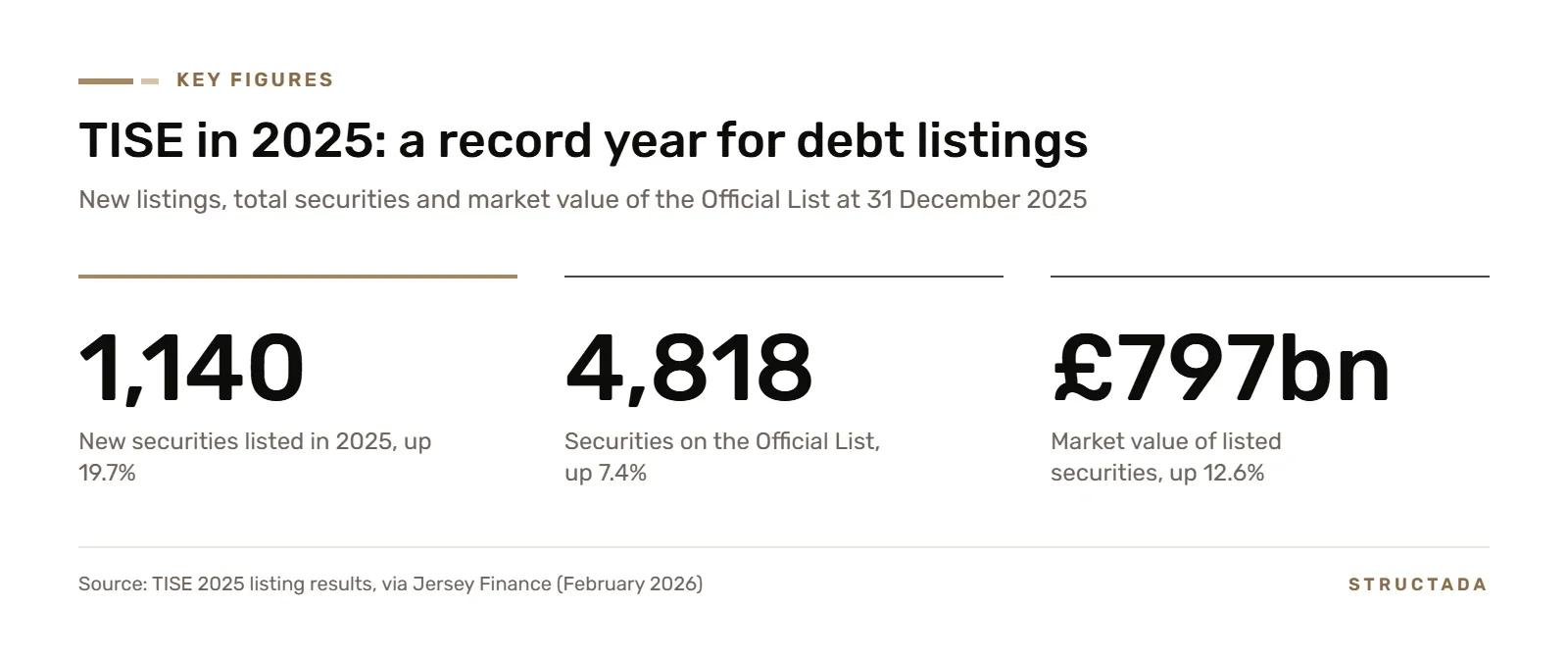
- Its Official List reached a record 4,818 securities with a market value of £797 billion at the end of 2025, after a record 1,140 new listings during the year.
- Most debt is listed on the Qualified Investor Bond Market (QIBM), which is open only to institutional, professional and other experienced investors and is not bound by EU listing directives.
- TISE is a recognised stock exchange for UK tax purposes, so listed notes can qualify for the quoted Eurobond exemption from UK withholding tax.
- Review is fast and predictable: first comments within three business days and later rounds within one, with listing fees measured in thousands of pounds rather than tens of thousands.
Most private debt is never traded. A private equity sponsor's shareholder loan notes, a lender's securitisation, a high yield bond sold to fifty institutions under Rule 144A: each will very likely be held to maturity by the investors who bought it. Yet a large share of these instruments are listed all the same, and the reason is rarely liquidity. It is tax, investor eligibility and the standing that an official listing lends to a private instrument.
Over the past decade, a growing share of that business has gone to a small exchange in the Channel Islands. The International Stock Exchange, or TISE, now hosts more than 2,000 private equity debt securities, over 600 securitisation bonds and more listed high yield bonds than any other European venue. Understanding why tells you a good deal about how the private debt market works.
What is TISE?
TISE is a stock exchange operating from Guernsey and Jersey. It launched in October 1998 as the Channel Islands Securities Exchange and has since grown from a regional market into an international venue for debt, with issuers from 38 territories listing in 2025. It is licensed and supervised in Guernsey, and its listing rules are set by The International Stock Exchange Authority. Since 2025 it has been owned by Miami International Holdings (MIAX), the US exchange group.
Its position is unusual. TISE sits within Europe but outside both the EU and the UK. That gives it the recognition issuers need from UK and US authorities without the weight of EU prospectus and listing directives, a combination that explains much of its growth.
The scale of the market
The 2025 figures, published by TISE in February 2026 and reported by Jersey Finance, were the strongest in its history. New listings rose 19.7% to a record 1,140, and the Official List grew 7.4% to 4,818 securities with a combined market value of £797 billion. High yield bond listings rose fastest, with 220 new issues, up 74.6%, taking the total to 533. Private equity debt, at 2,135 securities, remains its largest segment, and TISE is also now the largest market for listed UK REITs.
UK issuers accounted for 46.9% of new listings, but EU issuers reached a record 31.1%, a sign that TISE is winning business that once went to Dublin or Luxembourg.
The Qualified Investor Bond Market
Most debt on TISE is listed on its Qualified Investor Bond Market (QIBM). As Mourant explains, securities listed there must be issued exclusively to qualified investors: institutional and professional investors and others experienced in investing in bonds.
That restriction is what makes the market workable for private debt. Because the investors are sophisticated, the disclosure required is proportionate to the transaction rather than designed for retail protection. A listing document is usually the offering memorandum the issuer already uses to market the notes, adapted to the listing rules, rather than a separate prospectus drafted from scratch. For a programme issuer, a base private placement memorandum with final terms for each series fits this model well.
The quoted Eurobond exemption
For many issuers, the decisive reason to list on TISE is UK tax. Interest paid by a company on its debt can be subject to UK withholding tax. The quoted Eurobond exemption removes that requirement where the debt is a security issued by a company, carries a right to interest and is listed on a recognised stock exchange. HMRC treats TISE as a recognised stock exchange for this purpose.
A UK borrower can therefore pay investors gross, sparing them the delay and cost of reclaiming tax under a treaty. That is why so much UK private equity, real estate and securitisation debt is listed on TISE.
TISE's recognitions extend beyond the UK. The US Securities and Exchange Commission treats it as a designated offshore securities market, which is relevant to Rule 144A and Regulation S offerings, and Appleby describes it as Europe's leading venue for high yield bonds, many of them documented under New York law.
How a TISE listing works
An issuer applies through a listing member of the exchange, usually a law firm or corporate services provider, which acts as its agent for the application and for continuing obligations once the notes are listed. The listing document is submitted for review, TISE returns comments, and once they are resolved the securities are admitted to the Official List.
What distinguishes TISE is the certainty of its timetable. Under its "3+1" framework, the exchange provides comments on a first submission within three business days and on each later submission within one. For a transaction with a fixed closing date, that predictability is often worth more than the listing itself.
The listing runs alongside, not instead of, the operational work of making notes investable. The securities still need an ISIN, a paying agent and settlement through the international clearing systems, which our Euroclear-ready checklist sets out.
TISE listing fees
TISE's fees are modest relative to the size of the transactions it lists. According to Mourant, initial application fees on the QIBM range from £6,500 to £8,500 depending on the type of security, with a formal notice fee of £250 and an annual fee of £1,600 per class. Programmes that expect to issue frequently can use a pre-emptive listing facility at £2,500 a year, with a small charge for each adjustment. Listing member and legal fees are additional.
TISE vs other debt listing venues
| TISE | Euronext Dublin (GEM) | Luxembourg Euro MTF | Vienna MTF | |
|---|---|---|---|---|
| Location | Guernsey and Jersey, outside the EU and UK | Ireland, EU | Luxembourg, EU | Austria, EU |
| Typical issuers | Private equity debt, high yield, UK securitisations, UK REITs | Securitisations, CLOs, structured notes, international debt | Eurobonds, Luxembourg vehicles, structured products | Smaller private note issues |
| Review | First comments in three business days, then one | Typically one to three business days | Short, exchange-led review | Short, exchange-led review |
| Natural fit | UK tax and UK-centric investors | EU and international programmes | Luxembourg issuers and EU investors | Cost-sensitive smaller issues |
Each of these venues is used by issuers relying on the quoted Eurobond exemption, and none is right for every transaction. Our guides to Euronext Dublin and the Vienna Stock Exchange cover the main alternatives. Channel Islands vehicles, including a Jersey PCC, tend to list on TISE for reasons of familiarity and shared service providers.
What this means for issuers
The listing venue is one of the last decisions on most note issues and one of the easiest to get wrong. It affects the tax treatment of every interest payment, which investors can hold the notes and how quickly the transaction can close. TISE has earned its place by solving those problems for professional investor debt better than most: recognised where it matters, fast where it counts and priced in proportion to the job.
The issuers who benefit most decide early. The venue, the vehicle, the offering document and the clearing arrangements are interlocking choices, and settling the listing at term sheet stage, rather than in the final week before closing, avoids rework and keeps the timetable intact.
Frequently Asked Questions
What is TISE?
The International Stock Exchange, a Channel Islands exchange launched in 1998 that lists mainly debt securities sold to professional investors, including high yield bonds, securitisations and private equity debt.
What is the TISE Qualified Investor Bond Market?
TISE's market for debt securities issued exclusively to qualified investors, meaning institutional, professional and other experienced bond investors, with disclosure proportionate to that audience.
Is TISE a recognised stock exchange?
Yes. HMRC treats TISE as a recognised stock exchange, so listed notes can qualify for the quoted Eurobond exemption. The US SEC treats it as a designated offshore securities market.
How long does a TISE listing take?
TISE comments on a first submission within three business days and on later submissions within one, so a well-prepared listing can be completed quickly.
How much does it cost to list on TISE?
Initial QIBM application fees range from about £6,500 to £8,500, with an annual fee of £1,600 per class, plus listing member and legal fees.
Who owns TISE?
Miami International Holdings (MIAX), the US exchange group, which acquired it in 2025.