- Euronext Dublin is the former Irish Stock Exchange, acquired by Euronext in 2018, and is now the group's centre for debt and fund listings and one of the world's leading venues for bonds and notes.
- It runs a regulated market, which requires a full EU prospectus, and the Global Exchange Market (GEM), a multilateral trading facility where Euronext Dublin reviews listing particulars under its own rules.
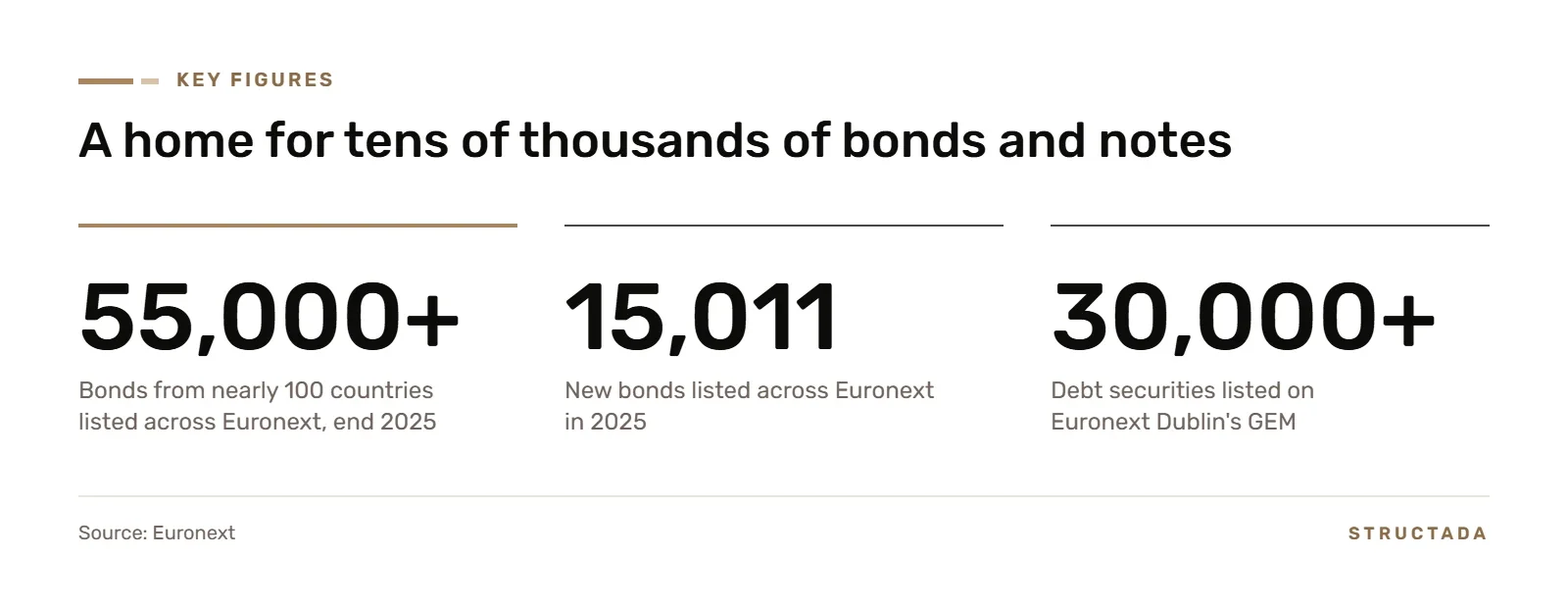
- GEM has over 30,000 debt securities listed, according to Euronext, and is widely used for private placements, securitisations, structured notes and CLOs.
- Review is fast: on GEM, comments on a first submission typically come back within three days, and on later submissions within two.
- Issuers list to meet investor requirements, to qualify for tax exemptions such as the UK's quoted Eurobond exemption and to give notes a recognised public reference, even when the notes rarely trade.
Most notes issued in private placements never trade on an exchange. They are bought by a handful of institutions and held to maturity. Yet a great many of them are listed all the same, because an investor's mandate may require listed securities, because tax rules favour them, or because a listing gives custodians and compliance teams a recognised reference point for an otherwise private instrument.
For debt securities, Euronext Dublin is one of the most popular places to do it. The former Irish Stock Exchange has built a reputation for fast, practical reviews and lists tens of thousands of bonds and notes from issuers around the world, from investment grade programmes to collateralised loan obligations.
Knowing how Dublin's markets differ, and what each asks of an issuer, is the starting point for deciding whether it is the right home for a note issue.
What is Euronext Dublin?
Euronext Dublin traces its history to the Dublin Stock Exchange, founded in 1793. It traded as the Irish Stock Exchange until Euronext acquired it in March 2018, according to Euronext. Within the Euronext group, which also runs exchanges in Amsterdam, Brussels, Lisbon, Milan, Oslo and Paris, Dublin is the centre of excellence for debt and fund listings.
It is authorised by the Central Bank of Ireland to operate four markets: the Euronext Dublin regulated market, Euronext Growth, the Global Exchange Market (GEM) and the Atlantic Securities Market. For debt issuers, only the first and third really matter, and the choice between them shapes the documentation, timetable and ongoing obligations of the whole transaction.
The scale of the group gives a sense of the market Dublin sits within. Across all its venues, Euronext had more than 55,000 bonds from nearly 100 countries listed at the end of 2025, and listed 15,011 new bonds that year, according to Euronext.
Euronext Dublin regulated market vs GEM
The two markets answer different questions. The regulated market is built for issues that may reach retail investors or need to be offered across the EU. GEM is built for debt sold to professional investors, where the protections of the full EU regime add cost without adding much value.
| Euronext Dublin regulated market | Global Exchange Market (GEM) | |
|---|---|---|
| Status | EU regulated market | Multilateral trading facility, exchange-regulated |
| Disclosure document | Full EU prospectus | Listing particulars under Euronext Dublin's GEM rules |
| Approval | Prospectus approved by the Central Bank of Ireland | Reviewed and approved by Euronext Dublin |
| Passporting | Prospectus can be passported across the EU | No EU passport |
| Typical review | Usually two to six business days | Usually one to three business days |
| Ongoing obligations | Full EU regime, including the Transparency Directive | Lighter, set by the GEM rules |
| Typical issuers | Public bond and MTN programmes, retail-facing issues | Private placements, securitisations, structured notes, CLOs |
GEM has over 30,000 debt securities listed, according to Euronext. Its appeal lies in proportion. An issuer selling only to professional investors avoids the cost and formality of a prospectus approved under the EU Prospectus Regulation, yet the notes still carry a listing on a recognised exchange, with the investor eligibility and tax benefits that follow. For a medium-term note programme that will only ever be placed privately, GEM is usually the natural fit.
How a Euronext Dublin listing works
Every issuer other than a public sector body must appoint a listing agent registered with Euronext Dublin, usually a law firm or corporate services provider. The agent submits the documents, handles the exchange's comments and remains the point of contact for continuing obligations once the notes are listed.
The disclosure document is listing particulars for GEM, or a prospectus for the regulated market. In practice it is usually prepared alongside the offering document the issuer already uses to market the notes. A programme issuer working from a base private placement memorandum can often adapt it for listing purposes with relatively little additional drafting, then add final terms for each series.
Review is where Dublin has earned its reputation. On GEM, Euronext Dublin returns comments on a first submission within three days and on later submissions within two, according to its GEM listing guide. Once comments are resolved, final documents are approved and the notes are admitted to the official list and to trading. From then on the issuer files notices, financial information and changes as the rules require.
The listing runs in parallel with the issue itself, and it does none of the operational work of making notes investable. The securities still need an ISIN, a paying agent and settlement through Euroclear and Clearstream, as our Euroclear-ready checklist explains.
Why issuers list in Dublin
The first reason is investor eligibility. Some insurers, pension funds and fund managers can hold only listed securities, or are permitted to hold more of them, and a listing widens the pool of buyers for a private note at little cost.
The second is tax. Euronext Dublin is a recognised stock exchange for UK purposes, so listing there can allow a UK borrower to pay interest without UK withholding tax under the quoted Eurobond exemption. That consideration alone drives a large share of private debt listings across Europe.
The third is practical. Short, predictable review times suit busy issuance programmes, and Dublin regularly handles complex transactions: securitisations, CLOs, structured notes and fund-linked products. Investors, trustees and custodians across Europe and beyond know the exchange and its documents well, which reduces friction at every stage of the life of the notes.
Finally, there is the vehicle. Irish section 110 companies and other Irish issuers often list locally, keeping the transaction within one legal and regulatory system. Our guide to the Irish DAC explains the vehicle most commonly used.
Euronext Dublin vs other debt listing venues
Dublin competes with several exchange-regulated venues for professional investor debt. The Luxembourg Stock Exchange's Euro MTF is the main EU alternative, used heavily for Eurobonds, Luxembourg vehicles and structured products, and is a common choice for a Luxembourg securitisation vehicle. The Vienna MTF tends to attract smaller and private note issues, and our guide to the Vienna Stock Exchange listing covers it in detail.
Outside the EU, The International Stock Exchange in the Channel Islands has become a strong rival for UK and Channel Islands debt and private equity structures, while the Cayman Islands Stock Exchange serves US CLOs and Cayman issuers. The right venue depends on where the issuer and investors are, the type of note, cost and the investors' own listing requirements.
Euronext Dublin listing costs
An issuer should plan for listing agent fees, Euronext Dublin's initial listing fees and any annual fees, which depend on the type of security and programme, and the legal cost of preparing listing particulars or a prospectus. There are also publication costs, such as Euronext's per-document website publication charge, and the continuing cost of filings and notices for as long as the notes are outstanding.
Listing fees are usually modest compared with the total cost of a note issue, but they should sit within the full fee schedule agreed at the outset rather than surface late in the transaction.
What this means for issuers
Euronext Dublin offers a fast, well-regarded home for bonds and notes, and for debt sold to professional investors GEM delivers most of what a listing is for, namely investor eligibility, tax treatment and recognition by custodians, without the weight of a full EU prospectus. Its strength lies in predictability, which matters more than prestige when a closing date is fixed.
The listing decision is best made early. Whether to list, and where, follows from who the investors are and how they are taxed, and it interacts with the choice of vehicle, offering document and clearing arrangements. Settled at term sheet stage, it is a routine step. Left to the final weeks, it becomes a source of rework and delay.
Frequently Asked Questions
What is Euronext Dublin?
The stock exchange in Ireland, formerly the Irish Stock Exchange, acquired by Euronext in 2018 and now the group's centre for debt and fund listings.
What is the Global Exchange Market?
An exchange-regulated multilateral trading facility run by Euronext Dublin, used mainly for listing debt securities sold to professional investors without a full EU prospectus.
Do I need a prospectus to list on GEM?
No. GEM requires listing particulars that meet Euronext Dublin's own rules, rather than a prospectus approved under the EU Prospectus Regulation.
How long does a Euronext Dublin listing take?
On GEM, comments on a first submission typically come within three days, with one to three business days common overall. Regulated market approvals usually take two to six business days.
Do I need a listing agent?
Yes. All issuers except public sector issuers must appoint a listing agent registered with Euronext Dublin.
Why list notes that will not trade?
Some investors can only hold listed securities, a listing can support favourable tax treatment such as the UK quoted Eurobond exemption, and it gives custodians a recognised reference.