- A DAC, or designated activity company, is an Irish private company with a stated objects clause, created under the Companies Act 2014.
- Unlike a standard Irish private company (an LTD), a DAC can list debt securities, which is why it is the usual form for Irish special purpose vehicles that issue notes.
- Most DACs used in structured finance qualify under Section 110 of the Taxes Consolidation Act 1997, which lets the vehicle deduct its funding costs so that it pays little tax beyond a small retained profit.
- A Section 110 company needs at least €10 million of qualifying assets on the day it first acquires them, must be Irish tax resident and must notify Revenue.
- Irish DACs suit large, standalone deals, while Luxembourg vehicles offer statutory compartments that make repeat and smaller issuance easier from a single vehicle.
Read enough term sheets for CLOs, repackagings or aircraft financings and one suffix recurs in the issuer's name: DAC. It signals an Irish designated activity company, and in almost every capital markets context it means something more specific still, a Section 110 vehicle built to hold assets and issue notes.
Ireland's position in structured finance rests on that combination of corporate form and tax regime. The DAC gives the issuer the legal capacity to list debt; Section 110 makes the vehicle tax-neutral, so that the income from the assets reaches noteholders without leakage. Together they have made Dublin one of Europe's principal centres for special purpose vehicles.
The question for an issuer is less whether the Irish DAC works, since it plainly does, and more whether its shape suits the transaction in hand. For a single large deal it is hard to beat. For a programme of smaller issues, the answer is often different.
What is a designated activity company?
Irish law offers several types of private company, and the distinction between the two most common explains why the DAC exists. The company limited by shares, or LTD, is the default private company. It has no objects clause, can do anything a natural person can do and can be run by a single director, but it cannot list its debt securities.
The designated activity company is a private company whose constitution sets out the specific activities it may carry on. It needs at least two directors and a company secretary, and its name must end in "Designated Activity Company" or "DAC". Crucially for issuers, a DAC can offer and list debt securities. That makes it the natural form for any vehicle issuing notes on Euronext Dublin's Global Exchange Market or another venue.
The objects clause also suits the discipline a special purpose vehicle requires. A company whose permitted activities are limited to acquiring, holding and financing a defined pool of assets is easier for investors, rating agencies and trustees to analyse than one that could, in principle, do anything.
What is a Section 110 company?
Section 110 of the Taxes Consolidation Act 1997 is the Irish tax regime for securitisation and similar vehicles. A DAC that meets its conditions is taxed as if it were trading, which means its interest and other funding costs are deductible against its income. In practice the vehicle pays out almost all of its income to noteholders, often through profit participating notes, whose return absorbs whatever the assets earn after expenses. What remains is a small retained profit, taxed at 25 per cent.
The conditions are short and precise. To qualify, the company must:
- Be resident in Ireland for tax purposes
- Hold, manage or acquire qualifying assets
- Hold at least €10 million of them on first acquisition
- Carry on no other activity beyond those assets
- Notify Revenue of its intention to qualify
Qualifying assets are broadly defined and include loans, bonds, receivables, leases, shares, commodities and many other financial instruments, which is why the regime supports such a wide range of transactions. The €10 million threshold is tested only on the day the company first acquires qualifying assets, so it sets a minimum deal size at launch rather than a continuing test.
Since 2016, rules have limited the deductions available on profit participating notes where a vehicle holds Irish property loans or other Irish property-related assets. Vehicles investing outside Irish property are generally unaffected, and for most international structured finance the regime works as it always has.
How an Irish DAC is set up
Most Section 110 DACs are orphan vehicles. Their shares are held by a corporate services provider on charitable trust, so the vehicle sits off the sponsor's balance sheet and is bankruptcy-remote, in the same way as a Cayman orphan SPV. The sponsor brings the assets and the transaction; it does not own the issuer.
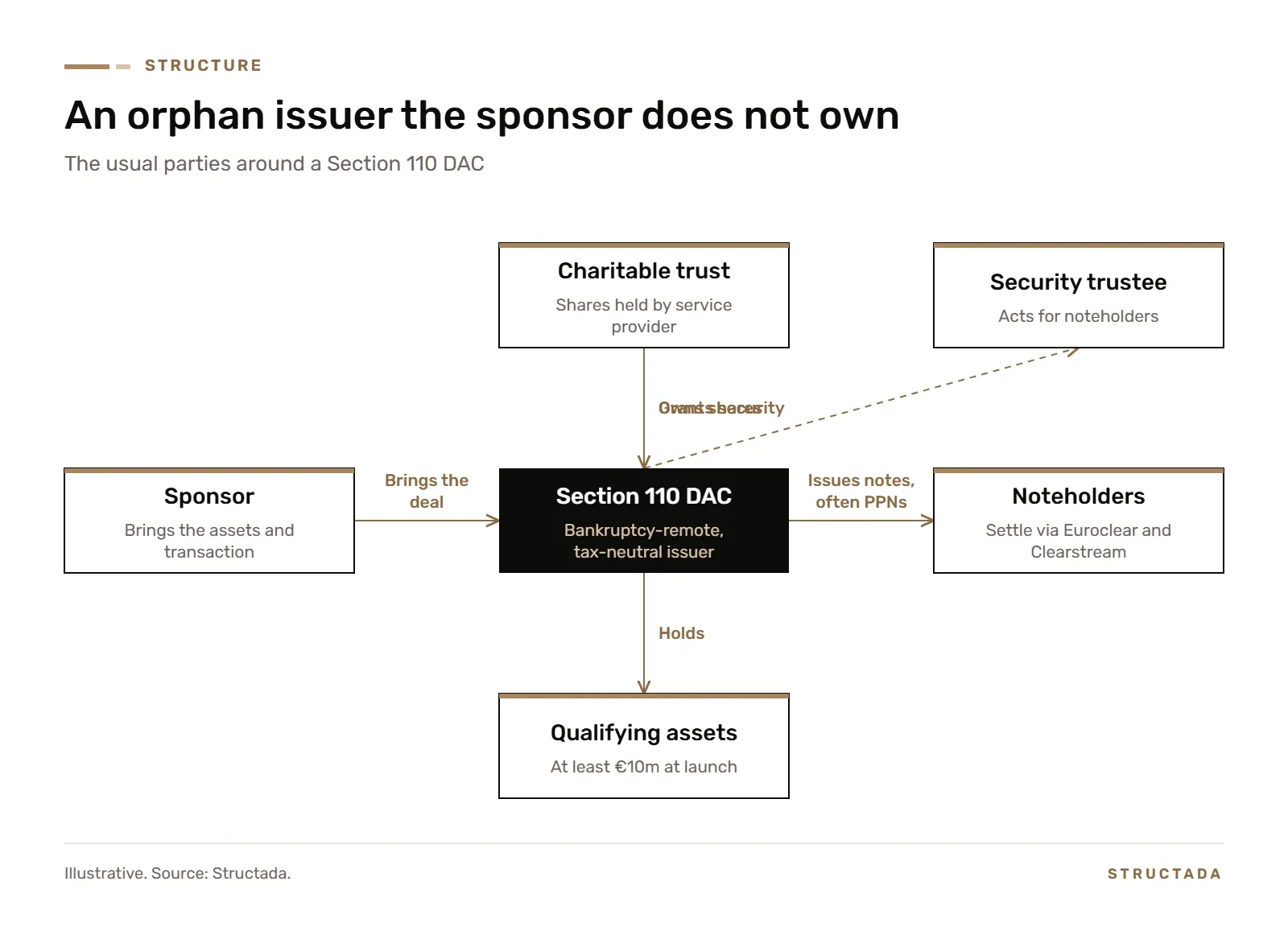
Around that core sits a familiar cast. Independent directors are usually provided by the corporate services provider. A trustee or security trustee holds the security and acts for noteholders. A paying agent handles payments, an arranger structures and places the notes and, where the notes are listed, a listing agent manages the exchange process. The notes themselves settle through Euroclear and Clearstream like any other international debt security.
Where the vehicle's activities meet the definition of a financial vehicle corporation, it must register with the Central Bank of Ireland and file regular statistical reports. That is a reporting obligation, distinct from regulation. A DAC itself does not need authorisation from the Central Bank of Ireland, and it is not a regulated fund.
Irish DAC vs Luxembourg securitisation vehicle
| Irish Section 110 DAC | Luxembourg securitisation vehicle | |
|---|---|---|
| Legal basis | Companies Act 2014 and Section 110 tax regime | 2004 securitisation law, reformed in 2022 |
| Minimum size | €10 million of qualifying assets at first acquisition | No minimum |
| Compartments | No statutory compartments; segregation by contract or one vehicle per deal | Statutory compartments, each legally ring-fenced |
| Tax treatment | Taxed on a small retained profit; funding costs deductible | Commitments to investors are deductible; little or no taxable profit |
| Typical use | Large CLOs, repackagings, aircraft and asset-backed deals | Credit linked notes, private credit and repeat issuance from one vehicle |
| Listing | Euronext Dublin Global Exchange Market and others | Luxembourg Stock Exchange, Vienna MTF and others |
Both regimes are well established, widely understood by investors and settle through Euroclear and Clearstream. Both deliver tax neutrality. The practical difference lies in how each handles more than one deal.
In Luxembourg, a single vehicle can create a new compartment for each transaction, with assets and liabilities separated by statute. In Ireland, issuers either set up a new DAC for each deal or rely on limited recourse and non-petition clauses within a multi-issuance programme. Contractual segregation works well when every creditor signs up to it, but it depends on the drafting and on the discipline of the vehicle, where statutory segregation is supplied by the law itself. Our guides to the Luxembourg securitisation vehicle and to why issuers choose Luxembourg for credit linked notes cover that route in detail.
When an Irish DAC makes sense
The Irish DAC is strongest where the deal is large and standalone, comfortably above the €10 million threshold, and where the costs of forming and running a dedicated vehicle are small relative to its size. It is also the default where investors or arrangers expect an Irish issuer, as is common in the CLO and aircraft markets, and where a departure from market convention would invite questions in diligence. Ireland's double tax treaty network can be decisive for assets whose income would otherwise suffer withholding, and issuers who prefer a Euronext Dublin listing will find the DAC a natural fit.
The calculation changes for an issuer planning several smaller issues over time, funding a loan book in tranches, or wanting to add new deals without forming a new company each time. There, a compartment of a Luxembourg vehicle is usually faster and cheaper, because each new transaction draws on an existing board, administrator and set of documents. Our guide on how to issue a credit linked note sets out that process.
What this means for issuers
The choice between Ireland and Luxembourg rarely turns on a single factor. Deal size, the nature of the assets, investors' expectations, the tax position of the underlying income and the plan for future issuance all bear on it. An Irish DAC is a proven workhorse for large standalone transactions, recognised instantly by the institutions that buy CLOs and asset-backed paper.
Its limitation is the one built into its design: one vehicle, one deal, unless the issuer accepts contractual rather than statutory segregation. Issuers who expect to return to market repeatedly, or whose individual transactions sit near or below the threshold, should weigh that before the first vehicle is formed, because the jurisdiction chosen for the first deal tends to become the jurisdiction for the programme.
Frequently Asked Questions
What does DAC stand for in Ireland?
Designated activity company: a private company whose constitution sets out the specific activities it may carry on.
What is the difference between an Irish LTD and a DAC?
An LTD has no objects clause and can have a single director, but cannot list debt securities. A DAC has an objects clause, needs at least two directors and can list debt securities.
What is a Section 110 company?
An Irish tax-resident company holding at least €10 million of qualifying assets that is taxed under Section 110 of the Taxes Consolidation Act 1997, allowing its funding costs to be deducted.
Is an Irish DAC regulated?
The DAC itself does not need Central Bank of Ireland authorisation and is not a fund, although it may need to register and report as a financial vehicle corporation.
Can an Irish DAC issue credit linked notes?
Yes. Irish Section 110 DACs are widely used to issue credit linked notes and repackaged notes, usually listed on Euronext Dublin and settled through Euroclear and Clearstream.
Should I use an Irish DAC or a Luxembourg securitisation vehicle?
An Irish DAC suits large standalone deals above the €10 million threshold. A Luxembourg vehicle with compartments suits repeat issuance, smaller deals and issuers who want to add transactions to one vehicle over time.