

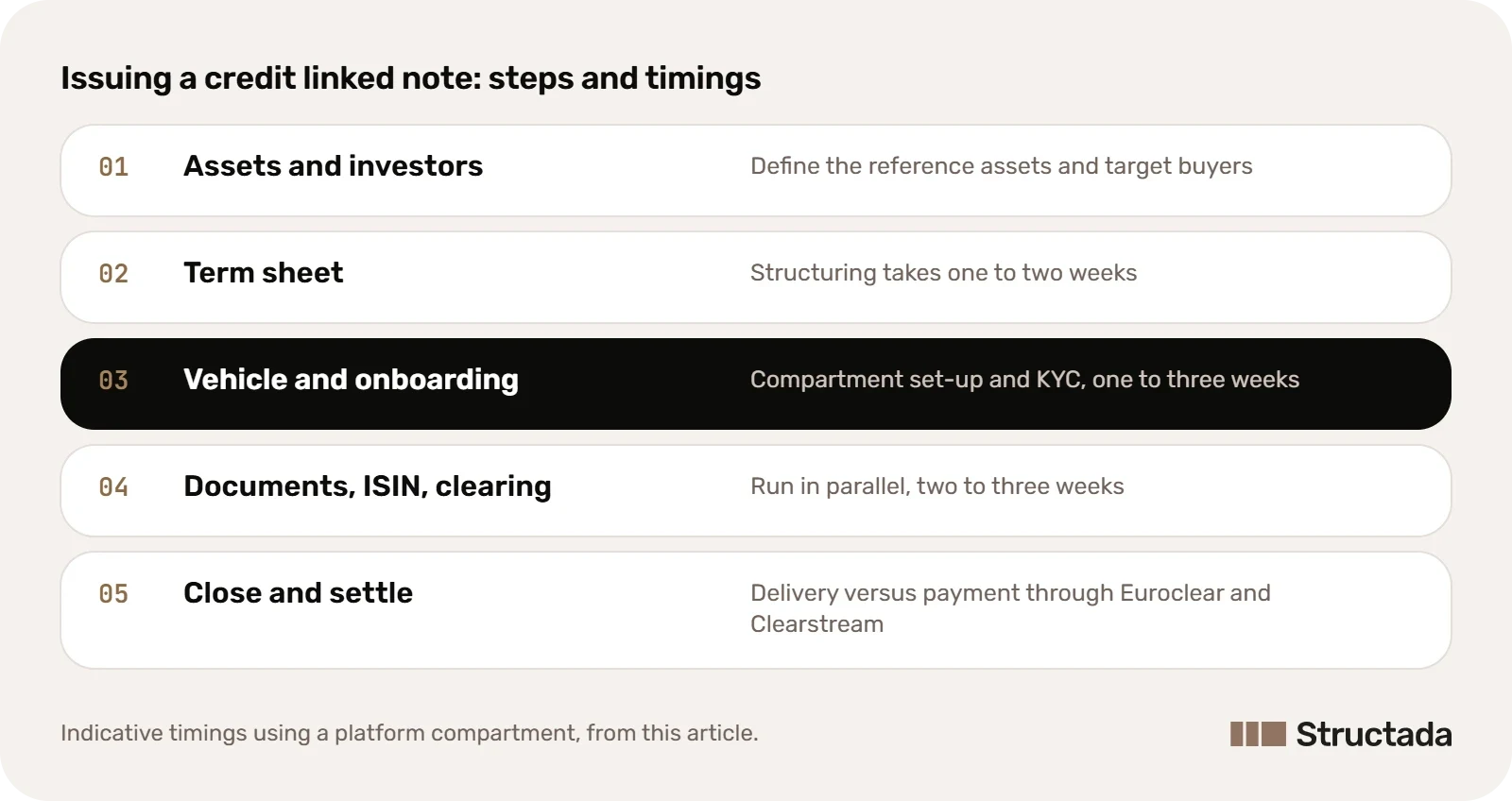
- Issuing a credit linked note follows a set path: define the assets and investors, agree a term sheet, set up the vehicle, document the notes, obtain an ISIN and clearing eligibility, then close and report.
- The biggest timing decision is the vehicle: a compartment on an existing securitisation platform can be ready in weeks, while a new standalone vehicle takes months.
- The core documents are the note terms and conditions, the compartment resolution, the asset purchase or loan agreement, the servicing agreement, the agency agreement and, where needed, an offering memorandum.
- A paying agent obtains the ISIN, sets the notes up with Euroclear and Clearstream and makes payments to investors.
- After closing, the issuer's work continues: servicing the assets, reporting to investors and making payments on every interest date.
A credit linked note lets a lender, credit manager or asset owner turn a loan, a loan book or a lending strategy into a security that professional investors can buy and hold through their existing custodians. The concept is simple enough to explain in a sentence. The execution involves a vehicle, several service providers, interlocking documents and the clearing systems, all of which must be ready on the same day.
Issuers who understand how to issue a credit linked note before they start tend to close faster and with fewer surprises. Most delays come from decisions left too late: an investor requirement discovered after the documents are drafted, an onboarding file that takes weeks to assemble, or a vehicle chosen without regard to the timetable.
This guide follows the issue from first term sheet to first coupon, and explains where the time goes and why. For the basics of the instrument itself, start with our overview of credit linked notes.
Defining the assets and the investors
Every credit linked note starts with two questions: what will the note be linked to, and who will buy it? The answers shape almost everything that follows.
The reference assets might be a single loan, a portfolio of loans, a lender's whole book, a property loan or a pool of receivables. Before any structuring begins, the issuer should be able to describe their size, tenor, yield, security and expected losses with some precision, because investors and their advisers will ask, and because the note terms must reflect how the assets actually perform.
The investors matter just as much. A note intended for private banks and wealth managers will need an ISIN, settlement through Euroclear and Clearstream and, often, a listing, because many of those buyers can only hold securities that meet those tests. A note placed with a single family office may need none of that. Ticket sizes, currency, reporting and settlement route all feed into the design.
Agreeing the term sheet
The term sheet turns the commercial arrangement into note terms. It sets the issue size, currency, denomination and minimum investment; the coupon, payment dates and the basis on which interest is calculated; and the maturity, together with any early redemption or extension options.
Its most important provisions describe the link to the reference assets: how payments on the notes follow payments on the underlying loans, and what happens to investors on a default or loss. Where the originator keeps a first-loss position or a retention, or where the notes are tranched, the term sheet records how losses are allocated. It also names the service providers and sets out the fees, governing law and selling restrictions.
Choosing the issuing vehicle
Most credit linked notes for private credit are issued by a special purpose vehicle, so that investors take exposure to the assets rather than to the originator's balance sheet. The issuer has two routes, and the choice drives the timetable more than any other decision.
| Platform compartment | Standalone vehicle | |
|---|---|---|
| Set-up | New compartment created by board resolution | New company, board, bank account and accounts |
| Service providers | Already appointed | Appointed and onboarded from scratch |
| Time | Weeks | Months |
| Cost | Shared across the platform | Borne by one deal |
A compartment of a Luxembourg securitisation vehicle is a common choice. Each compartment is legally ring-fenced from the others, and the vehicle's administration, audit and agency arrangements are already in place, so a new issue needs a board resolution rather than a new company. A standalone vehicle gives the originator full control of the structure, at the price of a longer set-up and costs that one transaction must carry alone. Our guide to how much Luxembourg securitisation costs sets out the difference in more detail.
Onboarding and know-your-customer checks
Before any service provider can act, the vehicle, its administrator and the paying agent must complete know-your-customer checks on the originator, its owners and the assets. On a first transaction this is often the longest step, and the one issuers most often underestimate.
The remedy is preparation. Corporate documents, ownership and control information, financial statements and asset data should be gathered at the term sheet stage rather than requested piecemeal later. On repeat issues, onboarding becomes largely a refresh of information already held.
Documenting the notes
The documentation on a credit linked note is substantial, but on an established platform much of it follows standard forms. The main documents on a typical transaction are:
- the terms and conditions of the notes, setting out payments, events of default and investor rights;
- the compartment resolution creating the compartment and approving the issue;
- the asset purchase, participation or loan agreement linking the compartment to the reference assets;
- the servicing agreement, where the originator continues to manage the loans;
- the agency agreement appointing the paying agent and any calculation agent;
- an offering memorandum or information document, where distribution or listing requires one.
The asset agreement deserves particular care, because it is the document that makes the credit link real. If it does not transfer, or give the compartment a clear claim to, the economics of the reference assets, the note terms are promising something the vehicle cannot deliver.
ISIN, clearing and listing
Once the documents are settled, the issuing and paying agent applies for an ISIN and common code and makes the notes eligible for settlement in Euroclear and Clearstream. Notes sold to US investors may also need a CUSIP. This is the step that allows investors to buy and hold the notes through the custodians they already use, and for most wealth and institutional buyers it is indispensable.
Some investors can hold only listed securities. Where that applies, the notes are admitted to a venue such as the Vienna MTF or the Luxembourg Stock Exchange. Listing usually runs in parallel with the final documentation and adds little time if planned from the start.
Closing, settlement and servicing
Investors subscribe, and on the closing date the notes settle delivery versus payment through the clearing systems. The compartment receives the subscription cash and uses it to buy or fund the reference assets. Our article on how credit linked notes reach investors covers distribution in more detail.
After closing, the work becomes routine but no less important. The originator services the loans, the compartment collects payments, and the paying agent pays investors on each interest date. Investors expect regular reporting on the assets, payments and any losses, and the vehicle produces audited accounts each year.
How long it takes to issue a credit linked note
Timing depends chiefly on the vehicle. On an existing platform, term sheet and structuring typically take one to two weeks, vehicle set-up and onboarding one to three weeks, and documents, ISIN and clearing two to three weeks running in parallel, with any listing completed alongside in one to two weeks. A new standalone vehicle stretches each stage: two to four weeks for structuring, two to four months for set-up and onboarding, four to eight weeks for documents and clearing, and two to four weeks for a listing.
These figures are indicative, and our guide to how long a Luxembourg securitisation takes gives the detail.
What this means for issuers
Most delays in a credit linked note issue come from three places: unclear assets or investor requirements at the outset, slow onboarding, and documents drafted from first principles. An issuer that arrives with a clear term sheet, clean asset data and its corporate documents in order, and uses an existing platform, can move from first conversation to closing in weeks.
The vehicle, the investor base, the clearing route and the listing are linked decisions, and they are best taken together at term sheet stage. For a wider view of the options, see our guide to alternatives to setting up a fund.