

- A Luxembourg securitisation company structured as a Sàrl needs only €12,000 in share capital, and vehicles issuing privately to professional investors fall outside direct CSSF supervision.
- Compartmentalisation lets one vehicle run several strategies or tranches without incorporating a new entity for each, which removes much of the duplicated legal and administrative cost.
- Standardised documentation and recognised KYC and AML standards cut both legal fees and investor onboarding time on syndicated deals.
- Luxembourg levies no withholding tax on interest paid to investors, securitisation funds are exempt from Luxembourg tax, and a treaty network of close to ninety countries protects net yield.
- A mature market of administrators, auditors and legal advisers lets issuers outsource at a lower cost than in London or New York.
The cost of a securitisation is rarely decided by the headline fee quote. It is decided by the structure: how much capital the vehicle must hold, whether it falls under regulatory supervision, how much legal work is duplicated each time a new investor or tranche is added, and how much tax leaks out between the assets and the noteholders. Those costs compound over the life of a transaction, and they rise sharply once a deal is syndicated.
Bringing several investors into a single structure tends to multiply legal work, documentation and onboarding effort unless the jurisdiction is built to absorb that complexity cheaply. Luxembourg securitisation has become the default choice for cost-conscious issuers largely because its legal framework, tax treatment and service provider market were designed with exactly this problem in mind.
Why cost matters in securitisation
Structuring a securitisation vehicle is a balance between investor protection and transaction efficiency. Capital requirements, regulatory supervision, investor due diligence and ongoing administration all reduce the return an issuer can deliver to noteholders. On a smaller transaction, fixed costs can consume a meaningful share of the spread before the first coupon is paid.
For an asset manager or corporate issuer placing notes with several investors at once, containing those costs without weakening credibility is where a jurisdiction's design either helps or hinders. Luxembourg's advantage is that it combines legal robustness with economic efficiency rather than trading one for the other. Its securitisation law gives investors statutory protection while keeping the vehicle itself light.
Setup costs and capital requirements
A Luxembourg securitisation company structured as a société à responsabilité limitée, or Sàrl, requires only €12,000 in share capital, a fraction of what comparable structures need in London, Dublin or New York. That makes Luxembourg a realistic option even for smaller and mid-sized transactions that would struggle to justify the setup cost elsewhere.
Supervision is the second lever. When securities are issued privately to professional investors rather than to the public, the vehicle falls outside the direct supervision of the CSSF, Luxembourg's financial regulator. That avoids regulatory fees and the ongoing compliance burden of authorisation, without leaving investors any less protected under the underlying law.
How compartments reduce cost
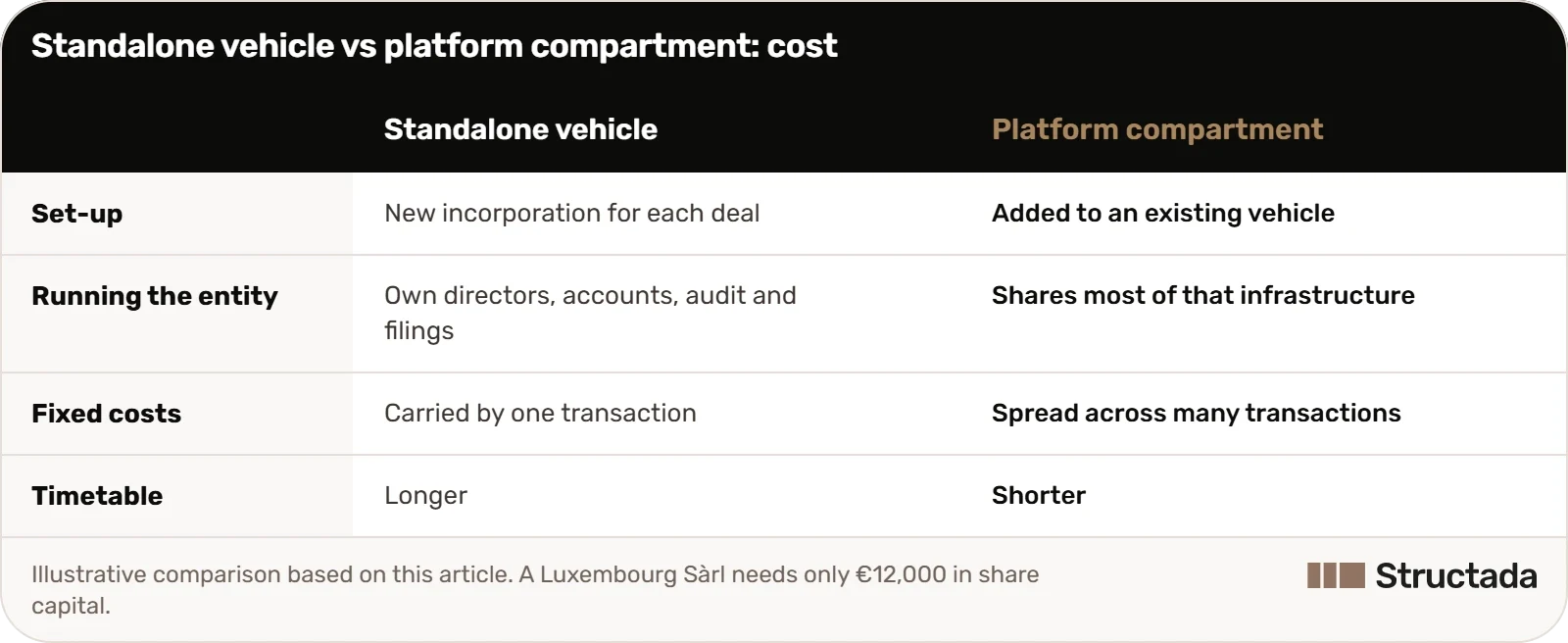
The most important cost feature of the Luxembourg regime is compartmentalisation. A single vehicle can be divided into multiple ring-fenced compartments, each with its own assets, liabilities and investors. An issuer can run several strategies, or syndicate different tranches, from one legal entity rather than incorporating a new company each time.
The saving is substantial. Every new standalone vehicle brings its own incorporation, directors, accounts, audit and filings. A new compartment on an existing vehicle shares most of that infrastructure, so the fixed costs are spread across many transactions. For an issuer that expects to come back to market, a compartment of an established platform is usually the most efficient starting point, and it also shortens the timetable, as our guide to how long a Luxembourg securitisation takes explains.
The cost of syndication
Syndicated deals, where several investors participate in one structure, usually drive up cost through complex negotiation, tailored legal arrangements for each participant and documentation that has to be rebuilt for every new investor. Luxembourg's framework addresses each of these.
A single vehicle with multiple compartments can issue notes in different currencies, maturities or risk profiles under one legal umbrella, so a senior secured tranche and a higher-yielding junior tranche can sit side by side without separate entities. The market is mature enough that most transactions draw on tested documentation rather than drafting from scratch, which keeps legal fees down and speeds execution. Luxembourg's well-established and widely recognised KYC and AML standards also simplify investor onboarding, a real saving when several counterparties must be brought in at once. Our guide to syndicated securitisation in Luxembourg covers the mechanics in more depth.
Tax neutrality and investor returns
Tax is often the hidden cost in a cross-border transaction, and Luxembourg's treatment is designed to keep the vehicle out of the way. A securitisation company can deduct payments made to investors, which leaves minimal taxable profit inside the vehicle. Luxembourg does not levy withholding tax on interest paid to investors, unlike many comparable jurisdictions. A securitisation fund, structured as a fonds de titrisation, is exempt from Luxembourg tax entirely, with tax falling on investors in their home jurisdictions.
The double tax treaty network, covering close to ninety countries, then reduces cross-border leakage and protects net yield for international investors. Taken together, this allows an issuer placing €50 million of notes through a Luxembourg vehicle to syndicate them to investors across the EU, the Middle East and Asia with minimal withholding and real treaty protection, something that would cost more in a jurisdiction without the same tax-neutral design.
Ongoing costs and outsourcing
Once a vehicle is live, the running costs are corporate services and directors, administration, audit, paying agency and any listing. Luxembourg's cost advantage here comes from the depth of its service provider market: administrators, auditors, custodians and legal advisers who already know securitisation structures well.
Outsourcing to this market lets an issuer avoid building in-house infrastructure while still meeting the compliance and reporting standards investors expect. Because the market is so mature, those services tend to cost less in Luxembourg than their equivalents in London or New York. The listing venue matters too: an efficient exchange such as the Vienna MTF keeps listing fees proportionate to the size of the issue. Issuers should also watch for the costs that rarely appear on a term sheet, which our guide to the hidden costs of CLN issuance sets out.
What this means for issuers
The cost of a Luxembourg securitisation is shaped far more by structural choices than by negotiation over individual fees. Low capital requirements, freedom from direct supervision for private placements, compartments that avoid duplicated work and a tax regime that stays out of the way of investor returns together make the jurisdiction hard to beat for professional investor transactions.
The issuers who capture those savings decide the structure first. Whether to use a standalone vehicle or a compartment of an existing platform, whether to list and where, and how the notes will settle are decisions that fix most of the cost before any fee letter is signed. Settled early, they leave the transaction with a cost base that stays proportionate for its whole life.