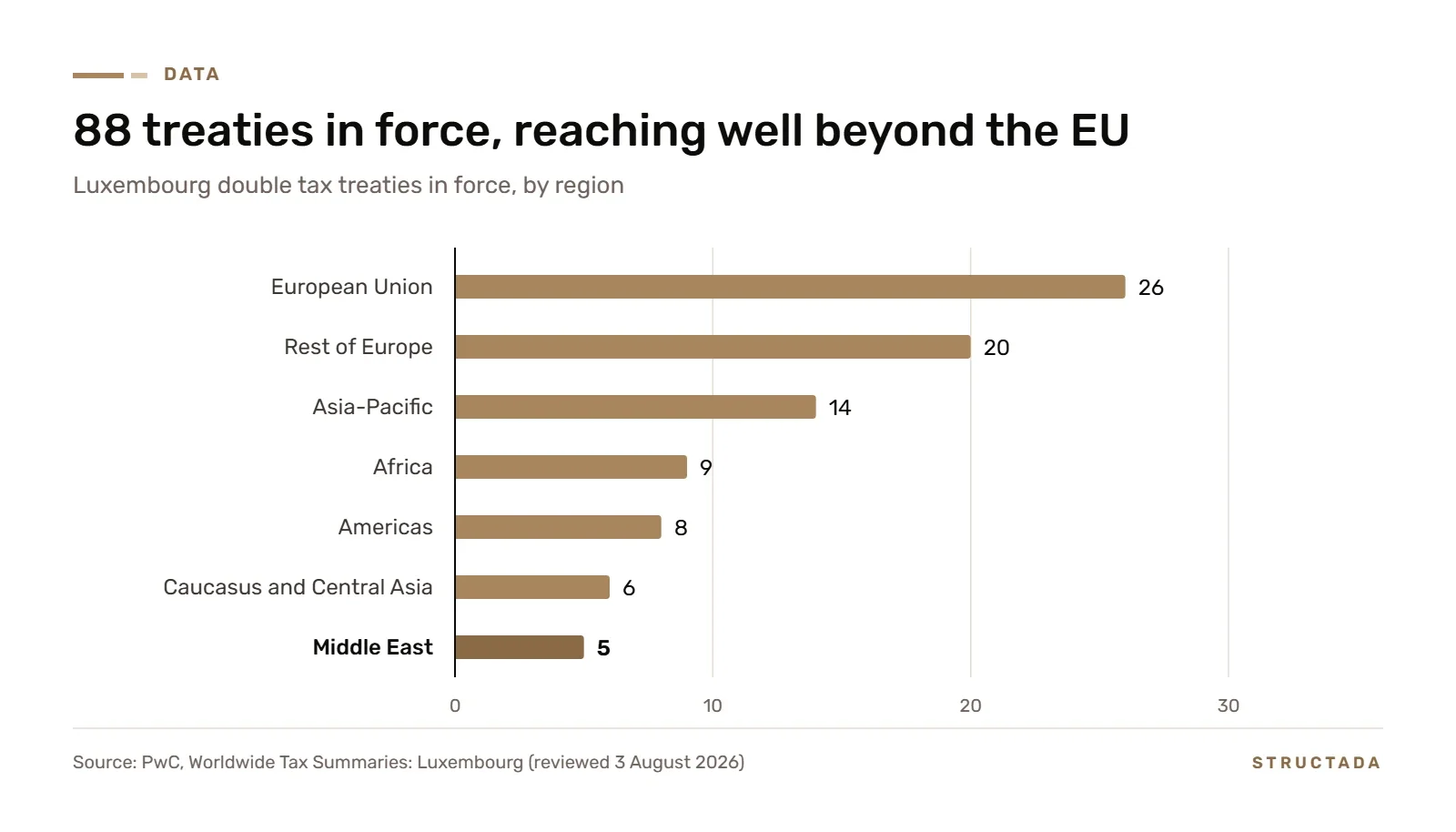
- Luxembourg has 88 comprehensive double tax treaties in force, and six more signed but not yet in force, according to PwC's review of August 2026.
- The network covers every other EU member state, the UK, the US, Switzerland, most of Asia and the Gulf states of the UAE, Saudi Arabia, Qatar and Bahrain, with Kuwait and Oman signed.
- For a securitisation vehicle, treaties matter mainly on the way in: they can reduce withholding tax charged by other countries on interest, dividends and other income paid to the vehicle from its underlying assets.
- A corporate Luxembourg securitisation vehicle is a Luxembourg tax resident and can generally obtain a tax residence certificate to claim treaty benefits. Partnership and fund forms generally cannot.
- Treaty access is never automatic. Each claim depends on the specific treaty, the source country's view of the vehicle, beneficial ownership and anti-abuse rules such as the principal purpose test introduced by the OECD multilateral instrument.
When income crosses a border, two countries may want to tax it: the country where the income arises and the country where the recipient is based. Double tax treaties exist to divide those rights and prevent the same income from being taxed twice.
For a securitisation vehicle holding loans, bonds or receivables from several countries, treaties can decide whether a deal works at all. A 10% or 15% withholding tax on interest from an underlying asset can consume much of the spread a transaction relies on. A treaty that reduces that rate to zero restores it.
Luxembourg's double tax treaties are one of the main reasons issuers choose a Luxembourg securitisation vehicle over offshore alternatives with no treaty network. This guide explains how the treaties work for securitisation and lists every treaty partner.
What is a double tax treaty?
A double tax treaty, also called a double tax agreement (DTA) or double tax convention, is an agreement between two countries that allocates the right to tax each type of income, such as business profits, dividends, interest, royalties and capital gains. It caps the rate of withholding tax the source country may charge on payments to residents of the other country, often reducing it to zero for interest. It also sets residence rules, relief for tax paid at source and procedures for resolving disputes. Most of Luxembourg's treaties follow the OECD model convention.
Why treaties matter for securitisation vehicles
A securitisation vehicle earns income from its assets and pays it out to investors, and tax can arise at either point.
On the way out, Luxembourg's own rules usually do the work. Luxembourg generally levies no withholding tax on interest paid to non-residents, and payments by a securitisation vehicle to its investors, even on equity-like instruments, are generally treated as interest for tax purposes. The outbound leg is therefore usually clean without needing a treaty.
On the way in, treaties carry the load. If a vehicle holds loans to borrowers in another country, that country may charge withholding tax on the interest. Where Luxembourg has a treaty with that country, the rate may be reduced or eliminated, subject to the treaty's conditions. Within the EU, the Interest and Royalties Directive and the Parent-Subsidiary Directive can provide similar relief in some cases, but treaties remain the main tool, particularly outside the EU.
Can a Luxembourg securitisation vehicle claim treaty benefits?
A corporate securitisation vehicle, such as a société anonyme (SA) or société à responsabilité limitée (Sàrl), is fully subject to Luxembourg corporate income tax, even though its payments to investors are deductible. That makes it a Luxembourg tax resident, and it can generally apply to the Luxembourg tax authorities for a tax residence certificate to support treaty claims, as CMS notes. Partnership vehicles, such as an SCSp, are generally tax transparent and do not benefit from treaties, and securitisation funds managed by a management company are in a similar position.
Residence is only the starting point. Some source countries look closely at whether a low-taxed or pass-through vehicle is really entitled to treaty benefits, and many treaties limit reduced rates to the beneficial owner of the income, which can raise questions for a vehicle that passes almost all its income to investors. Luxembourg ratified the OECD multilateral instrument (MLI), in force for Luxembourg from 1 August 2019, which adds a principal purpose test to many treaties and denies benefits where obtaining them was one of the main purposes of an arrangement. Some treaties also contain limitation-on-benefits clauses or specific provisions for collective vehicles.
Substance underpins all of this. A board in Luxembourg, local administration and real decision-making support the vehicle's residence, and each claim should be checked against the specific treaty and the source country's practice.
Luxembourg's double tax treaties in force
The list below reflects PwC's worldwide tax summary for Luxembourg, last reviewed on 3 August 2026, checked against the Luxembourg tax authority's treaty page. Treaty status can change, so always confirm the current position and the applicable text before relying on a treaty.
European Union (26): Austria, Belgium, Bulgaria, Croatia, Cyprus, Czech Republic, Denmark, Estonia, Finland, France, Germany, Greece, Hungary, Ireland, Italy, Latvia, Lithuania, Malta, Netherlands, Poland, Portugal, Romania, Slovak Republic, Slovenia, Spain, Sweden. Rest of Europe (20): Albania, Andorra, Guernsey, Iceland, Isle of Man, Jersey, Kosovo, Liechtenstein, Moldova, Monaco, Montenegro, North Macedonia, Norway, Russia, San Marino, Serbia, Switzerland, Turkey, Ukraine, United Kingdom. Middle East (5): Bahrain, Israel, Qatar, Saudi Arabia, United Arab Emirates. Caucasus and Central Asia (6): Armenia, Azerbaijan, Georgia, Kazakhstan, Tajikistan, Uzbekistan. Asia-Pacific (14): Brunei, China, Hong Kong, India, Indonesia, Japan, Laos, Malaysia, Singapore, South Korea, Sri Lanka, Taiwan, Thailand, Vietnam. Americas (8): Barbados, Brazil, Canada, Mexico, Panama, Trinidad and Tobago, United States, Uruguay. Africa (9): Botswana, Ethiopia, Mauritius, Morocco, Rwanda, Senegal, Seychelles, South Africa, Tunisia. Total in force: 88.
One entry needs a caveat. Russia partially suspended key provisions of its treaties with Luxembourg and 37 other countries from August 2023, including those on dividends, interest and capital gains, as DLA Piper reported. The Luxembourg-US treaty, for its part, includes a limitation-on-benefits article that any US-facing structure must satisfy.
Signed treaties and recent changes
Six further treaties are signed but not yet in force. Argentina's 2019 convention and 2024 protocol are signed but not yet applicable, as are the treaties with Cape Verde (signed January 2022), Colombia (January 2024) and Ghana (December 2021). Kuwait's treaty was signed in 2007 and amended in 2021 but is not yet applicable, and the treaty with Oman is signed but not yet in force. Treaties are also under negotiation with several countries, including Chile, Egypt and Kyrgyzstan.
The network continues to move. Albania's new treaty applies from 1 January 2026, and Ethiopia's from 1 January 2024. An amending protocol with Germany, signed in July 2023, also applies from 1 January 2024, while a protocol with Georgia signed in July 2025 has been published but is not yet applicable. France and the UK have both concluded new treaties with Luxembourg in recent years, with updated rules on cross-border payments, so older analysis of those relationships may be out of date.
Treaties and Gulf assets
For issuers funding Gulf assets through Luxembourg, the network is a practical advantage. Luxembourg has treaties in force with the UAE, Saudi Arabia, Qatar and Bahrain, and signed treaties with Kuwait and Oman. The UAE currently applies a 0% withholding tax rate, so the treaty matters less for UAE interest than for residence and certainty, but treaties can reduce withholding tax on income from other Gulf countries. Our guide to securitising UAE and GCC assets via Luxembourg SPVs covers the wider issues.
How Luxembourg compares
| Luxembourg | Cayman Islands | Guernsey | |
|---|---|---|---|
| Treaties in force | 88 | None | Limited network |
| Vehicle tax | Taxable, but payments to investors deductible | No tax | 0% for most companies |
| Can claim treaty relief on asset income | Generally yes, for corporate vehicles | No | Rarely relevant |
A Cayman or Guernsey vehicle relies on the assets being free of withholding tax, or on investors accepting the leakage. A Luxembourg vehicle can often reduce that cost through treaties. Our comparisons of Luxembourg vs Cayman Islands securitisation and Guernsey vs Luxembourg securitisation explain when that matters most.
What this means for issuers
Luxembourg's treaty network is one of the main reasons it dominates European securitisation, and one of the strongest arguments for issuing credit linked notes in Luxembourg. For issuers whose assets generate income abroad, a corporate vehicle can reduce withholding tax that would otherwise come straight out of investors' returns.
The benefit is real but conditional. It depends on the specific treaty, the source country's attitude to securitisation vehicles and the anti-abuse rules now layered over most treaties, and it rests on genuine substance in Luxembourg. Treaty analysis belongs at the start of structuring, asset by asset and country by country. This article is a general overview and not tax advice; treaty status, rates and conditions should be confirmed with tax advisers for each transaction.
Frequently Asked Questions
How many double tax treaties does Luxembourg have?
Luxembourg has 88 comprehensive double tax treaties in force, and six more signed but not yet in force, as of August 2026.
Does Luxembourg have a tax treaty with the UAE?
Yes. Luxembourg has a double tax treaty in force with the United Arab Emirates, as well as with Saudi Arabia, Qatar and Bahrain.
Can a Luxembourg securitisation vehicle use tax treaties?
A corporate securitisation vehicle is a Luxembourg tax resident and can generally claim treaty benefits, subject to each treaty's conditions and anti-abuse rules. Partnership vehicles generally cannot.
Does Luxembourg charge withholding tax on interest?
Generally not on interest paid to non-residents, and payments by securitisation vehicles to investors are generally treated as interest.
What is the principal purpose test?
An anti-abuse rule, added to many treaties by the OECD multilateral instrument, that denies treaty benefits where obtaining them was one of the main purposes of an arrangement.
Does Luxembourg have a treaty with the US?
Yes. The Luxembourg-US treaty is in force, and includes a limitation-on-benefits article.