- UAE and GCC lenders increasingly fund their books through offshore securitisation vehicles, and Luxembourg is a natural choice where investors are European or the notes need to be cleared through Euroclear and Clearstream.
- The key legal questions sit onshore: whether the receivables can be transferred, whether the transfer survives the originator's insolvency, and who is licensed to service the loans.
- The UAE's new Civil Transactions Law, in force from 1 June 2026, codifies the assignment of rights: debtor consent is not needed, but the assignment takes effect against the debtor and third parties only once the debtor is notified or accepts it.
- Tax is generally favourable, with no UAE withholding tax on cross-border interest, but corporate tax at 9%, VAT and transfer pricing must be built into the structure.
- Data protection, Sharia requirements and local licensing rules all need to be resolved before the first loan moves to the vehicle.
The Gulf has produced a growing class of specialist lenders: fintech platforms, SME financiers, buy-now-pay-later providers and real estate lenders. Many have outgrown their equity and bank lines and are looking for longer-term funding from capital markets investors. Few want, or can easily build, an onshore securitisation programme, and securitising UAE and GCC assets through Luxembourg has become one of the routes they consider.
Most UAE-originated deals have so far used Cayman Islands or DIFC and ADGM vehicles, according to the Chambers 2026 securitisation guide. Where the investors are European, or the notes must sit comfortably in private bank custody, a Luxembourg compartment offers a recognised EU securitisation law and settlement through Euroclear and Clearstream.
The Luxembourg side of such a deal is well understood. The difficult work lies in making the Gulf side hold up: proving the assets have moved, that they stay moved if the originator fails, and that they are serviced lawfully afterwards.
How the structure works
The originator in the UAE or another GCC country makes the loans or generates the receivables. Those assets are transferred to a Luxembourg securitisation compartment by sale or assignment, or financed through a loan or credit linked note structure. The compartment issues notes to professional investors, with an ISIN and settlement through the international clearing systems. The originator usually stays on as servicer, collecting payments and reporting on the portfolio, and collections flow to accounts held for the compartment before being paid out under an agreed waterfall.
Two bodies of law therefore meet in every transaction. Luxembourg law governs the securitisation vehicle and the notes. UAE or other local law governs whether the assets have actually moved, and that is where investors and their counsel will focus.
Transferring UAE receivables to a Luxembourg vehicle
Investors need comfort that the vehicle owns the assets, or has an effective security interest over them, and that the originator's creditors cannot reach them.
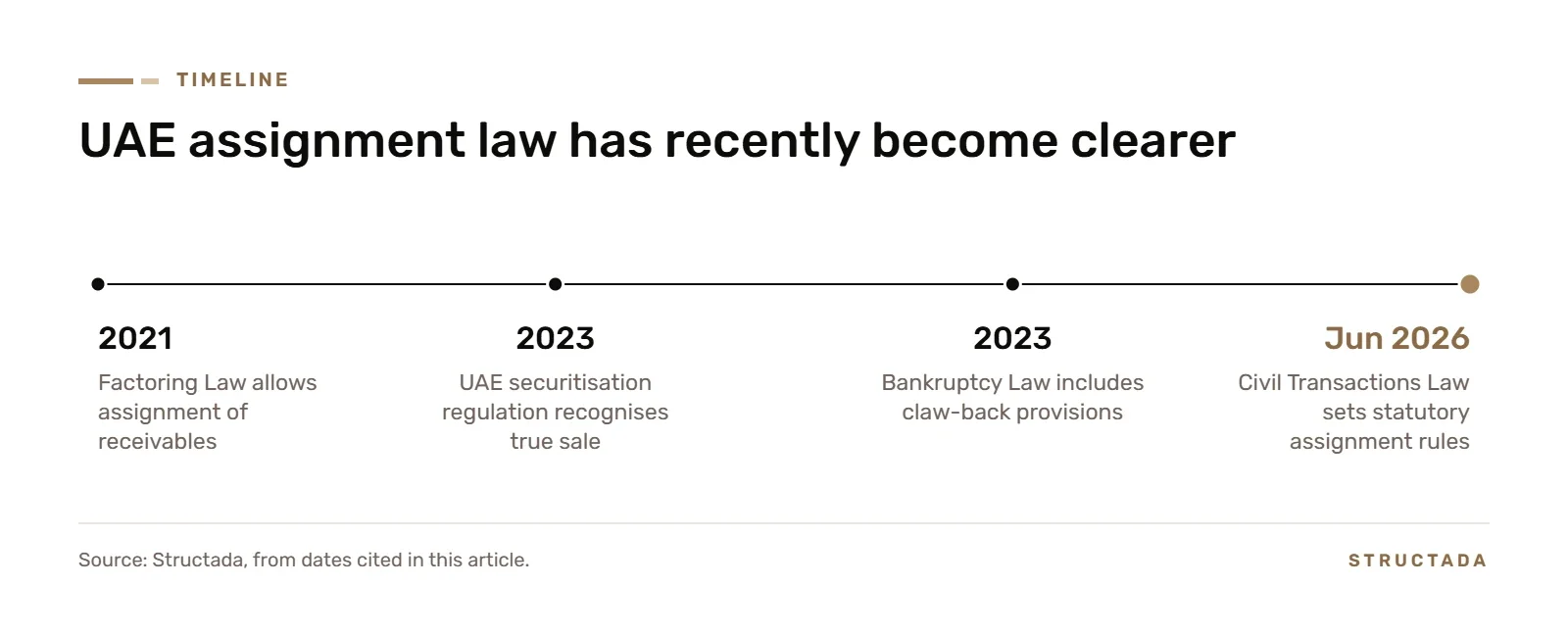
Onshore in the UAE, the position has recently become clearer. The new Civil Transactions Law, Federal Decree-Law No. 25 of 2025, came into force on 1 June 2026 and for the first time sets out statutory rules on assignment. As Afridi & Angell summarises, a creditor can assign a right without the debtor's consent, unless the law, the contract or the nature of the obligation prevents it. The assignment takes effect against the debtor and third parties once the debtor is notified or accepts it, and priority between competing assignees depends on when that happens.
The Factoring Law, Federal Decree-Law No. 16 of 2021, allows the assignment of present and future receivables. Best practice is to register in the Emirates Movable Collateral Registry, operated by the EIRC, for priority, and to notify debtors, which can be heavy work for large or revolving portfolios. Our guide to perfecting security in the UAE covers the registration steps.
The UAE securities regulator's securitisation regulation of 2023 recognises true sale and bankruptcy remoteness, but it covers a narrow set of deals, such as those involving listed companies or notes listed in the UAE, and most private deals fall outside it. Originators in the DIFC and ADGM operate under common law-based regimes, which offer more predictable rules on assignment, trusts and insolvency.
Elsewhere in the GCC, each country has its own rules. Saudi Arabia, for example, has a dedicated regime for special purpose entities, and its Capital Market Authority consulted in 2026 on allowing public offers of asset-backed securities, according to White & Case. Local counsel is needed in every jurisdiction where the debtors or the originator sit.
Insolvency and claw-back risk
A transfer that looks clean on day one can still be challenged if the originator later fails. The UAE Bankruptcy Law of 2023 includes claw-back provisions for certain transactions entered into before insolvency, so structures should rely on fair value, clear documentation and, where possible, true sale opinions. Contractual subordination has been upheld by the Dubai Court of Cassation, but how a multi-tranche waterfall would be treated in a UAE insolvency remains untested. Investors will price that uncertainty, and the documentation should be drafted with it in mind.
Licensing and servicing in the UAE
In the UAE, lending and servicing retail loans are regulated activities. Only licensed institutions may service retail portfolios, which determines who can act as servicer and back-up servicer. Foreign vehicles generally cannot carry on lending, leasing or consumer finance in the UAE without a licence. Whether a Luxembourg compartment can hold acquired loans depends on the assets and how the deal is structured, so this needs local advice, and collection and enforcement should stay with licensed parties. Similar questions arise in other GCC countries.
Tax treatment
The tax position is generally favourable. The UAE currently applies a 0% withholding tax rate, so interest paid from the UAE to a Luxembourg vehicle is not reduced at source. On the Luxembourg side, the compartment's payments to investors are generally deductible, so it remains close to tax neutral, and Luxembourg's treaty network can help with assets in other GCC countries that levy withholding tax.
The originator's position needs more care. UAE corporate tax at 9% applies to its profits, including any gain on sale and servicing fees. VAT at 5% may apply to servicing and other fees, although many financial services are exempt. Where the originator holds junior notes or earns servicing fees, the terms must be at arm's length for transfer pricing purposes.
Data protection and Sharia compliance
Loan-level data has to reach the vehicle, the investors and often a rating agency or data agent. The UAE's federal data protection law restricts transfers of personal data outside the country, and the DIFC and ADGM have their own data protection regimes. Banking secrecy rules may also apply. Common solutions include anonymised or pseudonymised data, borrower consent in loan documents and data processing agreements with each party.
Where the originator's assets are Sharia-compliant, the sale of debt at a discount raises difficulties under Islamic finance principles, and the UAE's Higher Sharia Authority has tightened its approach. Structures may need to use asset-based contracts, such as ijara or murabaha, or a sukuk format, and to obtain a Sharia board's approval. A Luxembourg vehicle can issue Sharia-compliant certificates, but the structure has to be designed for it from the start.
Preparing a UAE securitisation
The notes are usually offered only to professional investors. If any are sold in the UAE, the onshore, DIFC and ADGM investor categories and promotion rules apply, as our guide to professional investors in the UAE explains. Before the first loan moves, the following should be settled:
- Local law analysis of transfer, perfection and insolvency in each originating jurisdiction.
- A debtor notification or acceptance strategy, with registration where needed.
- Licensed servicer and back-up servicer arrangements.
- A tax review on both sides, including transfer pricing.
- A data protection plan for loan-level reporting, and Sharia review where relevant.
- Selling restrictions for every country where the notes will be offered.
What this means for issuers
Funding a Gulf loan book through a Luxembourg compartment gives an originator access to European investors and a recognised EU securitisation framework without the cost and delay of building an onshore programme. The Luxembourg mechanics are settled and familiar to custodians and private banks.
The judgement lies in the Gulf. Investors will ask whether the assets have truly moved, who is licensed to collect them and how tax, data and Sharia questions have been answered, and the transactions that close on time are the ones where those answers exist before the questions are asked. Our article on how securitisation works covers the wider structure.
Frequently Asked Questions
Can UAE assets be securitised through a Luxembourg vehicle?
Yes. A Luxembourg securitisation compartment can acquire or finance UAE receivables, provided the transfer is effective under UAE law and servicing stays with licensed parties.
Is debtor consent needed to assign receivables in the UAE?
Under the new Civil Transactions Law, debtor consent is generally not needed, but the assignment only takes effect against the debtor and third parties once the debtor is notified or accepts it.
Does the UAE charge withholding tax on interest paid abroad?
The UAE currently applies a 0% withholding tax rate on such payments.
Why use Luxembourg rather than a DIFC or Cayman vehicle?
Luxembourg suits deals aimed at European investors, offers a dedicated securitisation law and statutory compartments, and is well known to European custodians and private banks.
Can Islamic finance assets be securitised?
Yes, but the sale of debt raises Sharia issues, so structures often use asset-based contracts or sukuk formats with Sharia board approval.
Who can service UAE retail loans in a securitisation?
Only institutions licensed in the UAE for that activity, which usually means the originator continues as servicer.