- The UAE has three main financial regulators, each with its own investor categories: the Capital Market Authority (CMA, formerly the SCA) onshore, the DFSA in the DIFC and the FSRA in ADGM.
- All three distinguish between retail investors, professional investors (or clients) and the most sophisticated institutional category, called counterparties or market counterparties.
- Individuals typically qualify as professional through a net assets test plus experience or industry employment: AED 4 million onshore, and US$1 million in the DIFC and ADGM, excluding the main residence.
- Institutions such as banks, funds, regulated firms and large companies are usually professional automatically, subject to size thresholds set by each regulator.
- For issuers, the classification decides who can be offered a private placement and how it can be marketed, so it should be built into the offering documents and the distribution plan from the start.
An issuer planning to place notes with investors in the UAE soon meets a question that sounds simple: who counts as a professional investor? The answer depends on where the investor sits, which regulator oversees the firm doing the selling, and whether the investor is an individual, a family office or an institution.
The difficulty is structural. The UAE has three main financial jurisdictions, each with its own regulator, its own investor categories and its own qualifying tests. Onshore, the Capital Market Authority regulates securities and investment activities. In Dubai, the DIFC has the Dubai Financial Services Authority. In Abu Dhabi, ADGM is regulated by the Financial Services Regulatory Authority. A single offer can touch all three.
This guide sets out the three regimes, the tests for individuals and institutions, and what they mean for issuers. It is a summary rather than legal advice: thresholds and rules change, and the current position should always be confirmed with counsel and the placing firm.
The three UAE regimes at a glance
The three regulators use a similar three-tier structure, with different labels and, above all, different thresholds.
| Onshore UAE | DIFC | ADGM | |
|---|---|---|---|
| Regulator | Capital Market Authority (CMA), formerly the Securities and Commodities Authority | Dubai Financial Services Authority (DFSA) | Financial Services Regulatory Authority (FSRA) |
| Retail category | Ordinary investor | Retail client | Retail client |
| Middle category | Professional investor | Professional client | Professional client |
| Most sophisticated category | Counterparty | Market counterparty | Market counterparty |
| Individual net assets test | AED 4 million | US$1 million | US$1 million |
The common logic is that protection falls as sophistication rises. Retail investors receive the full weight of conduct and disclosure rules; professional investors receive less; counterparties, usually large regulated institutions, receive the least.
Professional investors under the UAE Capital Market Authority
Onshore regulation has recently changed hands. From 1 January 2026, the Securities and Commodities Authority was reconstituted as the Capital Market Authority under Federal Decree-Law No. 32 of 2025, alongside a new Capital Market Law, Federal Decree-Law No. 33 of 2025. According to King & Spalding, the CMA is the SCA's legal successor, and existing rules continue to apply where they are consistent with the new laws. The new law also reaches activities carried on from outside the UAE or from a free zone when they target clients onshore, which matters to any issuer distributing from the DIFC or ADGM.
The classification rules carried over from the SCA's rulebook, as summarised by Emirates NBD Securities, divide investors into ordinary investors, professional investors and counterparties. An ordinary investor is anyone who falls outside the other two. Counterparties are licensed firms dealing with other licensed firms, together with certain professional investors by nature.
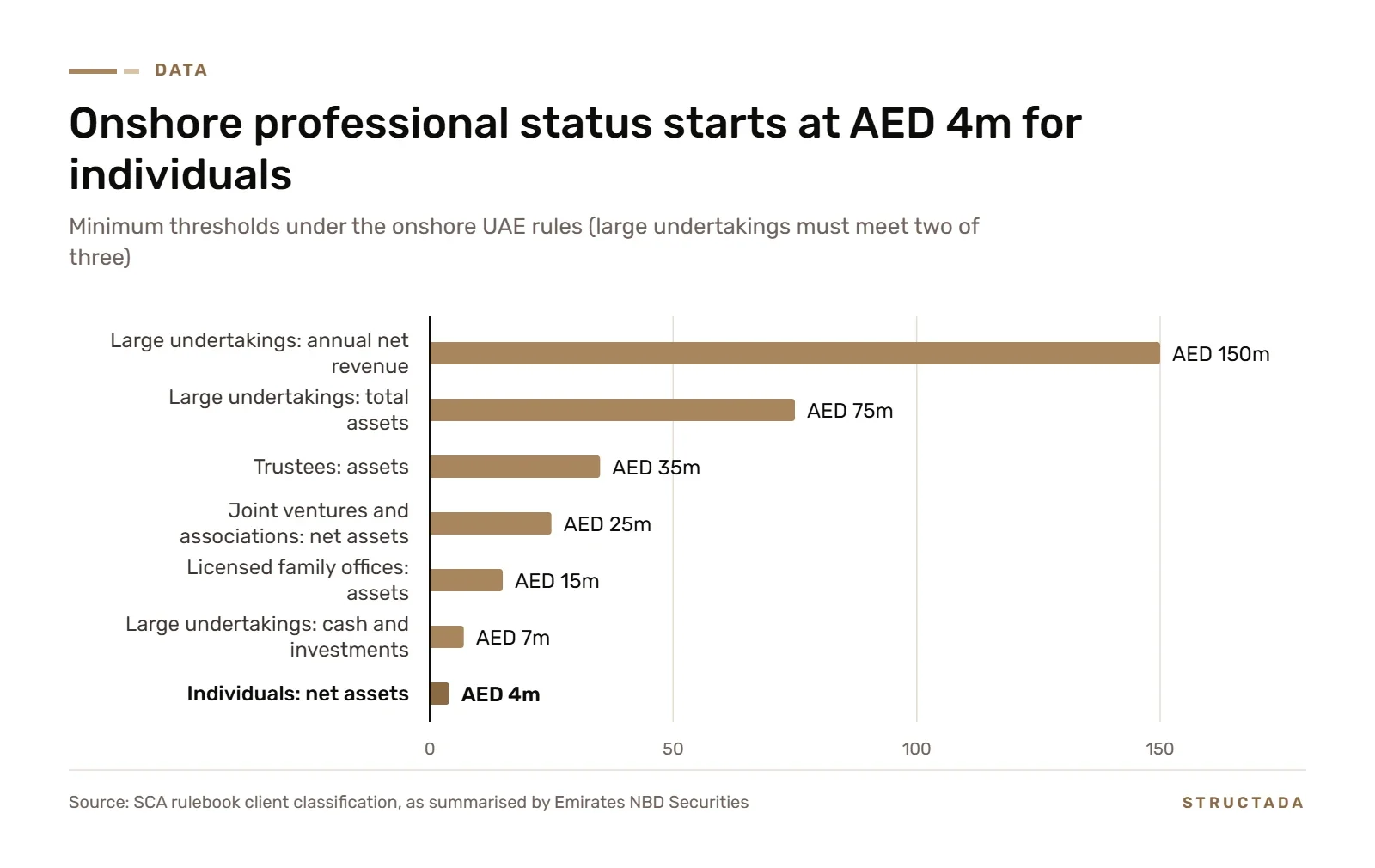
An individual qualifies as a professional investor by meeting a wealth or industry test together with an experience test. The wealth route requires net assets of at least AED 4 million, excluding the main residence. The industry route covers individuals approved by the regulator or a similar authority, or who are or have been employed in the past two years by a licensed or regulated financial institution. In either case, the individual must also have sufficient knowledge and experience of investing and its risks, assessed under the suitability rules.
Entities can be professional investors by their nature. That group includes governments and international bodies, licensed and regulated financial institutions, investment funds and pension funds, companies listed on an IOSCO member market, and entities whose main activity is investing or securitisation. Other entities qualify by size:
- Large undertakings meeting at least two of: total assets of AED 75 million, annual net revenue of AED 150 million, or cash and investments (or uncalled capital) of AED 7 million.
- Licensed family offices with assets of at least AED 15 million.
- Trustees with assets of at least AED 35 million.
- Joint ventures and associations with net assets of at least AED 25 million.
Professional clients in the DIFC under the DFSA
In the DIFC, firms classify clients as retail clients, professional clients or market counterparties.
Individuals can be assessed as professional clients if they have net assets of at least US$1 million, excluding their primary residence, and either have relevant professional experience in the financial sector or have sufficient knowledge and understanding of the relevant markets, products and risks. The DFSA raised the net assets threshold from US$500,000 to US$1 million in 2016, as Asian Private Banker reported.
Institutions such as governments, regulated financial institutions, funds, pension funds and large undertakings that meet the DFSA's financial thresholds are deemed professional clients without an individual assessment. Deemed professional clients can, on notice, be treated as market counterparties for certain business.
Professional clients in ADGM under the FSRA
ADGM uses the same three categories. As Waystone describes, clients are either deemed professional, mainly institutions and large undertakings, or assessed professional, mainly individuals and smaller entities.
Individuals can be assessed as professional clients if they have net assets of at least US$1 million, excluding their primary residence and certain insurance and pension benefits, and either work, or have recently worked, in a professional role at a regulated firm or appear to have sufficient experience and understanding of the relevant markets and risks. The FSRA proposed raising this threshold from US$500,000 to US$1 million in its Consultation Paper No. 2 of 2023, and amendments to client classification took effect in August 2023.
Institutions, including government bodies, authorised and regulated financial institutions and large undertakings meeting the FSRA's thresholds, are deemed professional clients. A deemed professional client can be classified as a market counterparty if it has been told in writing and has not asked for different treatment.
Opting up and opting down
Classification can move in both directions. A professional investor can usually ask to be treated as retail, gaining the greater protection that comes with it. Movement upwards is more tightly controlled: an individual who meets the tests must normally be assessed by the firm, warned in writing about the protections that will be lost, and confirm acceptance of professional status. Firms must keep records of each classification and review it periodically.
For issuers, the practical point is that classification belongs to the placing firm, which must be able to evidence it. A placement that relies on a poorly documented classification is exposed to challenge.
Why classification matters for a private placement
Investor classification shapes the whole offer. Private placements in the UAE are generally limited to professional investors and counterparties, and our guide to private placements explains how the exemptions work. Marketing to retail investors brings far stricter rules on disclosure, approval and suitability, so the line between a private placement and a regulated public offer often turns on who the investors are.
Distribution must also go through firms licensed in the relevant jurisdiction, which carry out the classification, and the offering documents should include UAE, DIFC and ADGM selling restrictions. Because the onshore regime now reaches free zone firms targeting onshore clients, an offer marketed from the DIFC to investors in Dubai's mainland must satisfy both sets of rules. Issuers looking to reach private wealth through intermediaries will find the wider picture in our guide to accessing the wealth channel.
What this means for issuers
Issuers placing notes in the region, such as credit linked notes issued from a Luxembourg securitisation vehicle, typically target professional investors only. That choice keeps the offer within private placement rules across all three jurisdictions and avoids the cost and delay of retail disclosure.
The discipline lies in treating classification as a design question rather than a compliance formality. The target investors, the jurisdictions in which they sit, the minimum subscription and the licensed firms that will place the notes should be settled together, before the offering documents are drafted. Our guide on how to issue a credit linked note covers the wider process.
Frequently Asked Questions
What is a professional investor in the UAE?
An investor who meets the qualifying criteria of the relevant UAE regulator, such as minimum net assets and investment experience, and can therefore access investments and services that are restricted for retail investors.
What are the net asset requirements for a professional investor in the UAE?
For individuals, at least AED 4 million onshore under the CMA rules, and at least US$1 million in the DIFC and ADGM, in each case excluding the main residence and subject to experience or employment criteria.
Is the SCA now called the CMA?
Yes. From 1 January 2026, the Securities and Commodities Authority was reconstituted as the Capital Market Authority under Federal Decree-Law No. 32 of 2025.
What is the difference between a professional client and a market counterparty?
A market counterparty is the most sophisticated category, usually large regulated institutions, and receives the fewest regulatory protections. Professional clients receive more protection than market counterparties but less than retail clients.
Can an individual opt up to professional investor status?
Yes, if they meet the relevant tests. The firm must assess them, explain the protections they will lose and obtain their written agreement.
Do DIFC and ADGM rules apply onshore?
No. Each jurisdiction has its own rules. Firms dealing with onshore UAE investors must also comply with the federal regime, even when they are based in a free zone.