- A private placement is the sale of securities directly to a limited number of selected investors, without a public offer and usually without a full approved prospectus.
- It is used for both debt and equity, and is a principal route by which mid-sized companies, specialist lenders and private issuers access institutional and professional investors.
- The main debt private placement markets are the US private placement (USPP), the Euro private placement (Euro PP) and the German Schuldschein, alongside privately placed notes issued from securitisation vehicles.
- Private placements rely on legal exemptions, typically limiting sales to professional or qualified investors, capping the number of offerees or setting high minimum investments.
- Compared with a public bond, a private placement is faster, cheaper, more flexible and more confidential, but it reaches fewer investors and is harder for holders to sell on.
A public bond is built for scale. It needs a full prospectus, regulatory review, usually a credit rating, a syndicate of banks and months of preparation, all to reach a market of investors the issuer may never meet. For a large, frequent borrower that machinery pays for itself. For most mid-sized companies, specialist lenders and asset owners, it is heavier than the transaction can bear.
A private placement takes the opposite approach. The issuer offers its securities to a small number of selected investors who understand the business and intend to hold the investment, and the law, in return, relieves it of most of the obligations that attach to a public offer.
The appeal is obvious. The discipline lies in staying inside the exemptions that make it possible, and in choosing the market and instrument that suit the assets and the investors.
What is a private placement?
A private placement is an offer of securities, such as notes, bonds, loans in securities form or shares, made to a limited group of selected investors rather than to the public. Because the offer is not public, it can usually rely on exemptions from the requirement to publish a full approved prospectus.
The investors are typically institutions and professional investors: insurers, pension funds, asset managers, banks, family offices and wealth managers acting for qualifying clients. Terms are often negotiated directly between the issuer and the investors, sometimes through an arranger or placement agent who structures the deal and introduces it to the market.
How a private placement works
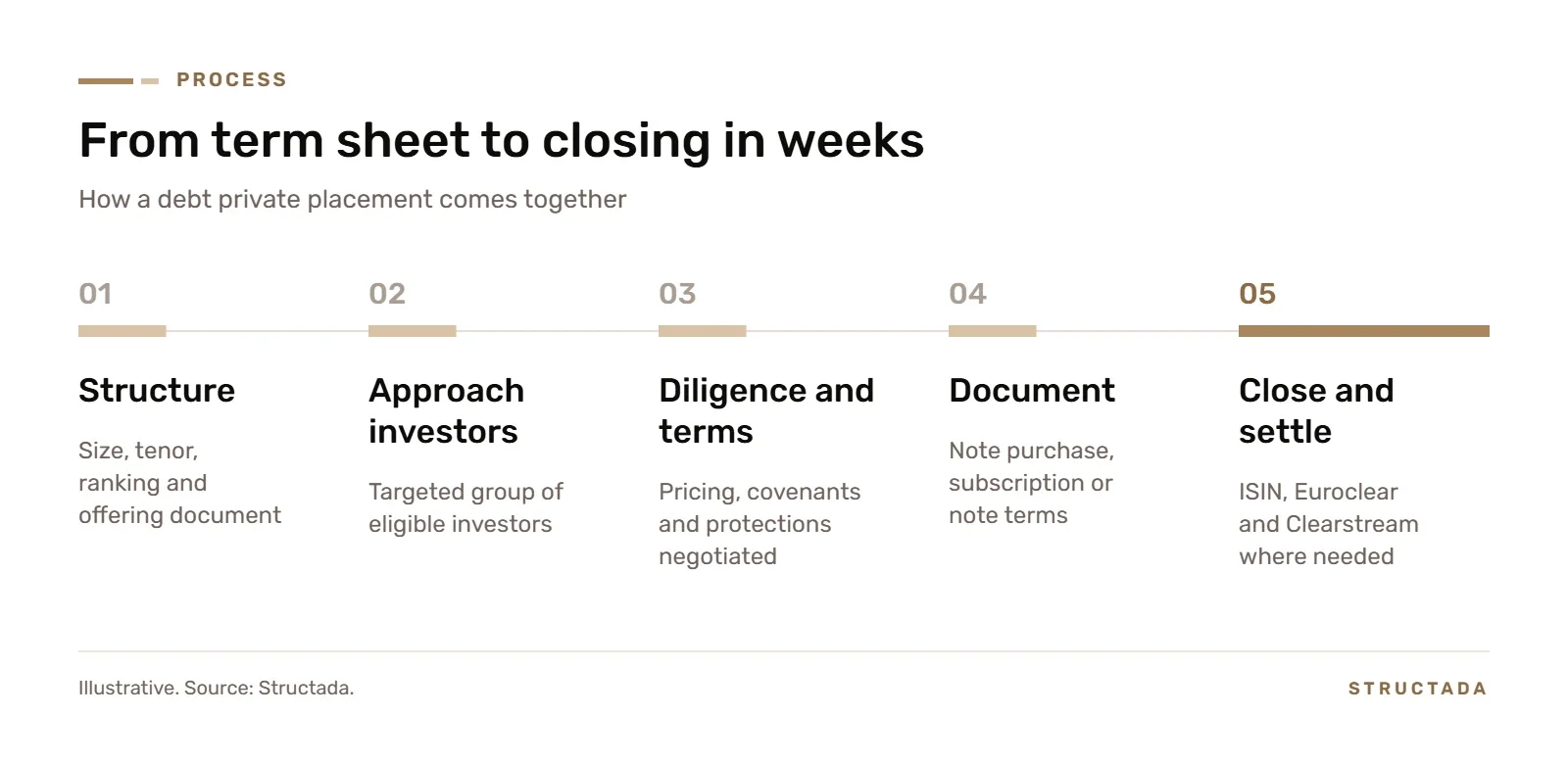
The process starts with structure. The issuer and its arranger agree the size, tenor, ranking and economic terms, and prepare an information memorandum or offering document that sets out the issuer, the assets and the risks. For issuers planning a series of transactions, a base private placement memorandum with final terms for each issue avoids redrafting the core document every time.
The arranger then approaches a targeted group of eligible investors, each of whom carries out its own due diligence. Pricing, covenants and protections are negotiated, sometimes investor by investor, and the outcome is documented in a note purchase agreement, loan agreement, subscription agreement or set of note terms, depending on the market.
At closing, the securities are issued and paid for. Where investors need to hold them through custodians, the notes are given an ISIN and settled through Euroclear and Clearstream; in other markets, such as the USPP, settlement can be direct between issuer and investor.
The main debt private placement markets
| Market | Typical issuers | Main investors | Key features |
|---|---|---|---|
| US private placement (USPP) | Investment-grade and crossover companies, including many from outside the US | US insurance companies | Long tenors, fixed rates, note purchase agreements |
| Euro private placement (Euro PP) | Mid-sized European companies, often unrated | European insurers and funds | Bond or loan format, standardised documents |
| Schuldschein | German and international companies | Banks and institutional investors | A German law loan instrument, flexible and widely distributed |
| Privately placed notes from an SPV | Lenders, managers and asset owners | Professional investors, family offices, wealth managers | Notes with an ISIN, linked to specific assets |
The three established corporate markets share a common character. As Greenberg Traurig notes, the USPP, Euro PP and Schuldschein are designed mainly for investment-grade companies, often unlisted, whose investors have a direct relationship with the issuer and a long-term horizon.
US routes deserve separate attention, because the exemptions available there, including Section 4(a)(2), Regulation D and Rule 144A, determine who can buy and how the securities can be resold. Our guides to types of US private placements and Rule 144A set them out.
The rules that make private placements possible
Every major market requires a prospectus for public offers and provides exemptions for private ones. The details vary by jurisdiction, but the exemptions usually rest on one or more of the following:
- Investor type, where the offer is made only to professional, qualified or institutional investors.
- Number of offerees, where the offer is made to fewer than a set number of investors in each country. In the EU, the Prospectus Regulation exempts offers to fewer than 150 non-qualified investors per member state.
- Minimum investment or denomination, such as €100,000, which limits the offer to sophisticated investors.
- No general solicitation, restricting public marketing and advertising.
These conditions are enforced through the documents and the process. Selling restrictions in the offering memorandum state where and to whom the securities may be sold, and placement agents must check that each investor qualifies before accepting a subscription. In the UAE, for example, the categories of eligible investor differ between onshore, the DIFC and ADGM, as our guide to professional investors in the UAE explains.
Private placement vs public offering
The difference between the two routes is one of breadth against efficiency. A public offering reaches the wider market, often including retail investors, and in exchange demands a full approved prospectus, usually a credit rating and a timetable measured in months. Its securities trade in public markets and its terms are largely standardised.
A private placement reaches a small number of selected, eligible investors on the basis of an information memorandum agreed with them. Ratings are often unnecessary, transactions close in weeks, costs are lower and financial information stays within the investor group. Terms can be negotiated to suit the issuer and the assets. The price of that efficiency is liquidity: privately placed securities have limited secondary trading, and investors who cannot easily sell will expect to be paid for holding.
Why issuers choose private placements
Speed and cost come first. Lighter documentation and the absence of regulatory approval of a prospectus shorten the timetable and cut the advisory bill. Size matters too: a private placement can be far smaller than the minimum practical size of a public bond, which makes it the natural route for a first institutional transaction.
Flexibility is often decisive. Terms, structures and covenants can be shaped around the issuer's business and the specific assets, rather than fitted to the expectations of an anonymous market. Confidentiality follows from the format, since financial information is shared only with the investors involved. The relationships that result are themselves an asset. Investors who have done the diligence once are well placed to support repeat issuance.
The trade-offs of a private placement
A smaller investor base means less price competition and a lower ceiling on deal size. Investors who know they will struggle to sell the securities may price that illiquidity into the coupon. They also tend to ask for stronger protections than public bondholders, including financial covenants and information undertakings; our guide to loan covenants explains what to expect.
Compliance is the less visible cost. The exemption is only as good as the process behind it, and an offer that drifts to ineligible investors or crosses a jurisdiction's threshold can lose its private status. Issuers need selling restrictions that are drafted carefully and observed in practice.
Private placements through notes and compartments
For specialist lenders, growth companies and asset managers, a common route is to privately place notes issued from a securitisation compartment, such as one within a Luxembourg securitisation vehicle. The notes carry an ISIN, settle through Euroclear and Clearstream and can be held by investors through their existing custodians, while the offer itself is made only to professional investors.
This combines the confidentiality and flexibility of a private placement with the operational standards institutional investors expect. A credit linked note is often the instrument used, and our guide on how to issue a credit linked note sets out the steps.
What this means for issuers
For a mid-sized issuer, a private placement is often the most efficient route to institutional investors. It gives up the breadth of a public offering in return for speed, flexibility, confidentiality and investors who know the business, and for most first and second transactions that is the right exchange.
The work lies in the choices made early. Which market and instrument fit the assets, which investors to approach, where they are located and how the offer is structured to stay within each relevant exemption are interlocking decisions. Issuers who settle them at the outset, rather than adjusting once investors are engaged, close faster and build a base of holders who come back.
Frequently Asked Questions
What is a private placement in simple terms?
A sale of securities directly to a small number of selected investors, rather than through a public offering.
Who can invest in a private placement?
Usually institutional and professional investors, such as insurers, pension funds, asset managers, banks and qualifying high-net-worth individuals, depending on local rules.
Does a private placement need a prospectus?
Usually not a full approved prospectus, provided the offer fits a legal exemption. Investors normally receive an information memorandum or offering document instead.
What is the difference between a private placement and an IPO?
An IPO is a public offering of shares to the market, with a full prospectus and listing. A private placement is offered only to selected investors and is usually unlisted.
What are the main private placement markets?
The US private placement market, the Euro private placement market and the German Schuldschein market, as well as privately placed notes issued by securitisation vehicles.
Can privately placed notes have an ISIN?
Yes. Privately placed notes often carry an ISIN and settle through Euroclear and Clearstream, which allows investors to hold them through their custodians.