- The wealth channel is the network of private banks, wealth managers, independent advisers, family offices and platforms that invest on behalf of high net worth individuals.
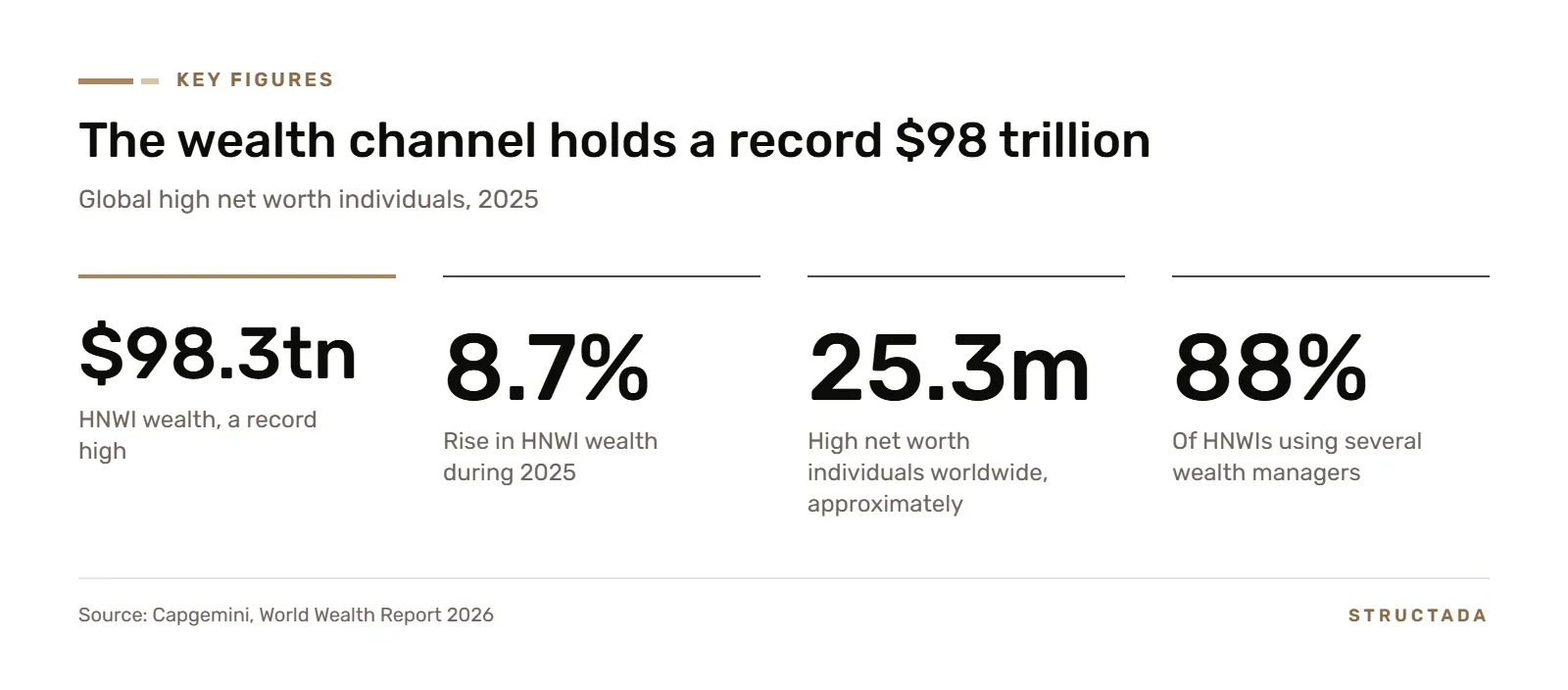
- It is large and growing: Capgemini puts global HNWI wealth at a record US$98.3 trillion in 2025, and 86% of private wealth professionals surveyed by Hamilton Lane plan to increase private market allocations in 2026.
- Intermediaries rarely buy what they cannot book. Most need a security with an ISIN, settled through Euroclear or Clearstream, that their custodian can hold and value alongside everything else in the client's account.
- Before a product reaches a client, it usually passes a gatekeeper: a private bank's product approval committee, a platform's due diligence or a family office's investment committee.
- Issuers that package their exposure as notes, document it properly and meet the investor eligibility rules in each market make it far easier for the channel to say yes.
A specialist lender with a strong book and a credible track record will often find genuine interest in the wealth channel. A family office in Geneva likes the opportunity; a private bank in Dubai has several clients who would take a ticket. Then the operational questions begin. Is there an ISIN? Can it settle in Euroclear? Who is the custodian? Is there an offering memorandum, and which investors is the product eligible for?
If the answers are unsatisfactory, the conversation usually ends there. The appetite was real, but the product could not pass through the systems the wealth channel relies on to hold, value and report what it buys.
That gap between demand and deliverability is where most issuers lose wealth channel business. Closing it is largely a matter of infrastructure, put in place before the first meeting with a gatekeeper rather than after.
What is the wealth channel?
The wealth channel is the part of the investment market that manages money for private individuals and families rather than institutions. Private banks hold client assets in custody and offer discretionary and advisory portfolios. Wealth managers and independent advisers build portfolios for clients and usually hold assets through a custodian bank or platform. Single-family and multi-family offices run concentrated pools of capital with their own investment committees. External asset managers manage client money held at private banks, while platforms and feeder structures aggregate many small tickets into one investment.
What unites them is their role as intermediaries. The end investor is a high net worth individual or family, but the buying decision, the paperwork and the custody all sit with the intermediary. An issuer is therefore selling to an institution's processes as much as to the client behind them.
Why the wealth channel matters
The pool of capital is very large. According to the Capgemini World Wealth Report 2026, HNWI wealth rose 8.7% in 2025 to a record US$98.3 trillion, held by around 25.3 million people.
Its interest in private markets is rising. In a Hamilton Lane survey of 390 advisers, private wealth firms and family offices, 86% said they plan to increase private market investments in 2026, and private credit was one of the most widely held strategies. Capgemini also found that 88% of HNWIs use several wealth managers, in part to get better access to alternative investments.
The largest managers have noticed. Franklin Templeton added its private credit and other private market strategies to Euroclear's FundsPlace platform in 2026 to reduce manual processes in distributing to wealth investors, as Alternative Credit Investor reported. When managers of that scale invest in distribution plumbing, it tells smaller issuers where the channel's expectations are heading.
How the wealth channel buys
Most investments reach the end client through a similar sequence:
- The issuer creates an investable security, usually a note or a fund unit.
- The security receives an ISIN and settles through Euroclear or Clearstream.
- The bank, platform or family office reviews the product, issuer and documents.
- The security is booked into custody, priced and reported.
- The adviser allocates it to eligible client portfolios.
Each step removes friction for the intermediary. A note held at a custodian looks, operationally, like any other bond in the account. It can be valued, reported on the client statement, pledged for Lombard lending where the bank allows it, and moved between banks. A bilateral loan agreement or a direct shareholding in an unfamiliar company offers none of those conveniences, which is why so much private credit now reaches wealth clients in note form.
A security the wealth channel can hold
The format matters more than many issuers expect. Notes, including credit linked notes, are common because they fit existing custody and settlement systems. Our guide to how credit linked notes reach investors explains the route in more detail, and our comparison of credit linked notes vs private credit funds sets out the trade-offs between the two main wrappers.
Settlement through the international central securities depositories lets almost any private bank or custodian hold the notes. That requires a common depositary, a paying agent, an ISIN and documentation that meets their standards, all of which our Euroclear-ready checklist covers step by step.
Documentation and gatekeeper approval
Gatekeepers expect an offering document they can review: a private placement memorandum or, for programmes, a base private placement memorandum with final terms for each issue. They will look for clear risk factors, an intelligible structure, the security package, fees and ongoing reporting.
They will also look at who else is involved. Independent parties, such as a trustee, paying agent or collateral agent, give a product approval committee comfort that cash and security are controlled by someone other than the issuer. Their absence is one of the commonest reasons a product stalls at this stage.
Investor eligibility and ticket sizes
Most private credit products are sold only to professional or qualified investors, and the rules differ by market. In the UAE, for example, the CMA, DFSA and FSRA each define professional investors differently, as our guide to professional investors in the UAE explains. Products sold into Europe may need to consider PRIIPs if any retail investors could be involved. Intermediaries will not take on a product that exposes them to a regulatory breach, however attractive its terms.
Denomination is the practical expression of the same issue. Private banks often allocate across many clients, so minimum denominations need to suit both the regulatory rules and the size of individual allocations. Set too high, the bank cannot spread the position across its clients; set too low, the product risks falling into a retail category with a heavier regime.
Listing and reporting
Some banks and investors can only hold listed securities, or prefer them. A listing on a market such as Euronext Dublin's Global Exchange Market gives the notes a recognised public reference without a full EU prospectus, and is often a modest cost relative to the access it opens.
Reporting matters as much once the product is held. Wealth intermediaries report to clients monthly or quarterly and need regular valuations, portfolio updates and clear notices. A product that cannot be priced or explained to the end client is hard to keep on an approved list, even if it performs well.
Why the wealth channel says no
The reasons for rejection are remarkably consistent: no ISIN or no Euroclear or Clearstream settlement, an offering document that is thin or out of date, unclear eligibility rules in the investor's jurisdiction, no independent parties, no regular valuation or reporting, and concentration in a single unfamiliar borrower with no ring-fencing. Almost every item on that list is an infrastructure issue rather than a judgement on credit quality, and each is easier to fix before the first conversation with a gatekeeper than during it.
What this means for issuers
The wealth channel has the capital and the appetite for private credit, but it buys through intermediaries that work to their own operational and regulatory standards, and those standards are not negotiable deal by deal. An issuer that arrives with an investable security, settlement in place, proper documentation, clear eligibility and reliable reporting is having a different conversation from one that arrives with a loan book and a presentation.
Building that infrastructure at the outset makes every later discussion with a private bank, adviser or family office simpler, and it allows the merits of the credit to be judged on their own terms.
Frequently Asked Questions
What is the wealth channel?
The network of private banks, wealth managers, independent advisers, family offices and platforms that invest on behalf of high net worth individuals and families.
How big is the wealth channel?
Capgemini estimates global HNWI wealth at a record US$98.3 trillion in 2025, held by around 25.3 million people.
Why do private banks prefer notes?
Notes with an ISIN that settle through Euroclear or Clearstream can be held in custody, valued and reported like any other bond in the client's account.
Do I need a listing to access the wealth channel?
Not always, but some banks and investors can only hold listed securities, so a listing on an exchange-regulated market can widen access.
Who can invest in private credit notes through the wealth channel?
Usually only professional or qualified investors, as defined by the rules in each investor's jurisdiction.
What do gatekeepers review?
The issuer, the structure, the offering document, the security package, independent service providers, fees, reporting and investor eligibility.