- To settle through Euroclear Bank and Clearstream, notes must pass the clearing systems' legal, operational and tax eligibility checks before the issue date.
- The core parties are the issuer, an issuing and paying agent, a common depositary or common safekeeper, and the clearing systems themselves, usually coordinated by the arranger.
- International notes receive an XS ISIN and common code allocated by Euroclear and Clearstream, which requires the key terms of the notes to be fixed.
- Most notes are represented by a global note held by the common depositary or common safekeeper, although dematerialised English law notes are now possible.
- KYC and onboarding of the issuer and agents usually take longer than the clearing steps themselves, so issuers should allow several weeks before the target issue date.
For many alternative issuers, the hardest part of a first note issue is the plumbing. The structure has been agreed and investors are lined up, but those investors want notes they can hold in their custody accounts like any other bond. In practice that means settlement through Euroclear Bank and Clearstream Banking, the two international central securities depositories (ICSDs).
Making notes Euroclear-ready involves a sequence of documents, agents and approvals that banks treat as routine and that lenders, credit managers and first-time issuers often find opaque. The requirements are well established, and delays usually come from starting late.
This guide explains what the clearing systems expect, who does what and how long it takes. For background, see our guides to clearing systems, Euroclear and ISINs.
Who is involved in clearing a note issue
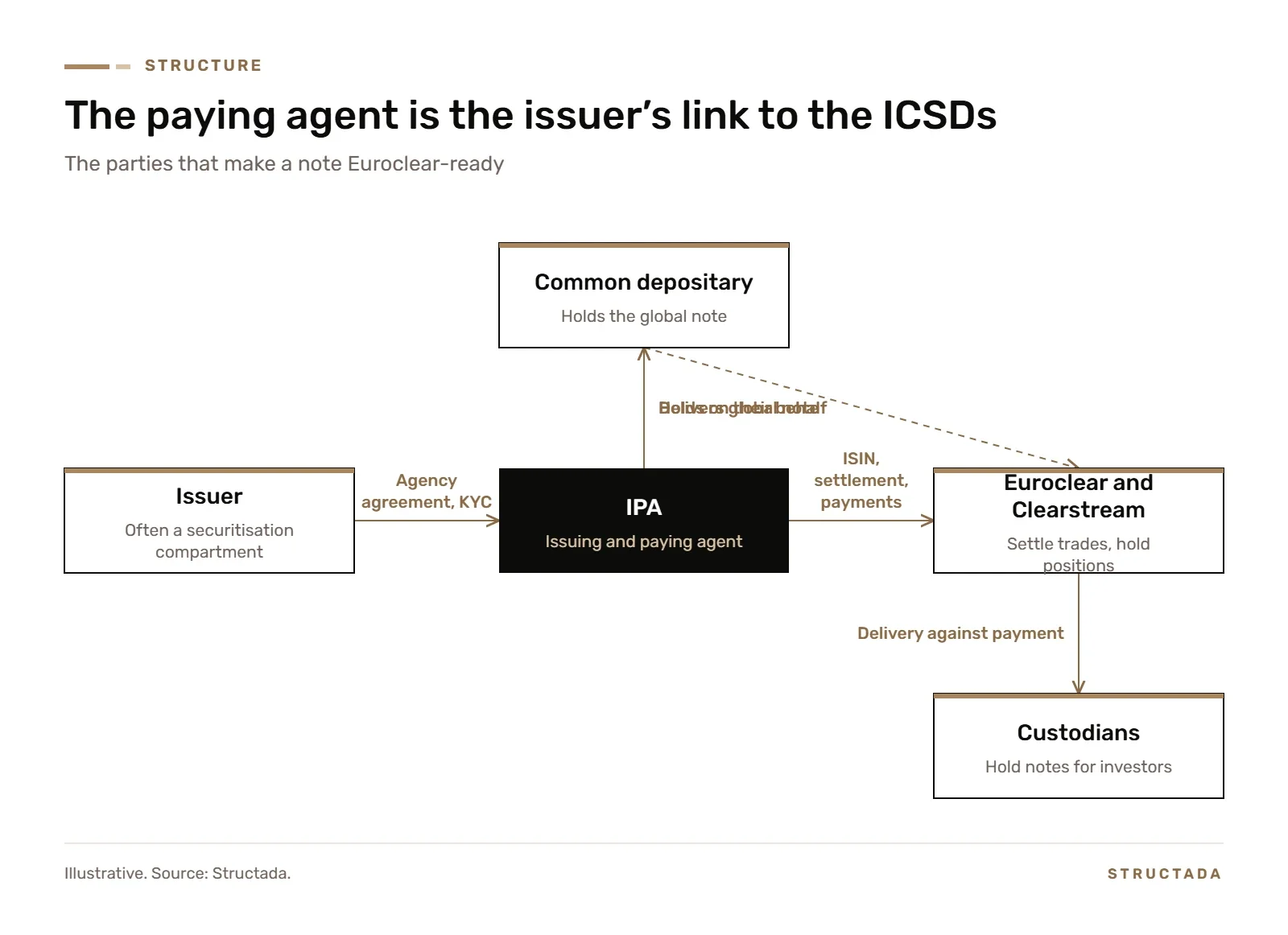
The issuer is the vehicle issuing the notes, often a securitisation compartment, and the arranger coordinates the process and the parties around it. The pivotal appointment is the issuing and paying agent (IPA), which requests the ISIN, issues the notes into the clearing systems and makes payments to investors throughout the life of the notes. In practice the paying agent is the issuer's main point of contact with Euroclear and Clearstream.
The global note is held on behalf of the ICSDs by a common depositary or, under the new safekeeping structure, a common safekeeper. On many issues a common service provider handles operational and payment messaging for the ICSDs. Euroclear and Clearstream accept the notes, settle trades and hold investors' positions through their participants. Lawyers draft the terms and confirm that the notes can be validly issued, and where the notes are listed, a listing agent manages admission to the exchange.
Confirming the notes are eligible
Each security admitted directly to the ICSDs is assessed from a legal, operational and tax perspective, as Clearstream explains. Settle eligibility first, because a feature the systems cannot process forces late changes to the documents.
Form comes first: bearer global note, registered global note or dematerialised notes. English law is the most common governing law, and dematerialised notes at the ICSDs currently have to be governed by English law. Currency and denomination must be acceptable, with minimum denominations of €100,000 or equivalent common for issues sold only to professional investors. Payment terms, including the interest calculation, payment business days and record dates, must be capable of being processed by the systems.
Tax requires particular care. The ICSDs' joint eligibility criteria call for tax information on the notes, including any withholding tax and how investors can claim relief, and unusual tax features should be raised with the ICSDs early. The same applies to partly paid notes, physical settlement or complex payment profiles, all of which need discussion before the terms are fixed.
Onboarding the issuer and agents
The IPA, the common depositary and the ICSDs each need to complete KYC on the issuer, which requires constitutional documents, registry extracts, details of directors and beneficial owners, and evidence of authority. The issuer will also need a legal entity identifier (LEI), which is widely required for regulatory reporting and by agents and trading venues.
The issuer then signs an agency agreement with the IPA and appoints the common depositary or common safekeeper. For new global notes and dematerialised notes, it also signs a standard agreement directly with the ICSDs. For a new issuer, KYC is often the longest single step in the whole process, and it should start as soon as the agents are chosen.
Finalising the documents
The documentation follows a familiar pattern. The terms and conditions of the notes, or final terms under a programme, sit alongside an offering document such as an information memorandum or prospectus. The agency agreement governs the IPA's role, and the global note or deed must be in the form agreed with the common depositary. Where there is a trustee, a trust deed or security documents complete the package, supported by board resolutions authorising the issue and, where investors or agents require them, legal opinions.
A late change to denominations, payment dates or form of note can reopen eligibility and delay closing.
Obtaining the ISIN and common code
International notes receive an XS ISIN and a common code, allocated jointly by Euroclear and Clearstream. The IPA usually submits the request once the key terms are fixed: issuer name and LEI, currency, nominal amount and denomination, issue and maturity dates, interest basis and payment dates, form of note and governing law. A CFI code and FISN are assigned at the same time.
Some investors and platforms want the ISIN well before closing for their own onboarding and product approval, so it is worth requesting it early, once the terms are stable.
Choosing the global note structure
Most notes are represented by a global note. Under a classic global note (CGN), a common depositary holds the note and the outstanding amount is recorded on the note itself. Under a new global note (NGN), a common safekeeper holds it and the outstanding amount is recorded in the ICSDs' own records. NGN form is needed for bearer notes intended to be eligible as Eurosystem collateral, and registered notes are often held under the equivalent new safekeeping structure.
Dematerialised notes dispense with the global note entirely. One ICSD keeps the issuance record and legal title sits with a nominee for the ICSDs. Most private placements by alternative issuers still use a classic or new global note through the IPA's affiliated common depositary.
Closing, settlement and listing
In the days before closing, the IPA confirms the details to the ICSDs and the common depositary, and investors' custodians give their settlement instructions. On the closing day the global note is signed, authenticated and delivered to the common depositary or safekeeper, or the issuance record is set up for dematerialised notes. The notes are then credited to investors' accounts through Euroclear and Clearstream, usually on a delivery against payment basis. After closing, the IPA handles coupon and principal payments, notices and any changes to the outstanding amount.
Listing is optional for many private placements, but some investors need listed notes. Common venues include the Luxembourg Stock Exchange's Euro MTF, the Vienna MTF and The International Stock Exchange. A listing adds a listing agent, an admission document and some ongoing disclosure.
A realistic timeline and checklist
| Stage | Typical timing |
|---|---|
| Agent selection and KYC | 2 to 4 weeks, sometimes longer for a new issuer |
| Documents agreed | 2 to 6 weeks, in parallel |
| ISIN and common code | A few days once terms are fixed |
| Eligibility confirmation | Days to a couple of weeks, longer for unusual features |
| Closing and settlement | On the agreed issue date |
Issuers using an established platform with agents already in place can move much faster, because the vehicle and its agents are already known to the clearing systems. Before the issue date, every issuer should be able to confirm the following:
- Form, governing law, denominations, currency, payment terms and tax analysis accepted by the ICSDs.
- Issuer KYC completed with the IPA, common depositary and ICSDs, and an LEI obtained.
- Agency agreement signed, common depositary or safekeeper appointed, and issuer-ICSD agreement signed where needed.
- Terms, offering document, global note and corporate approvals final.
- XS ISIN and common code allocated and settlement details given to investors' custodians.
- Listing completed, if required.
What this means for issuers
Getting notes Euroclear-ready is a matter of sequence and preparation. The clearing systems' requirements are clear, but each depends on something else being finished first: the issuer onboarded, the documents final, the agents in place. Most delays trace back to KYC and to late changes in the documents, and both are avoidable with an early start.
Issuing through an existing platform, where the vehicle, IPA and common depositary are already set up, removes most of the friction. Our guide on how to issue a credit linked note shows how these steps fit into the full issuance process.
Frequently Asked Questions
What does Euroclear-ready mean?
Notes that have passed Euroclear and Clearstream's eligibility checks and can be settled and held through them.
Who applies for the ISIN?
Usually the issuing and paying agent, on behalf of the issuer, once the key terms of the notes are fixed.
What is an XS ISIN?
An ISIN with the XS prefix, used for international securities settled through Euroclear and Clearstream.
Do notes need a global note to clear through Euroclear?
Most do, held by a common depositary or common safekeeper. Dematerialised English law notes can now be issued without one.
How long does it take to get notes Euroclear-ready?
Typically several weeks for a new issuer, mostly because of KYC and documents. Issuers using an existing platform can move faster.
Do the notes need to be listed?
Not always. Many private placements are unlisted, though some investors require a listing.