- The EIRC, or Emirates Integrated Registries Company, operates the Emirates Movable Collateral Registry (EMCR), the UAE's central electronic register of security interests over movable assets.
- Under the Movables Security Law, Federal Law No. 4 of 2020, registering a notice on the registry is the main way to make a security interest over movable assets effective against third parties.
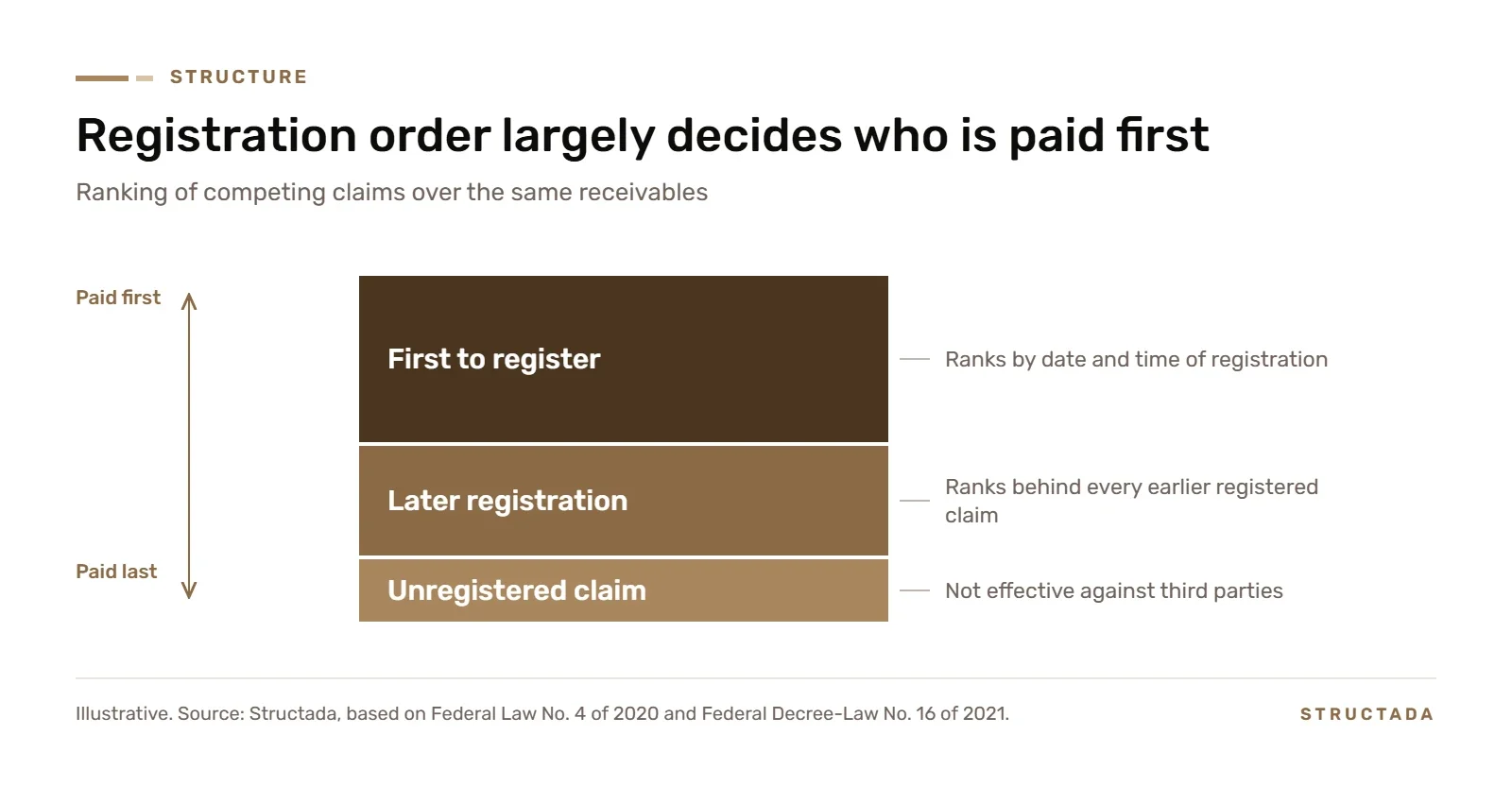
- Under the Factoring Law, Federal Decree-Law No. 16 of 2021, assignments of receivables must also be registered to be effective against third parties, with priority set by the date and time of registration.
- Priority works on a first-in-time, first-in-right basis, so lenders, factors and securitisation vehicles should register as early as possible and search the registry before lending or buying assets.
- For anyone funding or securitising UAE receivables, EIRC registration is a core part of proving that the assets belong to, or are secured for, the funder and not the originator's other creditors.
When a UAE borrower defaults, one of the first questions its funders face is ranking. Two lenders may each hold a signed security agreement over the same invoices, and only one of them can be paid first.
Onshore, that question is usually settled by the EIRC. The Emirates Integrated Registries Company runs the registry on which security interests and assignments of receivables over movable assets are recorded, and the order of registration largely decides the order of payment. It gives lenders, buyers of receivables and anyone else taking security a public, searchable record of their claim, and a clear rule for ranking competing claims.
For specialist lenders, factoring companies and issuers securitising UAE assets, the registry is part of everyday deal mechanics. Getting it right is the difference between owning an asset and merely having a contract that says so.
What is the EIRC?
The Emirates Integrated Registries Company manages the Emirates Movable Collateral Registry. The registry is an online database where secured parties record notices of security interests over movable property, and where anyone can search for existing claims before lending against, or buying, an asset.
Movable property covers almost anything that is not land or buildings. It includes receivables such as invoices, loan repayments and card settlement proceeds; bank accounts and deposits; equipment, machinery and vehicles; inventory and goods; intellectual property and other intangible rights; and future assets, such as receivables not yet arising. Assets subject to their own specialist register, along with salaries and wages and certain public property, are excluded.
Readers familiar with US practice will recognise the concept: the registry plays a role comparable to a UCC filing, giving public notice of a claim and fixing its place in the queue.
The legal framework
Three statutes shape how the registry works. The first is the Movables Security Law, Federal Law No. 4 of 2020 on securing interests in movable property, with its executive regulations in Cabinet Resolution No. 29 of 2021. It replaced the earlier 2016 law and allows security over existing and future movable assets without the lender taking possession, provided there is a written security agreement and the security is perfected. As this overview summarises, registering a notice on the registry makes the security enforceable against third parties.
The second is the Factoring Law, Federal Decree-Law No. 16 of 2021 on factoring and the assignment of receivables, which came into force on 8 December 2021. It allows bulk assignments of present and future receivables described by class or type. According to DLA Piper, an assignment must be registered on the electronic register operated by the EIRC to be effective against third parties, with priority set by the date and time of registration.
The third is the new UAE Civil Transactions Law, in force from 1 June 2026, which codifies the assignment of rights. It confirms that debtor consent is generally not required, while notice to, or acceptance by, the debtor remains important for the assignment to be effective against the debtor. Issuers should take advice on how the new code and the Factoring Law work together for their transaction.
How registration and priority work
The secured party, or the assignee of receivables, files a notice describing the parties and the collateral. The description can be general, for example "all present and future trade receivables", which matters a great deal for revolving pools. Registration takes effect when the information is entered in the database and becomes searchable, and competing interests rank by the date and time they became effective against third parties, typically the time of registration.
Registration is the main route to perfection, but it sits alongside others. Possession of goods and control agreements over bank accounts can also perfect security, and a control agreement lets the secured party instruct the account bank directly. Where collateral is sold or replaced, the secured party may need to register the proceeds within fifteen working days, unless they are already covered by the registration. When the debt is repaid, the registration must be cancelled within five working days. Registration fees are paid by the secured party unless agreed otherwise. Our guide to how to perfect security in the UAE sets out these routes in more detail.
Notification vs registration
Registration and debtor notification do different jobs, and confusing them is a common source of weakness in receivables structures.
| EIRC registration | Notice to the debtor | |
|---|---|---|
| Purpose | Effectiveness against third parties and priority | Ensuring the debtor pays the funder, not the originator |
| Protects against | Other lenders, buyers and insolvency claims | The debtor paying the wrong party |
| Timing | As early as possible, ideally before funding | At closing, or later on a trigger event |
| Practical burden | One filing can cover a whole class of receivables | Can be heavy for large or revolving pools |
Many receivables financings register at closing and delay notifying debtors until a trigger, such as a servicer default. That keeps the originator's customer relationships intact while protecting the funder's priority.
Why the EIRC matters for securitisation
In a securitisation or ABS, investors rely on the assets having moved to the issuing vehicle, or being secured for it, so that the originator's creditors cannot reach them. Our guide to how securitisation works explains why that separation matters. For UAE receivables, EIRC registration sits at the centre of that analysis.
Registering the assignment to the vehicle makes the transfer effective against third parties, and a search before closing shows whether anyone else holds an earlier claim. A general description of present and future receivables lets one registration cover new receivables as they are sold into a revolving pool, while registered security or control agreements over collection accounts protect cash as it arrives. Clear registration also supports the argument that the assets belong to the vehicle in an insolvency, although transfers may still face scrutiny under the UAE Bankruptcy Law.
Our article on securitising UAE and GCC assets via Luxembourg SPVs covers the wider cross-border issues, including licensing, tax and data protection.
The DIFC and ADGM
The EIRC registry applies to onshore UAE. The financial free zones, the DIFC and ADGM, have their own legal systems and keep their own registers of security interests. A transaction with assets or parties in a free zone may need registration in the relevant free zone register as well as, or instead of, the EIRC, and local advice should confirm which registers apply.
What this means for issuers
For anyone lending against or securitising UAE assets, the EIRC registry is the record that decides who ranks first. The disciplines are simple to state and easy to neglect: search before funding, describe the collateral broadly enough to cover future assets, register at or before closing, put control agreements in place over collection accounts, plan the debtor notification triggers, and diarise cancellation when the financing ends. Where a free zone is involved, check its register too.
Done properly, registration supports the true sale and security analysis on which investors rely. For originators, a clean registry position makes their receivables easier to fund and can widen the pool of investors willing to buy notes backed by them. That is why registration belongs in the first draft of the transaction timetable, rather than among the conditions precedent tidied up the week before closing.
Frequently Asked Questions
What does EIRC stand for?
Emirates Integrated Registries Company, the company that manages the Emirates Movable Collateral Registry in the UAE.
What is registered with the EIRC?
Security interests over movable assets, such as receivables, bank accounts, equipment, vehicles and inventory, and assignments of receivables under the Factoring Law.
Is registration mandatory?
Registration is needed for a security interest or assignment to be effective against third parties. Without it, a funder risks being outranked by other creditors.
How is priority decided?
By the date and time the interest became effective against third parties, usually the time of registration.
Does registration replace notice to the debtor?
No. Registration protects against third parties, while notice ensures the debtor pays the right party.
Does the EIRC cover the DIFC and ADGM?
The EIRC covers onshore UAE. The DIFC and ADGM keep their own security registers.