- A UCC filing is a public notice, usually a UCC-1 financing statement, that a lender or buyer has an interest in a debtor's personal property under Article 9 of the US Uniform Commercial Code.
- Filing is the most common way to perfect a security interest in the US, making it effective against other creditors and a bankruptcy trustee, and fixing its priority.
- The filing generally goes to the central filing office, usually the Secretary of State, in the state where the debtor is located. For a US company, that is normally its state of incorporation or formation.
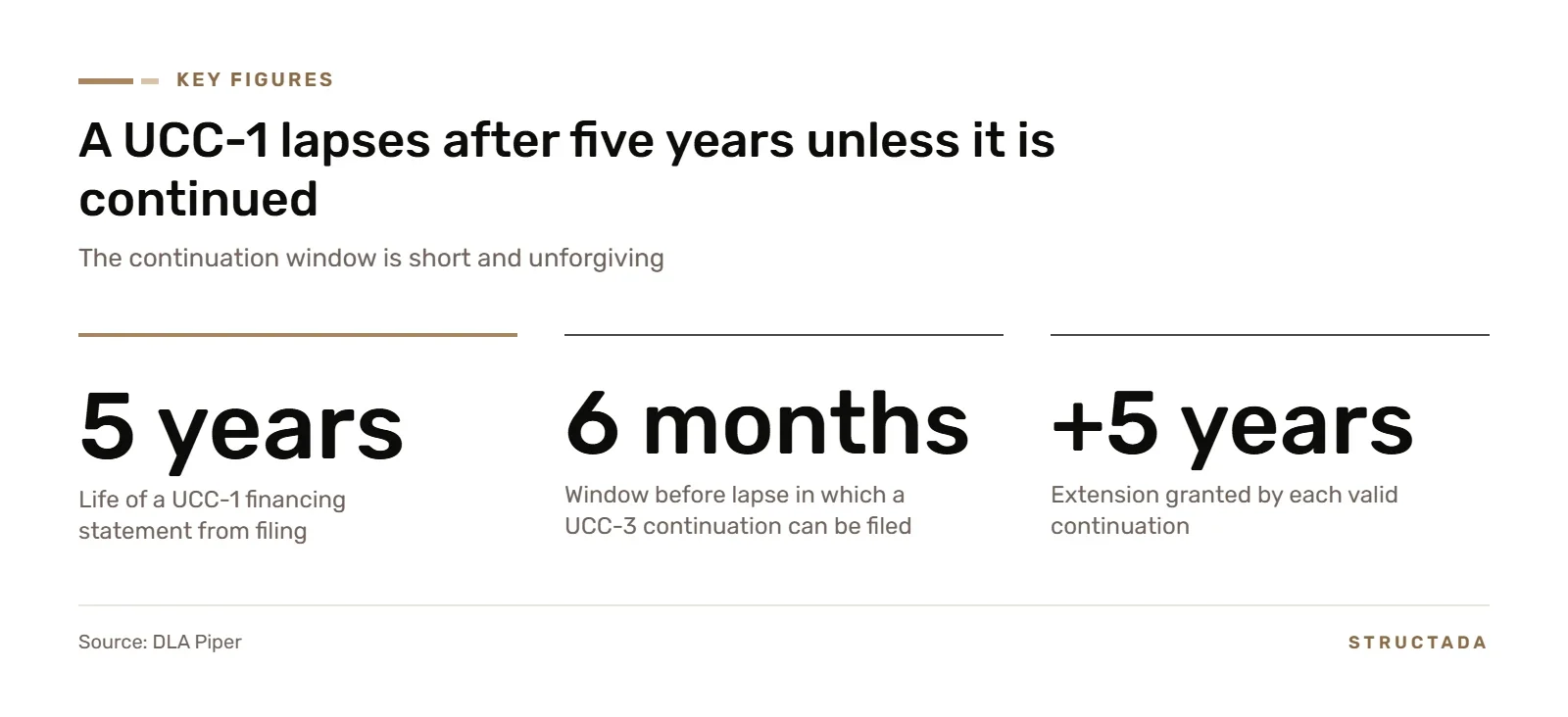
- A UCC-1 lapses after five years unless a continuation is filed in the six months before lapse. A lapsed filing cannot be revived.
- Article 9 also covers sales of accounts and certain other receivables, so in US securitisations the buyer of receivables, often an SPV, files a UCC-1 against the seller even where the transfer is a true sale.
A lender in New York advances money to a manufacturer and takes security over its equipment, inventory and receivables. The security agreement is signed, but it binds only the two parties to it. Another lender could take security over the same assets next month, and a bankruptcy trustee would look at the claim with a sceptical eye.
In the United States, the answer to that problem is a UCC filing. A short form lodged with a state office puts the world on notice of the lender's claim and fixes where it ranks against everyone else. It is one of the least glamorous documents in any deal and one of the most consequential.
For anyone lending to US businesses or investing in notes backed by US assets, a UCC filing made in the wrong state, against the wrong name or allowed to lapse can turn a secured investor into an unsecured one.
What is the UCC?
The Uniform Commercial Code is a model set of laws governing commercial transactions, adopted with some variations by every US state. Article 9 deals with secured transactions: security interests in personal property, meaning almost everything other than land and buildings. Its reach is broad, taking in receivables and other payment rights, inventory, equipment, deposit accounts, shares and other investment property, intellectual property, contract rights, instruments and chattel paper.
What makes Article 9 central to structured finance is that it also governs outright sales of accounts, chattel paper, payment intangibles and promissory notes. A buyer of receivables is treated, for the purposes of perfection, much as if it were a secured lender. That single design choice explains why UCC filings appear in nearly every US securitisation.
What is a UCC-1 financing statement?
A UCC-1 is the standard form used to make a UCC filing. It names the debtor, using its exact legal name, and the secured party, gives their addresses and describes the collateral. That description can be specific or general, and a financing statement may describe the collateral simply as "all assets", although the underlying security agreement must describe it more precisely.
The UCC-1 need not attach the security agreement or state the debt. Its function is notice: anyone searching the record learns that a claim may exist and knows to ask further questions.
Attachment and perfection
Article 9 separates two steps that are easily confused. Attachment makes the security interest enforceable between the lender and the debtor. It requires value to have been given, the debtor to have rights in the collateral and, usually, a signed security agreement. Perfection makes the interest effective against third parties, including other creditors and a bankruptcy trustee. Filing a UCC-1 is the most common way to achieve it.
An attached but unperfected security interest is fragile. It can be defeated by a later creditor who perfects first, and it is exposed in the debtor's bankruptcy, where the trustee can set it aside. The wider principle, and how it plays out in other legal systems, is covered in our guide to perfection of security.
Ways to perfect under Article 9
Filing is the default, but it is one of several methods, and for some collateral another route gives a stronger position.
| Method | How it works | Typical collateral |
|---|---|---|
| Filing | UCC-1 filed with the relevant state office | Receivables, inventory, equipment, general intangibles |
| Control | Secured party controls the asset, for example through a deposit account control agreement | Deposit accounts, investment property, letters of credit |
| Possession | Secured party holds the asset | Instruments, certificated securities, goods |
| Automatic | Perfected on attachment without further steps | Certain consumer goods and some sales of payment intangibles |
Where more than one method is available, control can give higher priority than filing. Lenders taking security over bank accounts therefore usually insist on a control agreement, and a collateral agent often holds that control on behalf of the lender group.
Where to file a UCC-1
The place of filing is where most errors occur, and a UCC-1 filed in the wrong state perfects nothing. The rule turns on where the debtor is located.
A registered organisation, such as a corporation, LLC or limited partnership, is located in the state under whose law it was formed. A Delaware LLC is located in Delaware wherever it operates, which is one reason Delaware plays such a central role in US structured finance. An individual is located in the state of their main residence. Other organisations are located at their place of business or, if they have more than one, at their chief executive office.
Foreign debtors are treated differently. They are located in their home country if it has a public filing system for this type of security. If it does not, they are treated as located in the District of Columbia, and the filing goes to Washington, DC. Filings are usually made online, and the fees are modest.
Priority and the first-to-file rule
The basic rule is that competing perfected security interests rank in the order of filing or perfection, whichever is earlier. A lender can file a UCC-1 before the loan is made, securing its place in the queue from the filing date rather than the funding date. There are important exceptions, including purchase-money security interests and control over certain assets, but first-to-file is the reason careful lenders search the records and file early.
Searches run against the debtor's exact legal name in the correct state and show existing financing statements, the collateral described and any amendments or terminations. They are run before closing and again after filing to confirm the new UCC-1 is on the record.
Keeping a UCC filing alive
A UCC-1 does not last forever, and the rules for maintaining it are unforgiving. As DLA Piper sets out, a financing statement is effective for five years from filing. A UCC-3 continuation extends it for another five years, but it can only be filed in the six months before lapse. A continuation filed outside that window is ineffective, and a UCC-3 amendment does not extend the lapse date.
If a filing lapses, the security interest becomes unperfected. A fresh UCC-1 takes effect only from its own filing date, and any creditor who filed in the meantime may now rank ahead. Name changes carry a similar trap. If the debtor changes its name so that the filing becomes seriously misleading, the secured party has four months to amend, or the filing will not cover collateral acquired after that period. On a long-dated deal, someone must own these dates.
UCC filings in securitisation
In a US securitisation, the originator sells receivables to a special purpose vehicle. Because Article 9 treats a sale of accounts as a security interest for perfection purposes, the SPV files a UCC-1 against the originator, even though the parties intend a true sale. Where the SPV then grants security to a trustee for the noteholders, a further filing is made against the SPV.
The first filing protects investors twice over. If the sale is respected, it perfects the SPV's ownership of the receivables against the originator's creditors. If a court were to recharacterise the sale as a secured loan, the SPV would still hold a perfected security interest rather than an unsecured claim. The same logic runs through most asset-backed securities.
For deals with a non-US issuer, such as a Cayman CLO, the place of filing against the issuer follows the foreign debtor rules described above, so the first question is whether the issuer's home jurisdiction has a qualifying public filing system.
What this means for issuers
UCC filings are a small administrative step with large consequences. Filed correctly, against the right name and in the right state, they protect the funder's position against competing creditors and in bankruptcy. Filed incorrectly, or allowed to lapse, they can leave investors holding an unsecured claim against assets they believed were theirs.
The discipline that matters is ownership after closing. Filings should be confirmed by search, logged with their lapse dates, continued within the window and amended promptly for any change of name, jurisdiction or structure. A UCC-1 needs managing for the life of the notes, long after the closing checklist is signed off.
Frequently Asked Questions
What is a UCC filing?
A public notice, usually a UCC-1 financing statement, that a creditor or buyer has an interest in a debtor's personal property under Article 9 of the Uniform Commercial Code.
Where is a UCC-1 filed?
Usually with the Secretary of State in the state where the debtor is located. For a US corporation or LLC, that is its state of formation.
How long does a UCC filing last?
Five years, unless a continuation statement is filed within the six months before it lapses.
What happens if a UCC filing lapses?
The security interest becomes unperfected. A new filing is effective only from its new date, so priority may be lost.
Does a true sale of receivables need a UCC filing?
Yes. Article 9 covers sales of accounts, so the buyer files a UCC-1 against the seller to perfect its interest.
What is a UCC-3?
The form used to amend, continue, assign or terminate a UCC-1 financing statement.