- Perfection is the set of steps that makes a security interest effective against third parties, such as other creditors, buyers of the asset and an insolvency officer, as well as against the borrower.
- Creating security and perfecting it are separate. A signed security agreement binds the parties, but without perfection the lender can be outranked or left unsecured in insolvency.
- The main methods are registration, possession, control and notice. Which one applies depends on the type of asset and the law of the country where it is located or the debtor is based.
- Perfection usually decides priority: in most systems, the first to register or perfect ranks first.
- In cross-border deals, each asset may need perfecting under a different law, so a structured finance transaction often involves several filings, notices and control agreements.
A lender takes security over a borrower's receivables. The documents are signed and the money is advanced. A year later the borrower collapses, and the insolvency practitioner, reviewing the security, finds that a registration was never made. In many countries that security is now void against the liquidator, and the lender ranks alongside every unsecured creditor.
That is the gap between creating security and perfecting it. Perfection of security is what turns a private agreement between lender and borrower into a right that holds against the world. It is rarely discussed at term sheet stage, yet in a default it is often the first thing an insolvency officer, a competing creditor or a rating agency examines.
For lenders, investors and issuers in structured finance, the subject repays attention. The rules are technical, they differ by country and by asset, and the consequences of a missed step are severe and usually irreversible.
Creating vs perfecting security
Creation, sometimes called attachment, is the step that makes security binding between the lender and the borrower. It usually requires a valid security agreement, an obligation being secured and the borrower having rights in the asset. Once those elements are present, the lender can enforce against the borrower.
Perfection is the further step that makes the security effective against third parties: other lenders, purchasers of the asset, execution creditors and, above all, a liquidator, administrator or bankruptcy trustee. Some systems also distinguish priority, meaning the order in which competing secured creditors are paid. Perfection usually determines priority, but special rules can change the order.
Why perfection of security matters
The most serious consequence of failing to perfect arises in insolvency. Unperfected security may be void against an insolvency officer, leaving the lender as an unsecured creditor sharing in whatever remains. Outside insolvency the risks are subtler but real. A later lender that perfects first may rank ahead, and a purchaser of the asset without notice may take it free of the unperfected interest.
Perfected security can also usually be enforced more quickly and with fewer challenges, because the lender's position is a matter of public record. In a securitisation, the point goes further still. Investors and rating agencies rely on legal opinions that the vehicle's interest in the assets is valid and perfected, and without those opinions the transaction does not close.
The main methods of perfection
Legal systems use a small number of techniques, matched to the nature of the asset.
| Method | How it works | Typical assets |
|---|---|---|
| Registration | Filing the security, or notice of it, on a public register | Company assets generally, receivables, land, ships, aircraft, IP |
| Possession | The lender, or an agent, holds the asset | Goods, bearer instruments, certificated shares |
| Control | The lender can direct the asset without the borrower's further consent | Bank accounts, securities accounts, digital assets |
| Notice | Notifying a third party, such as the debtor on a receivable or the account bank | Receivables, bank accounts, insurance proceeds |
Many deals use more than one. A receivables financing might rely on registration for third-party effect, notice to the underlying debtors on a trigger event and a control agreement over the collection account. Where several lenders share the security, a collateral agent typically holds it and takes the perfection steps on their behalf.
Perfection in different jurisdictions
In England and Wales, most charges created by a UK company must be registered at Companies House within 21 days of creation. If they are not, the charge is void against a liquidator, administrator and creditors, and the secured debt becomes immediately payable. Late registration requires a court order. Land is also registered at HM Land Registry, and assignments of receivables are perfected against the underlying debtor by notice.
In the United States, Article 9 of the Uniform Commercial Code governs security over personal property. It is usually perfected by filing a UCC-1 financing statement in the debtor's state of location, or by control or possession for certain assets, and filings lapse after five years unless continued. Our guide to UCC filings explains the process.
Luxembourg takes a different route for financial assets. Under its financial collateral law, pledges over financial instruments, cash and claims are perfected by dispossession or control, such as recording the pledge in the share register or notifying an account bank. The regime is widely used for share pledges over holding companies and for security in securitisation structures.
In the UAE, onshore security over movable assets and assignments of receivables are perfected by registration with the Emirates Movable Collateral Registry, run by the EIRC. Real estate mortgages are registered with the relevant land department, and the DIFC and ADGM have their own registers. Our guide to how to perfect security in the UAE covers each route.
Which law governs perfection?
In cross-border deals, the governing law of the security agreement is often different from the law that decides perfection, and this is where experienced parties still make mistakes. Land is governed by the law of the country where it sits. Shares generally follow the law of the company's place of incorporation, or for book-entry securities, the law of the account. Bank accounts often follow the law of the account bank's location. Receivables vary, with the answer often turning on the law governing the receivable or the location of the assignor, and company-wide registration follows the place of incorporation.
The practical effect is that one transaction can require steps under several legal systems at once. A Luxembourg securitisation vehicle buying receivables from a UAE originator, for example, may need Luxembourg-law steps for its own security in favour of investors and UAE-law steps for the transfer of the receivables.
Perfection in securitisation
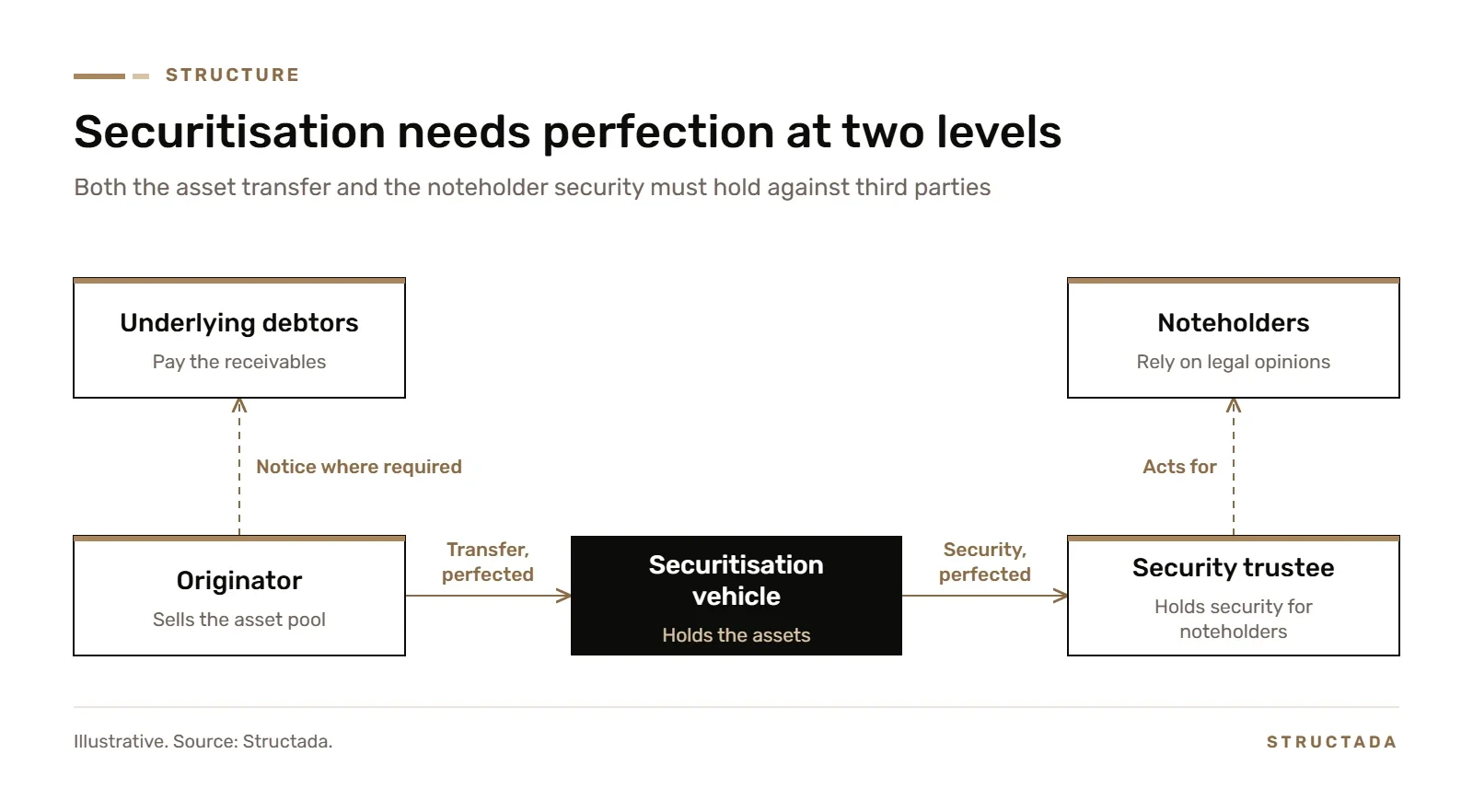
Securitisation adds a second layer. The transfer of assets from the originator to the vehicle must itself be effective against the originator's creditors and insolvency officer, which depending on the country may require registration, notice to the underlying debtors or both. The vehicle then typically grants security over its assets and accounts to a trustee for noteholders, and that security also needs perfecting.
Legal opinions on both levels are a standard condition of closing. They underpin the separation of the assets from the originator's estate, which is the foundation of how securitisation works.
Common perfection mistakes
Most failures are mundane. A registration deadline, such as the UK's 21-day window, is missed. A filing is made against the wrong name or in the wrong place, or is allowed to lapse without renewal. Security is taken over an asset but not over its proceeds or replacement assets. Local steps for assets in another country are overlooked, or contractual notice is relied on where the law requires registration. Filings are not updated after a name change, merger or relocation. None of these errors is exotic, which is precisely why they persist.
What this means for issuers
Perfection is the step that makes security count when it matters most, in a default or insolvency. For lenders and investors, it can mean the difference between full recovery and ranking with unsecured creditors. For issuers and originators, getting perfection right at closing, and keeping it right through the life of the deal, is what allows investors to rely on the assets behind their notes.
The work is technical and jurisdiction-specific, and it is best handled as a schedule rather than a sentence in the documents. A perfection checklist agreed with counsel for every asset and every country involved, with owners and dates for each ongoing step, is the most reliable protection an issuer can give its investors.
Frequently Asked Questions
What does perfection of security mean?
The steps that make a security interest effective against third parties, such as other creditors and an insolvency officer, as well as against the borrower.
What is the difference between attachment and perfection?
Attachment makes security binding between lender and borrower. Perfection makes it effective against everyone else.
What happens if security is not perfected?
The lender may be outranked by other creditors or, in insolvency, treated as unsecured.
What are the main methods of perfection?
Registration, possession, control and notice, depending on the asset and the jurisdiction.
How long do I have to register a charge in the UK?
Generally 21 days from creation, at Companies House. Late registration requires a court order.
Does perfection determine priority?
Usually. In most systems, the first security to be perfected or registered ranks first, subject to specific exceptions.