- A share pledge gives a lender security over the shares in a company, usually a borrower or a holding company, so that on default the lender can take control of the company or sell the shares.
- It is often the most important piece of security in private credit and real estate deals, because control of the company gives control of all its assets in one step.
- The legal form and the steps needed to perfect it depend on where the company is incorporated: a share charge under English law, a pledge recorded in the share register in Luxembourg, a notarised and registered pledge for a UAE LLC.
- Luxembourg share pledges are widely used because the financial collateral law allows quick out-of-court enforcement, including appropriation of the shares, and protects the pledge in insolvency.
- Lenders often use a holding company structure, sometimes with two holding companies, so that the share pledge sits over a company with nothing but the target assets beneath it.
A secured lender to a property company will typically take a mortgage over the buildings, a charge over the bank accounts and an assignment of the rents. Each is valuable, and each is slow to enforce. On default, realising them one by one can mean separate courts, separate procedures and months or years of delay, during which the assets lose value and the borrower's management remains in charge.
A pledge over the shares of the company that owns everything changes that position entirely. On default, the lender can take the shares, appoint its own directors and control the whole business in a single step, then sell it as a going concern or work out the assets on its own timetable. That is why experienced lenders often regard the share pledge as the security that matters most.
Its value, however, depends almost wholly on where the company is incorporated, how the holding structure is built and whether the pledge has been properly perfected. Those details decide whether the security works when it is needed.
What is a share pledge?
A share pledge is a form of security in which a shareholder grants a lender rights over its shares in a company to secure a debt. The shareholder, known as the pledgor, usually keeps ownership and voting rights while the loan performs. If a default occurs, the lender, known as the pledgee, can enforce by selling the shares, by taking ownership of them, or by exercising the votes to replace the board.
The pledge is usually granted by the borrower's parent over the borrower's shares, or by a sponsor over a holding company. It sits alongside security over the company's own assets, such as property, receivables and bank accounts, rather than replacing it. Asset-level security protects value; the share pledge delivers control.
How a share pledge works
The shareholder signs a pledge or share charge in favour of the lender, or in favour of a collateral agent where several lenders or noteholders share the security. The steps required by the company's home law are then taken to perfect it, such as recording the pledge in the share register or registering it with the relevant authority.
While the loan performs, the shareholder keeps its voting and dividend rights, subject to restrictions in the loan documents. On an event of default, the lender can serve notice, take over the voting rights and receive dividends. It then enforces, by selling the shares, appropriating them or using its control to sell the underlying assets, and applies the proceeds to the debt.
The moment that matters is the transfer of control. A pledge that cannot be enforced quickly, because of a missing consent, an unregistered filing or a restriction in the articles, gives the lender far less than it appears to on paper.
Share pledges in different jurisdictions
The law that governs a share pledge is usually the law of the company whose shares are pledged, so the form and perfection steps change with the place of incorporation.
| Jurisdiction | Form | Main perfection steps |
|---|---|---|
| England and Wales | Share charge or mortgage over shares | Registration at Companies House within 21 days if granted by a UK company; delivery of share certificates and signed transfer forms |
| Luxembourg | Pledge under the financial collateral law | Recording in the company's share register and acknowledgement by the company |
| United States | Security interest under Article 9 of the UCC | Control over certificated or uncertificated securities, or a UCC filing |
| UAE onshore LLC | Pledge of shares | Pledge consistent with the memorandum of association, typically notarised and registered in the commercial register |
| DIFC and ADGM | Security over shares | Filing with the DIFC Registrar of Security or registration with the ADGM Registration Authority |
Our guides to perfection of security, the UCC filing and perfecting security in the UAE explain these steps in more detail. A share charge and a share pledge serve the same purpose: English law usually uses a charge or mortgage over shares, while Luxembourg and many civil law countries use a pledge.
Why Luxembourg share pledges are so popular
Many international deals use a Luxembourg holding company precisely so that the lender can take a Luxembourg share pledge. The attraction lies in the Luxembourg law on financial collateral arrangements, which gives the pledgee a rare combination of speed and certainty.
On default, the pledgee can enforce without a court order, subject to the terms agreed. It can choose among several routes, including appropriating the shares at a fair value, a private sale, a public sale and court-ordered allocation. Financial collateral arrangements are designed to remain enforceable even if the pledgor becomes insolvent, and are protected against many insolvency challenges. Perfection is simple: recording the pledge in the share register is usually enough.
That combination has made the Luxembourg pledge a standard tool in real estate, leveraged and private credit financing. Luxembourg is also home to many securitisation vehicles, and the same financial collateral rules apply to security granted by a Luxembourg securitisation vehicle.
The double holding company structure
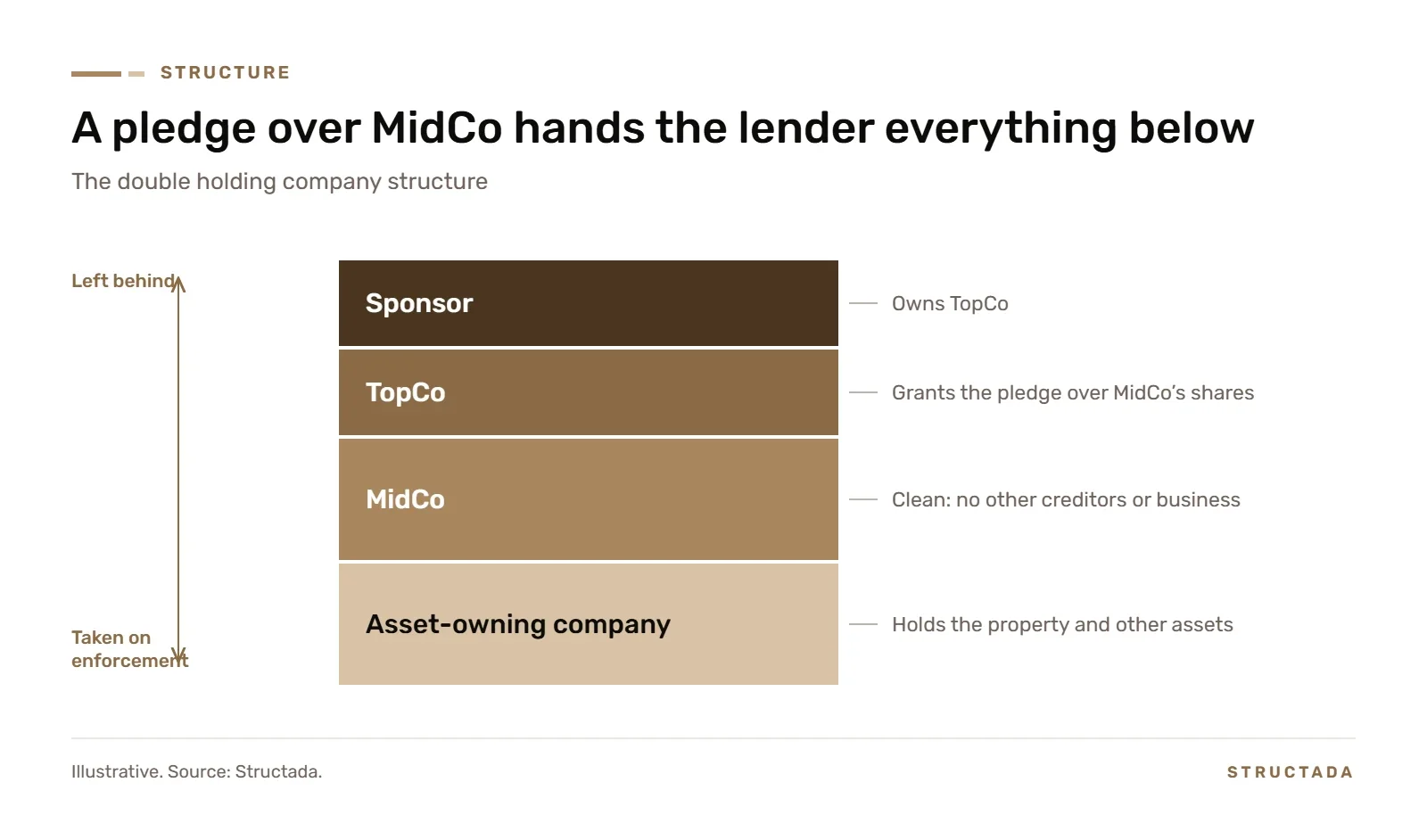
Lenders often ask for two holding companies above the asset-owning company. TopCo is owned by the sponsor and owns MidCo. MidCo owns the asset-owning company and has no other activities. The share pledge is granted by TopCo over the shares in MidCo.
On enforcement, the lender takes MidCo and, through it, everything below, while leaving TopCo's other liabilities behind. The value of the arrangement lies in MidCo being clean, with no other creditors, no other business and nothing that could complicate a transfer. A well-built MidCo makes the pledge more valuable and enforcement simpler, and it is often placed in a jurisdiction, such as Luxembourg, chosen for the strength of its pledge regime.
What lenders look for in a share pledge
Lenders start with clean ownership: no other security over the shares and no transfer restrictions that could block enforcement. The articles or memorandum must allow both the pledge and the transfer of shares on enforcement, and the documents must state clearly when voting rights pass to the lender and how distributions are restricted while the loan is outstanding.
Delivery items matter as much as the pledge itself. Share certificates, signed transfer forms, resignation letters from directors and powers of attorney, where the law allows, are what make enforcement practical on the day. Regulated businesses add a further layer, since a change of control may need approval before the lender can take the shares, and that approval can take longer than the enforcement itself.
Share pledges in structured finance
In private credit and securitisation, share pledges appear at two levels. At the borrower level, a lender, or a securitisation vehicle funding a loan through a credit linked note, takes a pledge over the borrower's shares as part of its security package, so that noteholders ultimately benefit from control of the underlying business.
At the level of the issuing structure, the shares of the issuing vehicle or a holding company are sometimes pledged to protect investors. In orphan structures the approach differs: the shares are held by a share trustee rather than pledged, as in a Cayman orphan SPV, so that no party with commercial interests controls the issuer.
What this means for issuers
A share pledge is among the most powerful forms of security a lender can take, because it delivers control of a whole business in one step. For borrowers and issuers, granting one is usually a condition of private credit, and the terms on which it can be enforced will shape both pricing and appetite.
The practical lesson is to structure with enforcement in mind from the outset. The jurisdiction of the holding company, the cleanliness of MidCo, the constitutional documents, regulatory approvals and perfection steps should all be settled before signing. Where several lenders or noteholders share the security, a collateral agent holding the pledge for all of them keeps enforcement orderly and the position of each creditor clear.
Frequently Asked Questions
What is a share pledge?
Security over the shares in a company, allowing a lender to take control of or sell the shares if the borrower defaults.
Who grants a share pledge?
The shareholder, usually the borrower's parent company or the sponsor's holding company.
Does the shareholder keep its voting rights?
Usually yes, until an event of default. After that, voting rights and dividends typically pass to the lender.
How is a share pledge enforced?
By selling the shares, appropriating them at fair value, or using control to sell the underlying assets, depending on the law and the documents.
Why are Luxembourg share pledges common?
Luxembourg's financial collateral law allows fast, out-of-court enforcement, including appropriation, and protects the pledge if the pledgor becomes insolvent.
Is a share charge the same as a share pledge?
They serve the same purpose. English law usually uses a charge or mortgage over shares, while Luxembourg and many civil law countries use a pledge.