- A Cayman orphan SPV is a special purpose company whose shares are held by an independent licensed trustee on a charitable or purpose trust, so it has no parent and is not owned by the originator or arranger.
- The orphan structure supports bankruptcy remoteness and off-balance sheet treatment: the SPV's assets should not be pulled back into the originator's group if the originator fails.
- "Orphan" describes who owns the vehicle, while a segregated portfolio company (SPC) describes how the vehicle is divided inside. An SPC can be, and often is, set up as an orphan.
- Cayman orphan SPVs are widely used for CLOs, repackagings, aircraft finance and other securitisations, and can usually be incorporated within one to two business days.
- Investor protection rests on independent directors, restricted objects, limited recourse and non-petition clauses, all of which rating agencies and investors will expect to see.
Every structured note issue eventually comes down to one question from investors: if the originator fails, will the assets backing these notes still be there? Where the issuing vehicle is a subsidiary of the originator, the honest answer is uncertain. A liquidator of the parent can argue that the subsidiary, and everything it holds, forms part of the group estate.
The Cayman orphan SPV answers that question by removing the parent altogether. Its shares are held by an independent trustee for charity, its directors are independent professionals and its activities are confined to the transaction. The Cayman Islands is one of the most established jurisdictions for the structure, alongside Jersey, Ireland and Luxembourg.
The structure is simple to describe and easy to get subtly wrong. Orphan ownership is only one layer of protection, and its value depends on how the rest of the vehicle is built, documented and run.
What is a Cayman orphan SPV?
A Cayman orphan SPV is a company, usually an exempted company incorporated under the Cayman Islands Companies Act, set up for a single financing purpose and owned by no one with an economic interest in the deal.
Typically a nominal number of shares is issued to a licensed Cayman trust company, known as the share trustee, which holds them on trust, usually for charitable purposes. As Ogier notes, publicly rated deals commonly use issued share capital of US$250, divided into 250 shares of US$1 each. The originator, the arranger and the investors hold none of the shares.
Because no transaction party owns it, the vehicle is in effect an orphan. The originator's economic interest sits in the transaction documents, such as a sale agreement, a servicing agreement or a holding of junior notes, rather than in share ownership.
How a Cayman orphan SPV works
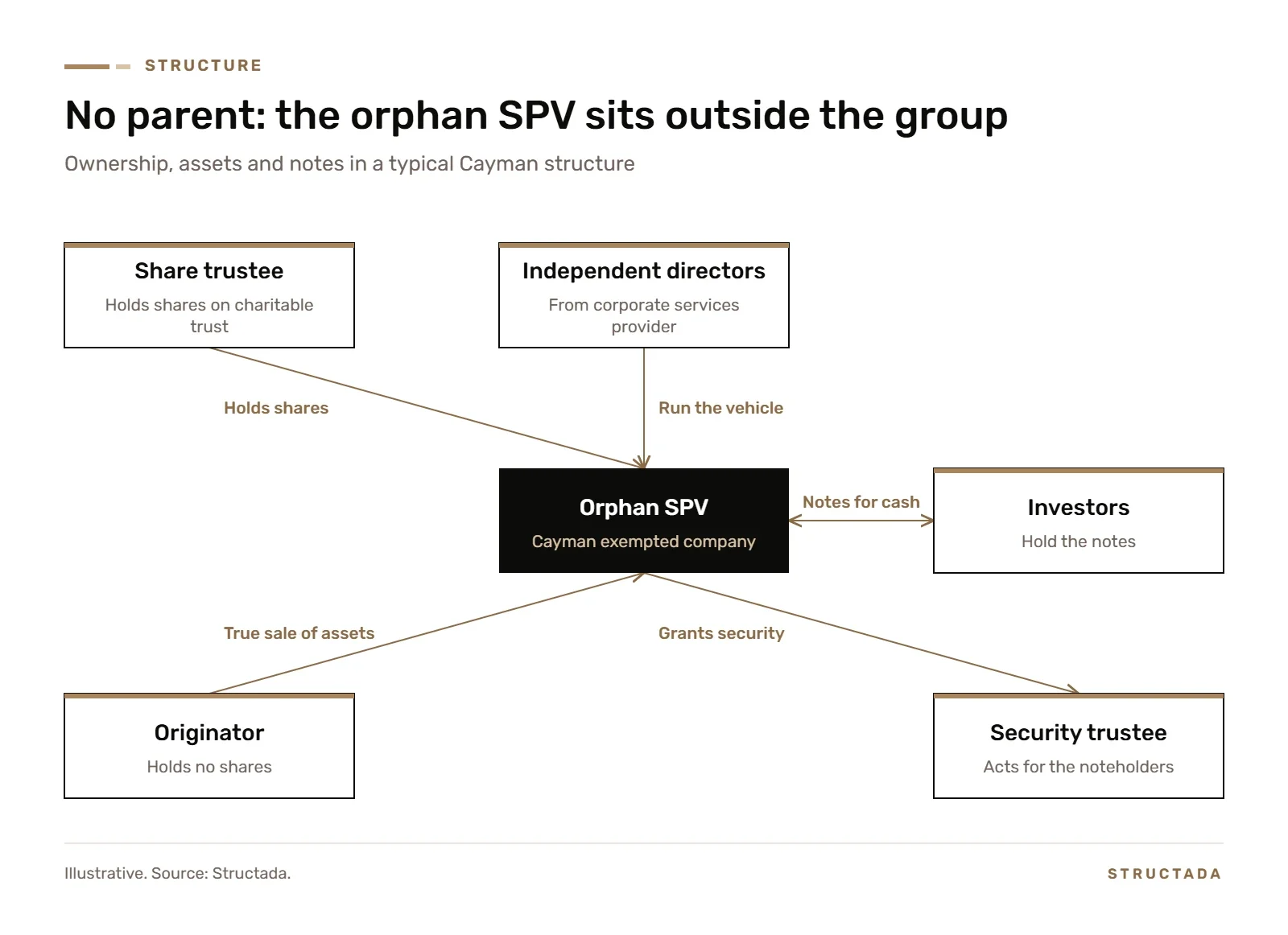
The share trustee, a licensed Cayman trust company, holds the shares on a charitable trust or on a STAR trust, the Cayman purpose trust regime, with a charity as residual beneficiary. A corporate services provider supplies the directors and the administration. Rated transactions usually have at least two independent directors with no connection to the arranger, so that the board can act in the interests of the vehicle rather than any single party.
The transaction then follows a familiar pattern. The originator sells or transfers the assets to the SPV, ideally by true sale. The SPV issues notes to investors and uses the proceeds to pay for the assets, granting security over them to a security trustee or note trustee acting for the noteholders. Collections from the assets pay the SPV's costs first, then interest and principal to investors through an agreed waterfall. Our guide to how securitisation works covers those mechanics in more detail.
What makes a Cayman SPV bankruptcy remote
Orphan ownership keeps the vehicle out of the originator's group, but it does not on its own stop the vehicle from failing. According to Mourant, bankruptcy remoteness is built from several features working together.
The first is a clean start: a new entity with no trading history and few creditors. Its constitution then restricts its objects to the transaction, so it cannot take on other business or other debt. Separateness follows from that: separate accounts, no mixing of assets with any other party and arm's-length dealings approved by the board.
The contractual protections do the rest. Limited recourse provisions confine each investor's claim to the proceeds of the specific assets backing their notes, with any shortfall extinguished rather than left as a debt capable of supporting a winding-up petition. Non-petition clauses commit every transaction party not to seek the SPV's winding up. Cayman law gives these clauses real force: under section 95(2) of the Companies Act, a Cayman court must dismiss or adjourn a winding-up petition brought in breach of such an agreement.
Rating agencies and investors examine each of these provisions, and a weakness in one can undermine the others.
Orphan SPV vs segregated portfolio company
The two terms are often confused because they so often appear together, but they answer different questions. An orphan SPV is defined by its ownership: the shares are held on trust, outside the originator's group. A segregated portfolio company is defined by its internal structure: one legal entity divided into segregated portfolios, each with its own assets and liabilities, ring-fenced by statute so that creditors of one portfolio cannot reach the assets of another.
As Mourant puts it, SPCs can be, and regularly are, incorporated as orphan trust vehicles. An issuer can therefore choose an orphan exempted company for a single deal, or an orphan SPC that issues many series, each in its own portfolio.
| Orphan exempted company | Orphan SPC | Luxembourg securitisation compartment | |
|---|---|---|---|
| Ownership | Share trustee on charitable or purpose trust | Share trustee on charitable or purpose trust | Usually orphan or platform-owned |
| Internal segregation | Contractual, through limited recourse | Statutory, by segregated portfolio | Statutory, by compartment under the Securitisation Law |
| Best suited to | A single deal, such as one CLO or one aircraft | Repeat issuance and repackaging programmes | Repeat issuance for European investors |
| Set-up time | One to two business days | Short, with each new portfolio added as needed | New compartment by board resolution on an existing vehicle |
| Common deals | CLOs, aircraft, single securitisations | Repack and note programmes | Credit linked notes, securitisations, fund-linked notes |
Comparable choices exist elsewhere. Guernsey offers the protected cell company, Jersey its own PCC and ICC, and Luxembourg the compartments of a securitisation vehicle.
Why issuers choose the Cayman Islands
Speed is the most practical advantage. An exempted company can be incorporated within one to two business days, and no government approval is needed for orphan status. There is no minimum share capital and no residency requirement for directors.
The tax position is equally straightforward. There is no Cayman income, capital gains or withholding tax, and an issuer can apply for a tax exemption undertaking, according to Conyers.
Familiarity may matter most of all. Investors, trustees, rating agencies and US and English counsel know the structure well. Notes can be listed on the Cayman Islands Stock Exchange, and the jurisdiction's position in US CLOs remains dominant: in June 2025, Cayman issuers with Delaware co-issuers made up 68% of CLOs listed there, as Maples reported. Our guide to why Cayman suits US-led issuances explains that pairing.
Where Cayman orphan SPVs are used
CLOs are the best-known use, with US transactions commonly pairing a Cayman issuer with a Delaware co-issuer. Repackagings are another: bonds, loans or other assets placed into a vehicle that issues new notes with a different risk, currency or payment profile. In aircraft and equipment finance, an orphan SPV holds the asset and leases it to the operator.
The structure is also used for securitisations of mortgages, auto loans, credit card receivables and insurance premium loans, and increasingly by private credit platforms that issue notes to investors against specific loans.
Points to check before using a Cayman orphan SPV
On economic substance, a pure financing vehicle is generally outside the relevant activities or subject to reduced requirements, but each vehicle's classification and filings should be confirmed. The SPV will usually need to register and report under FATCA and CRS, typically through its administrator. Note terms are often governed by English or New York law, which brings its own non-consolidation analysis.
Investor fit is the question most often settled too late. Some European investors and regulators prefer EU vehicles, and for notes aimed at them a Luxembourg vehicle or an Irish DAC may suit better, a trade-off set out in our comparison of Luxembourg and Cayman securitisation. Trustee, director, administration, audit and listing fees also run for the life of the vehicle and should be priced into the transaction from the start.
What this means for issuers
A Cayman orphan SPV gives investors what they need most from a structured transaction: a vehicle that sits outside the originator's group, is run by independent directors and does nothing but the deal. It is fast to establish, tax-neutral and understood by every party likely to sit across the table.
The decision that matters is less whether to use an orphan than which kind. A single-deal exempted company, an orphan SPC and a compartment on an existing European platform each fit a different pattern of issuance and a different investor base. Issuers who settle how often they will issue, where their investors sit and which vehicle those investors already know, before the vehicle is formed, avoid restructuring it later.
Frequently Asked Questions
What is an orphan SPV?
A special purpose vehicle whose shares are held by an independent trustee, usually on charitable trust, so it is not owned by the originator, arranger or investors.
Why is it called an orphan?
Because it has no parent company. Its shares are held on trust for charity or a purpose rather than by any party to the deal.
Is an orphan SPV the same as a segregated portfolio company?
No. Orphan describes ownership, while an SPC describes a company split into ring-fenced portfolios. An SPC can be set up as an orphan.
What is a share trustee?
A licensed Cayman trust company that holds the SPV's shares on trust, independently of the transaction parties.
What is a STAR trust?
A trust under the Cayman Special Trusts Alternative Regime, which can be set up for a purpose, such as holding an SPV's shares, rather than for named beneficiaries.
How long does it take to set up a Cayman orphan SPV?
The company can usually be incorporated within one to two business days. The full transaction takes longer, depending on documents, onboarding and investors.