- Most US collateralised loan obligations (CLOs) and many US-led repackagings are issued by a Cayman Islands company, often alongside a small Delaware co-issuer.
- The main reason is tax: a Cayman issuer pays no Cayman tax and, if it stays outside a US trade or business, no US tax on its income, while a US corporation would pay US corporate tax on its profit.
- CLO investment guidelines are written to keep the issuer within US rules that allow foreign companies to trade securities and loans without being treated as doing business in the US.
- The Delaware co-issuer helps some US insurers and regulated investors hold the senior notes, for example within limits on foreign investments.
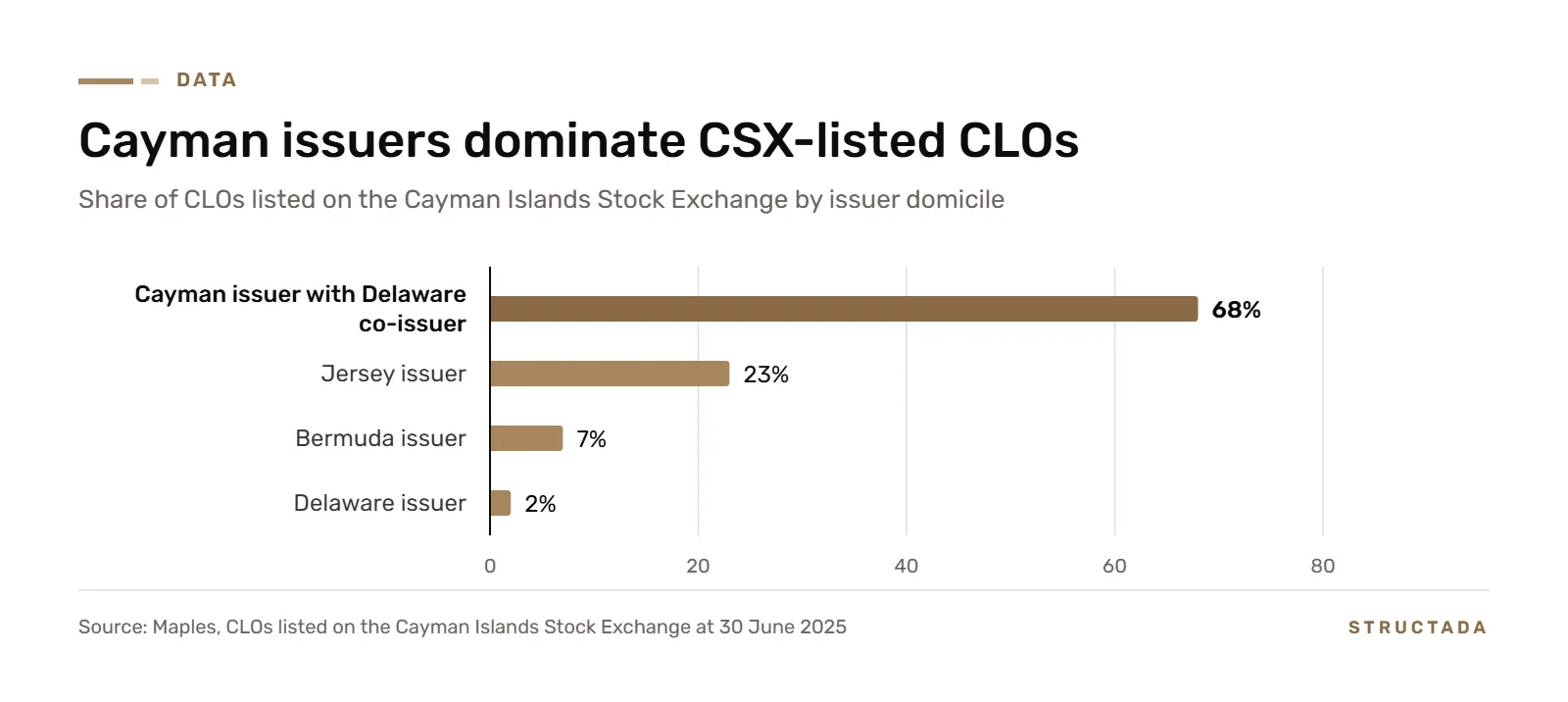
- Speed, an orphan structure that rating agencies know well, standard documents and familiarity among investors and lawyers keep Cayman the default. In June 2025, Cayman issuers with Delaware co-issuers made up 68% of CLOs listed on the Cayman Islands Stock Exchange.
A US CLO buys loans made to US companies. It is managed by a US manager, arranged by a US bank and sold mainly to US and international institutions. Yet the issuer of the notes is almost always a company incorporated in George Town, Cayman Islands.
The choice can look odd, but to practitioners it is simply the template. The Cayman issuer solves a tax problem that a US issuer would create, and it does so in a format the US structured finance market has refined over decades.
Understanding why the Cayman Islands is used for US-led issuances, how the Delaware co-issuer fits in and when the answer changes is useful to any issuer choosing a domicile for notes sold to American investors.
The tax problem a US issuer would create
A CLO earns interest on its loans and pays interest on its notes. The difference, after costs, flows to the equity investors. If the issuer were a US corporation, that profit would be subject to US federal corporate income tax at 21%, reducing returns for every investor in the deal.
A US partnership or LLC could avoid entity-level tax, but it creates difficulties of its own. Foreign investors in a US partnership that lends or trades through a US manager may be treated as carrying on a US trade or business themselves, with US tax filings and tax on their share of income. US investors in a partnership also face limits on deducting expenses.
A Cayman exempted company avoids both problems. The Cayman Islands charges no income, capital gains or withholding tax, and a foreign corporation is taxed in the US only on income connected with a US trade or business, plus withholding on certain US-source income. The whole structure therefore turns on keeping the issuer outside a US trade or business.
The trading safe harbour
US tax rules allow a foreign company to trade in stocks and securities for its own account, including through a US manager, without being treated as engaged in a US trade or business. This is often called the trading safe harbour, and CLO documents are built around it.
The first consequence is that broadly syndicated CLOs buy loans rather than originate them. They acquire assets in the primary syndication or the secondary market, because regular lending through a US agent may be treated as a US trade or business, as this analysis of onshore CLOs explains. The second is that the collateral manager operates under tax guidelines that limit activities which could create a US trade or business, such as negotiating new loans or taking on certain workout roles. Deals usually also obtain tax advice that the issuer should not be treated as engaged in a US trade or business.
Interest the Cayman issuer receives on US loans can generally be paid to it without US withholding tax under the portfolio interest rules, provided the loans and the issuer meet the conditions.
Neutral for investors everywhere
US CLOs attract investors from Japan, Europe, the Middle East and elsewhere, as well as from the US. A Cayman issuer keeps the deal neutral for all of them. Foreign investors do not become subject to US tax on business income through their investment, and payments on the notes come from a non-US issuer, so they are generally free of US withholding tax for foreign holders. US investors are taxed under their own rules, including specific regimes for holders of equity in foreign companies. Because the issuer itself pays no tax, nothing leaks out of the structure before investors are paid.
Why there is a Delaware co-issuer
Many US CLOs issue the senior notes jointly with a small Delaware company, known as the co-issuer. The co-issuer has no material assets. The Cayman issuer owns the loan portfolio and makes the payments.
The co-issuer exists mainly for investors. Some US insurers have limits on how much they can invest in foreign securities, and notes co-issued by a US entity have been treated by some as US obligations. Whether that treatment is correct is debated, because the co-issuer has no real assets or income, but the practice has become part of the standard structure. Junior notes and equity are typically issued by the Cayman issuer alone. Our guide to the role of Delaware in structured finance covers the US entity in more depth.
The orphan structure and bankruptcy remoteness
The Cayman issuer is usually set up as an orphan SPV. Its shares are held by a licensed Cayman share trustee on charitable or purpose trust, so it is owned by none of the manager, the arranger or the investors. Independent directors, restricted objects, limited recourse and non-petition clauses complete the picture.
Rating agencies, trustees and investors have reviewed this structure thousands of times, and that familiarity has real value in a market where speed and standard documents keep costs down.
The practical advantages reinforce the tax case. A Cayman exempted company can be incorporated in one to two business days, with no government approval needed for orphan status. There is no minimum share capital and no residency requirement for directors, and the companies law works well with New York law documents. The Cayman courts apply English common law principles and recognise non-petition clauses, with appeals to the Privy Council in London. Notes can be listed on the Cayman Islands Stock Exchange, Cayman complies with FATCA and CRS, and an established community of administrators, share trustees, independent directors and law firms works on hundreds of deals a year.
Cayman vs other jurisdictions for US-led deals
According to Maples, at 30 June 2025 the CLOs listed on the Cayman Islands Stock Exchange were split as follows.
| Issuer domicile | Share of CSX-listed CLOs |
|---|---|
| Cayman issuer with Delaware co-issuer | 68% |
| Jersey issuer | 23% |
| Bermuda issuer | 7% |
| Delaware issuer | 2% |
Jersey gained share while the Cayman Islands was on the EU's AML high-risk list, which mattered for deals sold to EU investors. Since Cayman's removal from that list in February 2024, it has regained its position as the leading choice.
Onshore US CLOs exist, and they can suit some insurers, because the notes do not count against foreign investment limits and no co-issuer is needed. They remain a small part of the market because of the tax and investor-status issues described above.
When Cayman is not the answer
Cayman is the default for US-led deals because the investors, documents and tax analysis are American. Where the investors are mainly European, the balance shifts. European private banks, insurers and wealth managers often prefer an EU issuer, and an EU vehicle can access tax treaties that a Cayman company cannot. For notes sold mainly in Europe, a Luxembourg securitisation vehicle is usually the more natural fit. Our comparison of Luxembourg vs Cayman Islands securitisation covers that choice in detail.
What this means for issuers
The Cayman Islands is used for US-led issuances because it keeps the structure tax neutral, keeps foreign investors outside US tax and offers a bankruptcy-remote vehicle that the US market knows intimately. The Delaware co-issuer and the trading safe harbour are part of the same template. For issuers whose investors are in the US, following that template avoids friction with rating agencies, trustees and buyers alike, and US notes are typically sold under Rule 144A and Regulation S.
For issuers selling to Europe, the domicile decision deserves a fresh look rather than a default. The right vehicle follows the investor base, and that question is best answered before documents are drafted. This article is a general overview and not tax or legal advice; US tax treatment depends on the specific structure and should be confirmed with advisers.
Frequently Asked Questions
Why are US CLOs issued from the Cayman Islands?
Because a Cayman issuer is tax neutral, can stay outside US tax by relying on the trading safe harbour, and is a structure US investors, lawyers and rating agencies know well.
What is a Delaware co-issuer?
A US company with no material assets that co-issues the senior notes of a Cayman CLO, mainly to help some US investors treat the notes as US obligations.
Would a US issuer pay tax?
A US corporation would pay US corporate income tax on its profit. A US partnership avoids entity-level tax but can create US tax issues for foreign investors.
What is the trading safe harbour?
A US tax rule that lets a foreign company trade securities for its own account, including through a US manager, without being treated as carrying on a US trade or business.
Why do CLOs buy loans rather than originate them?
Because regular lending through a US agent may be treated as a US trade or business, which could expose the issuer to US tax.
Do European deals use Cayman issuers?
Some do, but deals aimed mainly at European investors often use EU vehicles, such as Luxembourg securitisation compartments.