- Luxembourg and the Cayman Islands are two of the most used domiciles for securitisation vehicles, but they serve different investor bases: Luxembourg is built for European distribution, Cayman for US-led and global deals such as CLOs.
- Luxembourg offers a dedicated securitisation law, statutory compartments, EU status, access to tax treaties and a home for Clearstream. Cayman offers speed, tax neutrality, a flexible companies law and deep familiarity among US investors.
- Since February 2024, when the EU removed the Cayman Islands from its anti-money laundering high-risk list, Cayman vehicles are no longer barred as issuers in securitisations sold to EU investors.
- EU institutional investors must carry out the same due diligence under the EU Securitisation Regulation whatever the domicile, but many find an EU vehicle easier to assess, approve and hold.
- For notes aimed mainly at European private banks, family offices and wealth managers, Luxembourg is usually the simpler route. Cayman tends to win where US investors lead or the deal follows a US template.
Every securitisation needs a home. The choice of where to set up the issuing vehicle shapes who can buy the notes, how they are taxed, how long the deal takes to launch and how comfortable investors feel signing off on it. It is usually made early, often by default, and it is difficult to reverse once the first notes are in investors' hands.
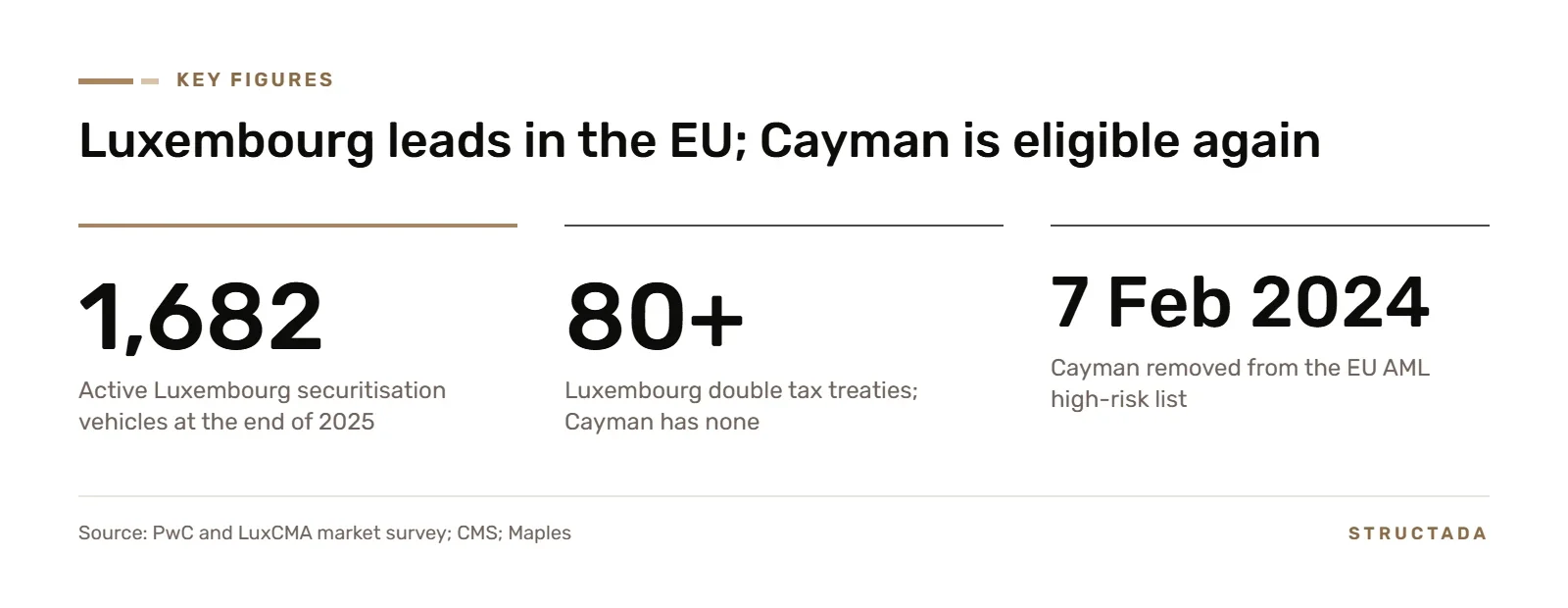
For deals with a European element, the Luxembourg vs Cayman securitisation question comes up more often than any other. Luxembourg is the largest securitisation centre in the EU, with 1,682 active vehicles at the end of 2025, according to the PwC and LuxCMA market survey. The Cayman Islands is the leading offshore domicile for US CLOs and a long-standing choice for repackagings and aircraft finance.
Both work. The real question is which one fits the investors who will buy the notes, and this guide compares the two on the points that matter most for European distribution.
Luxembourg securitisation vehicles and Cayman SPVs
A Luxembourg securitisation vehicle is a company, partnership or fund set up under the Law of 22 March 2004 on securitisation, reformed in 2022. It can create any number of compartments, each ring-fenced by statute, and issue notes from each one. Most vehicles are unregulated: a licence from the CSSF is needed only where the vehicle issues to the public on a continuous basis.
A Cayman orphan SPV is usually an exempted company, sometimes a segregated portfolio company, whose shares are held by a licensed share trustee on charitable or purpose trust. It relies on the general Cayman companies law, with ring-fencing achieved through limited recourse and non-petition clauses, or through segregated portfolios.
The difference in legal foundation runs through everything that follows. Luxembourg gives the issuer a statute written for securitisation; Cayman gives it a flexible corporate law and a long record of market practice built on contract.
Luxembourg vs Cayman at a glance
| Luxembourg | Cayman Islands | |
|---|---|---|
| Legal basis | Dedicated securitisation law (2004, amended 2022) | General companies law, plus SPC and STAR trust regimes |
| Segregation | Statutory compartments | Contractual limited recourse, or segregated portfolios in an SPC |
| EU status | Inside the EU | Outside the EU |
| Tax | Taxable company, but commitments to investors are deductible, so typically close to neutral | No income, capital gains or withholding tax |
| Tax treaties | More than 80 double tax treaties | None |
| Typical set-up | A few weeks for a new vehicle; a new compartment on an existing vehicle by board resolution | One to two business days to incorporate |
| Main investor base | European banks, insurers, private banks, family offices | US institutions, CLO investors, global funds |
| Typical deals | Credit linked notes, repacks, trade receivables, fund-linked notes, private ABS | US CLOs, repacks, aircraft and equipment finance |
| Listing | Luxembourg Stock Exchange, Euro MTF | Cayman Islands Stock Exchange |
The EU Securitisation Regulation and the choice of domicile
The EU Securitisation Regulation places due diligence duties on EU institutional investors, such as banks, insurers, pension funds and fund managers. Before buying a securitisation position, they must check risk retention, transparency and credit-granting standards, wherever the issuer is based.
There is one domicile-specific rule. Article 4 of the Regulation prevents the issuing vehicle from being established in a country on the EU's AML high-risk list or its list of non-cooperative tax jurisdictions. The Cayman Islands was on the AML list from 2022 until 7 February 2024, when it was removed, as Maples reported. During that period, Cayman vehicles could not be used for securitisations sold to EU investors. Today they can.
That episode still weighs on some investors. A Luxembourg vehicle carries no listing risk of this kind, which can make internal approvals faster, particularly at private banks and insurers with policies on offshore exposure.
The EU framework is also being reformed. The European Commission proposed changes in June 2025, aimed at easing due diligence, and trilogue negotiations are expected in the second half of 2026, according to Walkers. Issuers should watch how the final text treats non-EU deals.
Tax treatment in Luxembourg and Cayman
Both jurisdictions aim for tax neutrality, so that investors are taxed on their returns while the vehicle itself pays little or nothing. They reach it by different routes.
Cayman gets there directly. There is no income, capital gains or withholding tax, and a vehicle can obtain a tax exemption undertaking.
Luxembourg gets there through deductions. A corporate securitisation vehicle is fully taxable, but payments to investors and creditors, including interest and returns on the notes, are generally deductible, as CMS explains. There is no withholding tax on interest paid to non-residents in most cases, management services are VAT-exempt, and the vehicle is exempt from net wealth tax apart from a minimum charge. As a Luxembourg tax resident, it can also access Luxembourg's network of more than 80 tax treaties, which can reduce withholding tax on income from underlying assets.
Set-up time and cost
Cayman is faster to set up. An exempted company can be incorporated in one to two business days, and an orphan structure needs no government approval.
Luxembourg takes longer for a brand-new vehicle, but much of that disappears where an issuer uses a compartment on an existing platform. The vehicle, its board, auditors and service providers are already in place, so a new compartment can be created by board resolution and the deal can focus on the assets and the notes. Multi-compartment vehicles are now the norm in Luxembourg, and some run hundreds of compartments.
Running costs in both jurisdictions include directors, administration, audit, trustee or agent fees and listing. The difference usually comes down to whether the issuer is building a new vehicle or using an existing one.
Clearing and investor operations
Both Luxembourg and Cayman notes can carry an ISIN and settle through Euroclear and Clearstream. European private banks and wealth managers tend to be more familiar with Luxembourg issuers, which helps with custody onboarding, product approval and suitability checks. For notes sold through wealth channels in Europe, that familiarity often saves weeks.
Choosing between Luxembourg and Cayman
Luxembourg tends to suit notes sold mainly to European investors, especially private banks, family offices and insurers. It works well for repeat issuance through compartments on an established platform, for assets that benefit from treaty access, and for credit linked notes and private ABS issued by lenders building a European investor base.
Cayman tends to suit US-led deals, including CLOs with a Delaware co-issuer, and transactions that follow a US or global template with New York law documents. It is also the natural choice where speed of incorporation matters most, or where the investor base already holds Cayman issuers and sees no internal hurdle. Our guide to why Cayman is used for US-led issuances sets out that case in full.
What this means for issuers
Neither domicile is better in every case, and the deciding factor is rarely the law and almost always the buyer. For an issuer whose investors are mainly in Europe, the Luxembourg route usually removes friction at the point that matters most: getting the notes approved and onto investors' books. Where the book is led from New York, Cayman remains the established answer. Settling that question before documents are drafted saves time later, and our guide to how securitisation works sets out the wider process.
Frequently Asked Questions
Can EU investors buy securitisations issued by a Cayman SPV?
Yes. Since the Cayman Islands was removed from the EU AML high-risk list on 7 February 2024, Cayman vehicles can be used for securitisations sold to EU investors, subject to the investors' own due diligence.
Is a Luxembourg securitisation vehicle regulated?
Usually not. CSSF authorisation is needed only where the vehicle issues financial instruments to the public on a continuous basis.
Which is cheaper, Luxembourg or Cayman?
It depends on the set-up. A new Cayman company is quick and inexpensive to form, while a compartment on an existing Luxembourg platform avoids most set-up costs.
Does Luxembourg tax securitisation vehicles?
Corporate vehicles are taxable, but commitments to investors are generally deductible, so the vehicle's taxable profit is usually small.
Why are US CLOs issued from the Cayman Islands?
Cayman is tax neutral, quick to use and well understood by US investors, and a Cayman issuer with a Delaware co-issuer is the established market template.
Can a Cayman SPV have compartments like Luxembourg?
A Cayman segregated portfolio company can create segregated portfolios, which work in a similar way to Luxembourg compartments.