- Delaware is the default home for special purpose entities in US structured finance, thanks to its flexible LLC and statutory trust laws, a deep body of case law and its specialist business court, the Court of Chancery.
- Delaware LLCs and Delaware statutory trusts are used as issuers, depositors, owner trusts and holding vehicles in securitisations, equipment finance and private credit.
- Delaware law lets the parties limit an entity's purpose, require an independent manager's consent to a bankruptcy filing and modify fiduciary duties, which supports the bankruptcy remoteness that investors and rating agencies require.
- In offshore structures, Delaware is often the US leg: a Delaware co-issuer alongside a Cayman CLO issuer, or a Delaware borrowing or holding vehicle through which offshore funding reaches US businesses and assets.
- Because a Delaware entity is located in Delaware for UCC purposes, security over its personal property is perfected by filing in Delaware, wherever the business operates.
Delaware is one of the smallest US states, yet a large share of America's business and financial structures are formed under its law. Corporations choose Delaware for its corporate law and its courts. Structured finance chooses it for something more specific: entities that can be set up quickly, shaped almost entirely by contract and made as resistant as possible to bankruptcy.
Open the structure chart of almost any US asset-backed deal and Delaware entities appear at several levels: the depositor, the issuer, the owner trust, the holding company. The same is true when the funding comes from abroad. A Cayman CLO, a Luxembourg note issuer or an offshore credit fund lending into the United States will very often meet the US assets through a Delaware vehicle.
Understanding the role of Delaware in structured finance is therefore less a matter of US domestic law than of how the whole transaction holds together, and where the risks sit if it is tested.
Why Delaware?
The case for Delaware rests on a combination of statute, courts and habit. The Delaware LLC Act and Statutory Trust Act are designed to give the parties maximum freedom of contract, so the governing agreement, rather than default rules, decides how the entity behaves. Decades of decisions give lawyers and rating agencies confidence about how Delaware entities will be treated, and the Court of Chancery, a specialist business court, decides entity disputes without juries, before judges experienced in commercial matters.
Practicality matters too. Entities are formed by a short filing, ongoing fees are modest and the only local requirement is a registered agent or Delaware trustee. Familiarity compounds the advantage. Rating agencies, trustees and investors are used to Delaware special purpose entities, and Moody's has described Delaware as "the preferred state" for single-member LLC SPEs, as this analysis notes.
The main Delaware vehicles
Four forms account for most Delaware entities in structured finance, and two of them, the LLC and the statutory trust, do most of the work.
| Vehicle | Main features | Typical uses |
|---|---|---|
| Delaware LLC | Single or multiple members; governance set by the LLC agreement; flexible tax classification | Depositors, issuers, borrowing SPVs, holding companies, co-issuers |
| Delaware statutory trust (DST) | Separate legal entity; perpetual existence; beneficial owners' creditors generally cannot reach trust assets | Auto and equipment ABS issuers, owner trusts, master trusts |
| Delaware corporation | Traditional corporate form with a board | Co-issuers, operating companies, holding companies |
| Delaware limited partnership | General and limited partners | Funds and investment vehicles |
The LLC is the workhorse, valued because almost every aspect of its governance can be set out in the LLC agreement. The statutory trust is preferred for many asset-backed securities issuers, particularly in auto and equipment finance, because it combines separate legal personality with strong insulation of the trust's assets from the creditors of its beneficial owners.
How Delaware supports bankruptcy remoteness
In a securitisation, investors need protection from two insolvencies: the originator's and the SPV's own. Delaware law helps on both, and it does so mainly by letting the parties write the protections into the entity itself.
The governing agreement restricts the entity to the transaction, so it has no unrelated assets or creditors. A voluntary bankruptcy filing can be made subject to the consent of an independent manager or director, usually supplied by a corporate services provider, and Delaware allows the agreement to modify or eliminate fiduciary duties so that the independent manager can act in line with the structure's purpose. A single-member LLC can provide for a springing member who steps in automatically if the sole member ceases to be a member, so the entity does not dissolve, and a member's or beneficial owner's bankruptcy does not dissolve the entity unless the agreement says so.
Separateness covenants, requiring separate books, accounts and decision-making, reduce the risk of substantive consolidation with the originator. And depending on its features, a statutory trust may not qualify as a debtor under the US Bankruptcy Code at all. Together these features are what rating agencies look for when they assess whether the assets will remain available to noteholders, which is the premise of how securitisation works.
Delaware in US securitisations
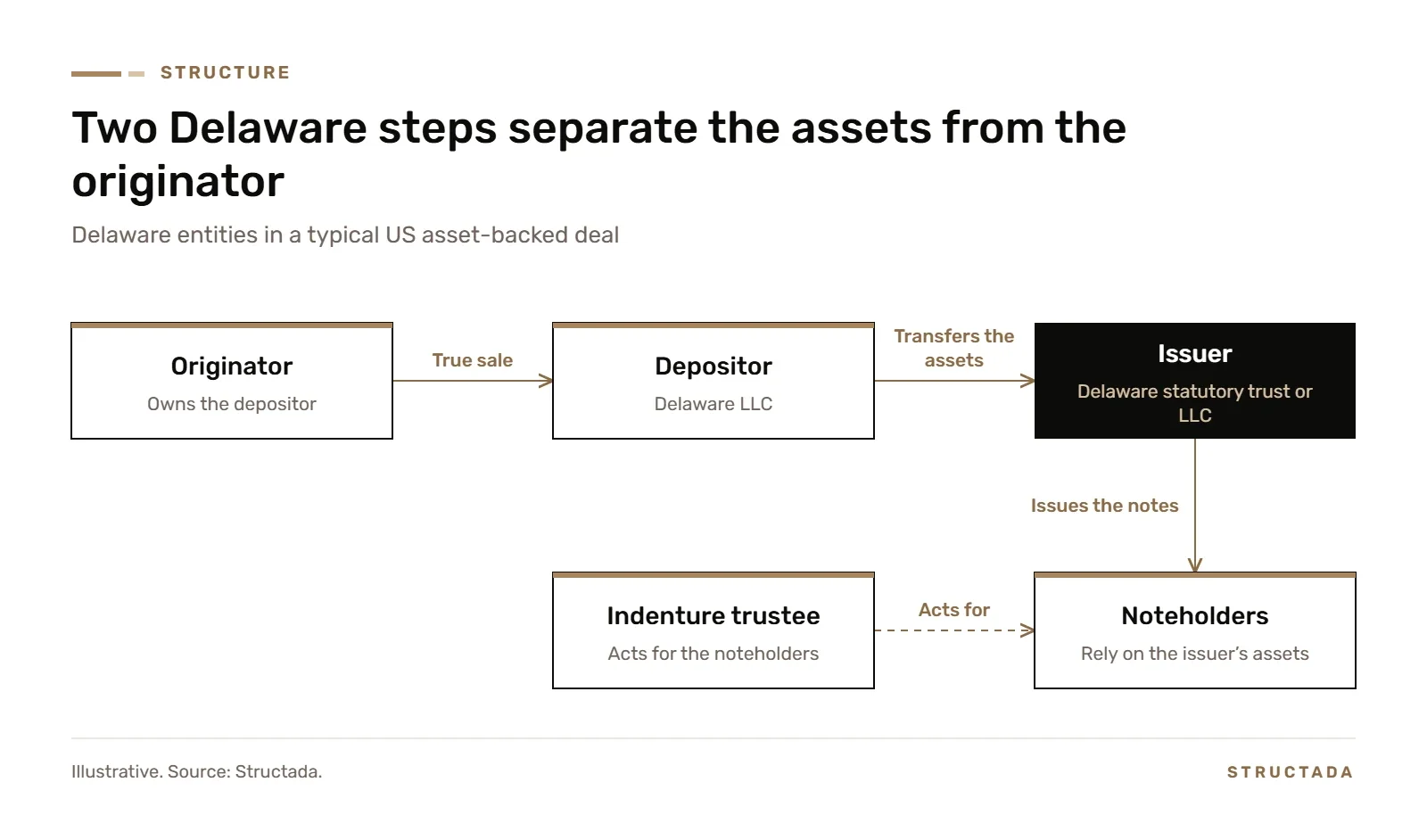
A typical US asset-backed deal uses Delaware entities in sequence. The depositor, usually a Delaware LLC owned by the originator, buys the assets from the originator in a true sale. The issuer, often a Delaware statutory trust or LLC, acquires the assets from the depositor and issues the notes. Where the issuer is a statutory trust, an owner trustee acts for it, while an indenture trustee acts for the noteholders. Tax classification is arranged so that the issuer avoids entity-level US tax, for example as a disregarded entity or grantor trust.
The two-step transfer through a depositor is deliberate. It strengthens the true sale analysis and puts a further entity between the assets and the originator, which is why the pattern has become standard.
Delaware in offshore structures
Delaware is just as important when the investors are outside the US. US CLOs are usually issued by a Cayman Islands company with a small Delaware co-issuer for the senior notes. The Cayman issuer holds the loans and keeps the structure tax neutral, while the Delaware co-issuer helps some US investors treat the notes as US obligations. Our guide to why the Cayman Islands is used for US-led issuances explains the full structure, and our comparison of Luxembourg and Cayman securitisation sets out when each is preferred.
When offshore lenders, funds or note issuers finance US businesses, the US borrower or asset-holding entity is often a Delaware LLC. It holds the US assets, grants security and receives the funding, while the lender or issuer sits offshore. Offshore investors sometimes also hold US investments through Delaware corporations acting as blockers, to manage US tax exposure and avoid business income flowing directly to them. A Luxembourg or Cayman issuer lending to a US business will usually take security over the shares and assets of the Delaware borrower, including a share pledge, governed by New York or Delaware law.
Delaware and UCC filings
Because a Delaware LLC, statutory trust or corporation is a registered organisation formed under Delaware law, it is treated as located in Delaware for Article 9 purposes. Security over its personal property is therefore perfected by filing a UCC-1 financing statement with the Delaware Secretary of State, even if all its assets and operations are in another state. Filing in the state where the business operates, a common mistake, achieves nothing. Our guide to UCC filings explains the rules.
Costs and practicalities
Forming a Delaware entity is straightforward. A certificate of formation or certificate of trust is filed with the Delaware Division of Corporations, and the substance sits in the LLC agreement or trust agreement, which sets out purpose, governance and the bankruptcy protections. An LLC needs a local registered agent, and a statutory trust a Delaware-resident trustee. The independent manager is usually provided by a corporate services firm. LLCs pay a modest annual tax, while statutory trusts generally pay no annual Delaware fee.
What this means for issuers
Delaware is the connective tissue of US structured finance. Its LLCs and statutory trusts provide the bankruptcy-remote, contract-driven vehicles that securitisations need, and its co-issuers and borrowing entities link offshore issuers and investors to US assets.
For non-US issuers financing US businesses, the Delaware entity is often the point at which the investors' protection is won or lost. The governing agreement must carry the separateness and independent manager provisions the rating agencies expect, the security over the entity must be perfected in Delaware, and those filings must be maintained for the life of the notes. Treating the Delaware leg as routine paperwork is the surest way to weaken an otherwise sound structure.
Frequently Asked Questions
Why are so many SPVs formed in Delaware?
Because Delaware's LLC and statutory trust laws offer flexibility, limited liability and strong bankruptcy-remoteness features, backed by extensive case law and a specialist business court.
What is a Delaware statutory trust?
A separate legal entity created under the Delaware Statutory Trust Act, often used as an issuer in auto and equipment ABS.
What is a Delaware co-issuer?
A Delaware company that co-issues the senior notes of a Cayman CLO, holding no material assets itself.
What is a springing member?
A special member of a Delaware single-member LLC who automatically becomes a member if the sole member ceases to be one, preventing dissolution.
Where do you file a UCC-1 against a Delaware LLC?
With the Delaware Secretary of State, because a Delaware LLC is treated as located in Delaware for UCC purposes.
How does Delaware fit into offshore financing?
Delaware entities often serve as the US borrower, asset holder or co-issuer, linking an offshore issuer or lender to US businesses and assets.