- An asset-backed security (ABS) is a bond repaid from the cash flows of a pool of assets, such as auto loans, credit card balances, consumer loans, leases or trade receivables.
- The originator sells or transfers the assets to a special purpose vehicle, which issues the ABS, so investors rely on the assets rather than the originator's balance sheet.
- Most ABS are issued in tranches, with senior notes paid first and junior notes or retained equity absorbing losses first.
- Public ABS are rated and widely sold, while private ABS are placed with a small number of investors and suit smaller or newer originators.
- Issuers need clean data, a robust servicing set-up, the right vehicle and, in Europe and the US, must generally retain at least 5% of the risk.
A lender that writes car loans meets the same constraint as it grows. Each loan ties up funding until the borrower repays, and its balance sheet can stretch only so far. The established answer is to pool thousands of those loans and sell bonds backed by them. The lender recovers its funding and can lend again, and investors hold a security whose payments come from the loans themselves.
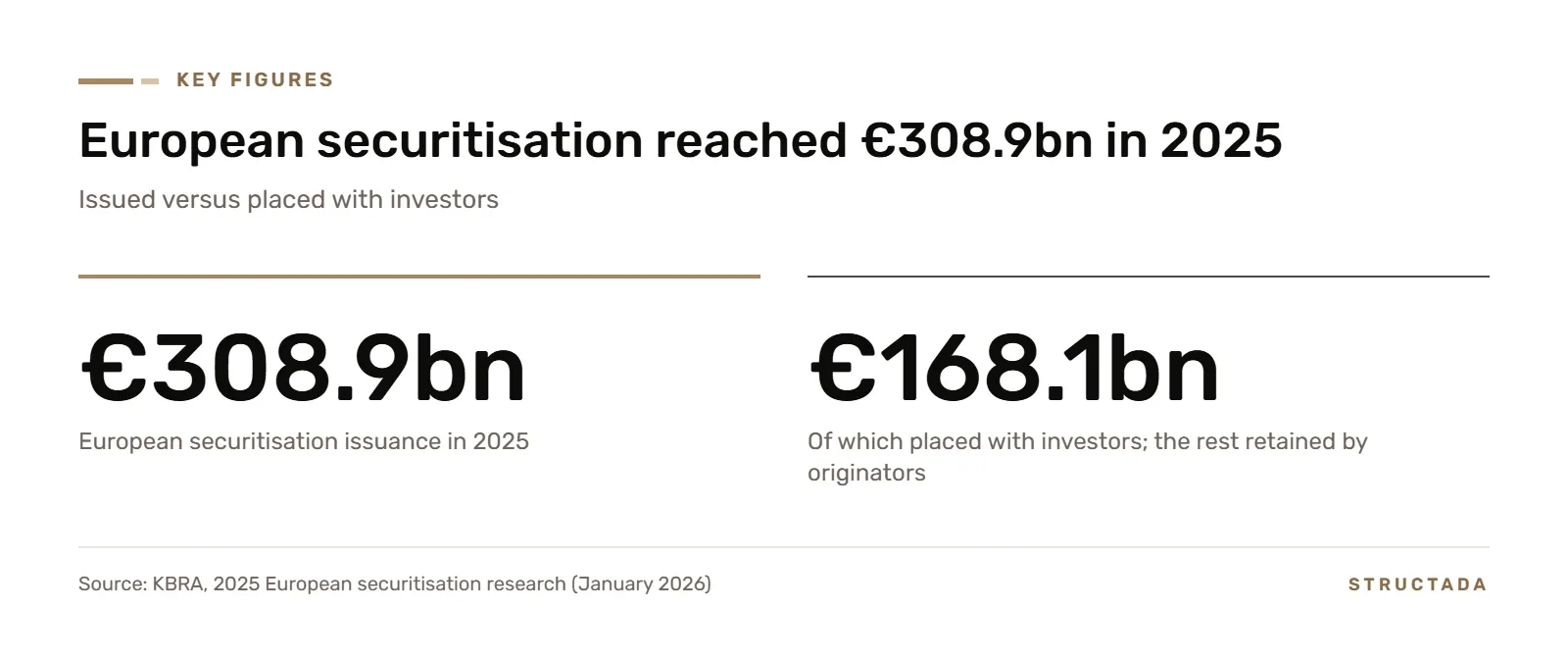
That security is an asset-backed security, or ABS. It is one of the oldest and largest instruments in structured finance, and the most common route by which lenders fund their loan books in the capital markets. In Europe alone, securitisation issuance reached around €308.9 billion in 2025, according to KBRA, of which €168.1 billion was placed with investors.
The gap between those two figures reflects notes retained by their originators rather than sold, and it is the placed portion that sets investor appetite and pricing. For a specialist lender, the question is how to reach that placed market, and on what terms.
What is an ABS?
An asset-backed security is a debt security whose interest and principal are paid from the cash generated by a defined pool of assets. The assets are usually loans or receivables with predictable payments: car loans and leases, credit card balances, personal loans, student loans, equipment leases or trade receivables.
The term is used in two senses. Broadly, ABS covers any security backed by a pool of assets, including mortgage-backed securities and collateralised loan obligations. In market practice, it usually means securities backed by consumer and commercial receivables other than mortgages and corporate loans. Our guide to securitised credit covers the wider family.
How an ABS works
The structure follows a well-established sequence:
- the originator makes the loans or generates the receivables in its normal business;
- the assets are transferred to a special purpose vehicle, usually by true sale, separating them from the originator's creditors;
- the vehicle issues notes to investors, typically in tranches, and pays the proceeds to the originator;
- a servicer, often the originator, continues to collect from borrowers;
- collections flow through a waterfall to fees, senior notes, junior notes and finally the originator.
The essential point is the separation. Because the assets sit in a vehicle that is remote from the originator's insolvency, investors are exposed to the performance of the pool, and the originator's own credit standing matters chiefly through its role as servicer. Our article on how securitisation works explains the mechanics, including true sale and synthetic structures, in more detail.
Types of asset-backed securities
The market divides by collateral, and each asset class brings its own characteristics. Auto ABS, backed by car loans and leases, are typically short, amortising and highly granular. Credit card ABS are backed by revolving balances and are usually issued through master trusts that come to market repeatedly. Consumer loan ABS, backed by personal and instalment loans, are often issued by fintech and specialist lenders, while student loan ABS, whether private or government-backed, tend to carry long maturities.
On the commercial side, equipment ABS are backed by equipment loans and leases to business obligors, and trade receivables ABS by invoices owed to companies, which are short-dated and often revolving. A growing esoteric segment covers royalties, franchise fees, data centres and aircraft, where the collateral and structures are more specialised and investors expect correspondingly deeper analysis.
How investors are protected
ABS investors rely on several layers of credit enhancement, and the way they combine is central to any transaction. Subordination is the first: junior tranches absorb losses before senior ones. Overcollateralisation means the pool is worth more than the notes issued, and excess spread, where interest on the assets exceeds interest on the notes, creates an earlier buffer still.
Many structures add a reserve fund, cash set aside to cover shortfalls, and performance triggers. If losses or arrears rise beyond agreed levels, cash is diverted to repay senior notes early, protecting them at the expense of junior holders. Together, these protections allow senior ABS tranches to achieve high credit ratings, often well above the rating of the originator itself.
Public vs private ABS
| Public ABS | Private ABS | |
|---|---|---|
| Investors | Many institutional investors | One or a few investors |
| Ratings | Usually rated by one or more agencies | Often unrated |
| Size | Typically hundreds of millions | Can be much smaller |
| Disclosure | Full offering document, public reporting | Agreed directly with investors |
| Speed and cost | Longer and costlier to set up | Faster and cheaper |
| Typical issuer | Established, large originators | Growing, specialist or first-time originators |
Many specialist lenders start with private funding, such as a warehouse facility or a privately placed note, and move to public ABS once their book is large and seasoned enough to support ratings and a broad investor base.
ABS vs CLO vs CLN
ABS are often discussed alongside collateralised loan obligations and credit linked notes, and the three overlap. A CLO is backed by leveraged corporate loans and is actively managed by an asset manager, issuing tranched notes from a special purpose vehicle. An ABS is backed by consumer and commercial receivables, with a pool that is usually static or revolves within set rules, and is issued by lenders and companies with receivables to fund.
A credit linked note is typically linked to a defined loan, facility or portfolio, is usually static, and is issued from a ring-fenced compartment. Issued from a Luxembourg securitisation vehicle, it can achieve a result similar to a private ABS for a smaller lender: the loan book is funded by investors through a security with an ISIN, without the cost of a full public transaction.
What issuers need to bring an ABS to market
The starting point is data. Investors and rating agencies expect loan-level performance history, typically covering several years of arrears, defaults, recoveries and prepayments. The pool itself must meet clear eligibility criteria on borrower, size, tenor and status, and a special purpose vehicle or compartment is needed to hold the assets and issue the notes.
Servicing must be proven, with established collection processes and, on larger transactions, a backup servicer. Risk retention applies in the EU, the UK and the US, where the originator or sponsor must generally keep at least 5% of the economic risk. The transaction also needs an arranger, lawyers, a trustee, a paying agent and, for rated deals, rating agencies. Finally, the notes need an ISIN and settlement through Euroclear and Clearstream, with a listing where investors require one.
What this means for issuers
Asset-backed securities let a lender fund its book against the assets themselves, freeing its balance sheet to keep growing and giving investors exposure to the loans rather than to the lender. For established originators, public ABS can be among the cheapest sources of funding available.
For smaller and growing lenders, the route usually starts privately: a warehouse line, a private ABS or a credit linked note from an existing platform. Each of those builds the performance history, data discipline and investor relationships that a public transaction will later demand, and the lenders who treat their first private deal as preparation for the public market tend to reach it sooner.
Frequently Asked Questions
What is an ABS in simple terms?
A bond whose payments come from a pool of loans or receivables, such as car loans or credit card balances, rather than from the general finances of the company that made them.
What are examples of asset-backed securities?
Auto loan ABS, credit card ABS, student loan ABS, consumer loan ABS, equipment lease ABS and trade receivables ABS.
What is the difference between an ABS and an MBS?
Mortgage-backed securities are backed by mortgages. ABS usually refers to securities backed by other consumer and commercial receivables.
Who issues ABS?
Banks, finance companies, car manufacturers' lending arms, credit card issuers, specialist and fintech lenders, and companies with large receivables books.
Why do companies issue ABS?
To fund their assets, often at a lower cost than unsecured borrowing, to free up balance sheet capacity and to diversify their funding sources.
Do ABS issuers have to retain risk?
Yes, in most major markets. EU, UK and US rules generally require the originator or sponsor to retain at least 5% of the credit risk.