- A group of companies can fund itself through a single note issue rather than each company borrowing on its own, which reduces cost, widens the investor base and gives the group one funding platform.
- The three main structures are a multi-originator securitisation, a funding vehicle that lends the proceeds on to group companies, and separate compartments for different businesses or asset types.
- Every structure raises legal questions in each country where a group company sits, including asset transfer rules, corporate benefit, financial assistance and tax.
- Investors want to know exactly which assets and which companies support their notes, so clear eligibility criteria, consistent reporting and ring-fencing are essential.
- The right structure depends on whether the group's value lies in its assets, such as receivables or loans, or in its overall credit as a business.
Very few established businesses are a single company. A specialist lender may hold its loan books in separate licensed entities in several countries. A trading group may invoice customers through subsidiaries across Europe and the Middle East. A real estate or infrastructure group will often hold each asset in its own company, for good reasons of liability and tax.
When such a group needs funding, the default is for each company to borrow separately, with its own facility, its own lender and its own documents. The result is a patchwork of terms, covenants and maturities that consumes management time and prices each entity on its own, usually smaller, balance sheet. The alternative is to issue notes once, through a single vehicle, and distribute the funding across the group.
Issuing notes for a group of companies works only if the structure reflects where the group's value really sits. This guide explains the main structures and the cross-border issues that decide whether the arrangement holds together.
Why groups issue notes at group level
The case rests on scale and consistency. A combined portfolio is larger and more diversified than any single entity's, which broadens the range of investors who can participate and tends to support better pricing. Pooling assets from several companies and countries also reduces concentration on any one originator, market or debtor group.
There is an operational argument too. One vehicle, one set of documents and one investor relationship replace a dozen bilateral negotiations. Fixed costs such as legal, audit, trustee and agent fees are shared across the group rather than duplicated, and new companies can usually join as the business grows without the structure being rebuilt.
Multi-originator securitisation
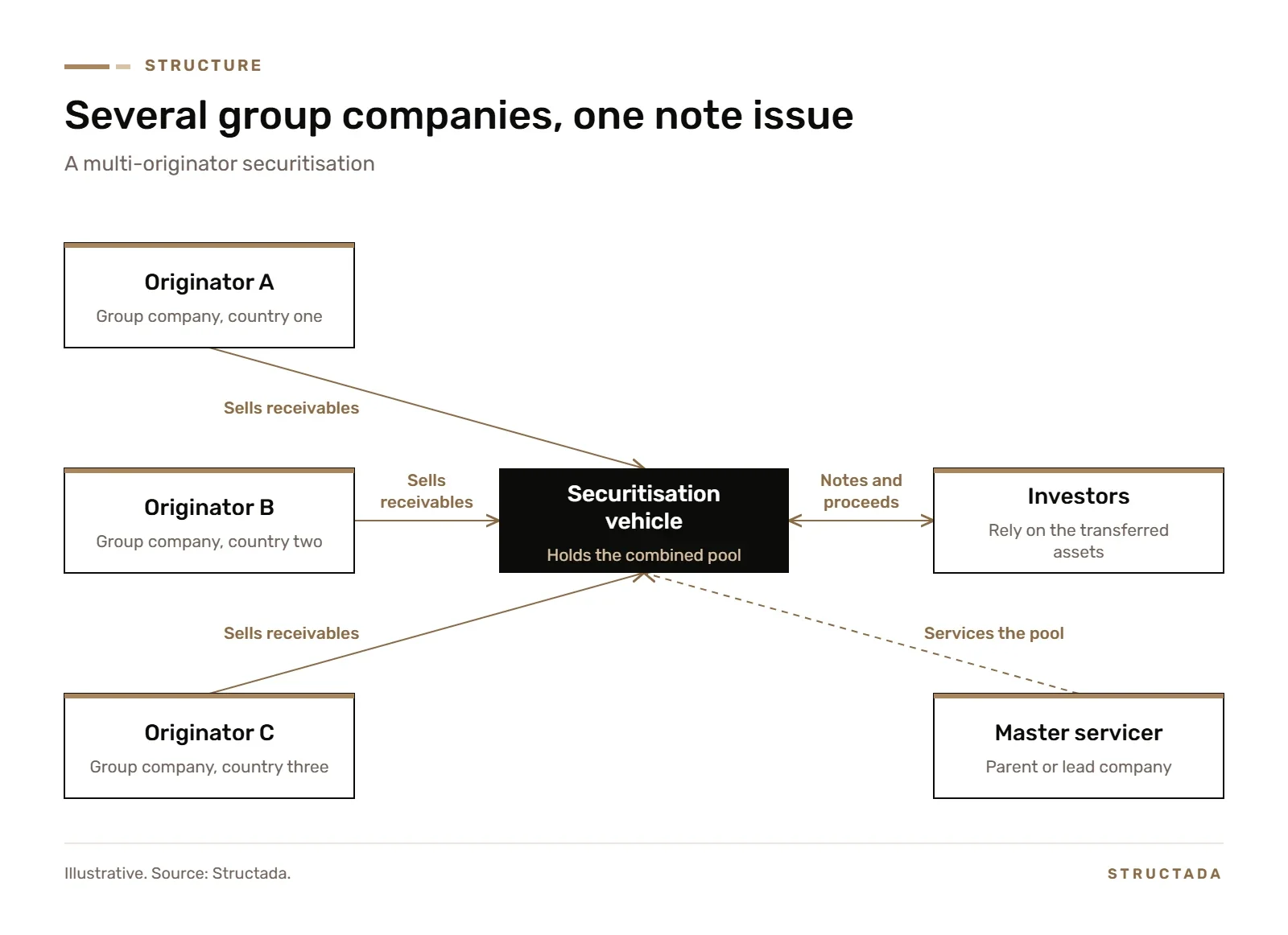
In a multi-originator structure, several group companies each sell or assign their receivables or loans to the same vehicle, which issues notes to investors backed by the combined pool. Each originator signs its own sale or assignment agreement with the vehicle. A parent or lead company commonly acts as master servicer, while local companies continue to service their own assets and collect from their own customers. The notes may be issued as a single class or in several tranches.
This is the classic structure for trade receivables, and large corporates routinely run multi-jurisdiction programmes with sellers in several countries, as Mayer Brown explains. The same approach suits lenders with loan books spread across entities. Eligibility criteria and concentration limits are the main controls, setting how much of the pool may come from any originator, country or debtor. Investors rely on the assets, and on the legal effectiveness of each transfer, rather than on the credit of the group. Our guide to asset-backed securities covers the wider market in which these programmes sit.
A funding vehicle lending to the group
Where assets are difficult to transfer, or the group prefers to keep them on its own books, the vehicle can instead issue notes and lend the proceeds to a parent or to several group companies under loan agreements. The loans are supported by security over the borrowers' assets, shares or bank accounts, and by guarantees from other members of the group, typically held by a collateral agent or security trustee for the noteholders.
The economics change accordingly. Investors take credit risk on the group as a whole, mitigated by security and guarantees, rather than on a ring-fenced pool of assets. A credit linked note is often the instrument of choice here, with returns referenced to the loan made to the group. The quality of the security package, and whether it has been properly perfected in each jurisdiction, becomes the central diligence question.
Compartments by business or asset type
Some groups run businesses with distinctly different risk profiles, such as consumer lending in one country and SME lending in another. Forcing them into a single pool would blur the risk and narrow the investor base. A Luxembourg securitisation vehicle offers a cleaner answer: separate compartments, each holding the assets of one business, country or product, and each issuing its own notes.
Luxembourg law segregates compartments, so losses in one cannot reach the assets of another. The group can match each investor to the exposure it wants, and add new compartments as businesses are launched or acquired, without establishing a new vehicle each time. Our guide on how to issue a credit linked note sets out the steps involved for each compartment.
Choosing between the structures
| Multi-originator securitisation | Funding vehicle lending to the group | Compartments by business | |
|---|---|---|---|
| Investors rely on | A pool of transferred assets | Group credit, security and guarantees | The assets of each compartment |
| Best for | Receivables and loan books | Groups with mixed or hard-to-transfer assets | Groups with distinct businesses or risk profiles |
| Off-balance sheet potential | Possible, subject to accounting | Usually on balance sheet | Depends on structure |
| Legal work | Transfer analysis in each originator's country | Guarantee and security analysis in each country | Per compartment |
| Flexibility to add companies | Accession of new sellers | New borrowers or guarantors | New compartments |
In practice many groups combine approaches, for example a multi-originator pool in one compartment and a group loan in another.
Legal and tax issues across the group
The structure is only as strong as its weakest jurisdiction. Rules on assigning receivables, notifying debtors and perfecting transfers differ from country to country. Some require debtor notification, some require registration, and some restrict the assignment of certain contracts altogether. Each originating country therefore needs its own analysis, and investors will expect a legal opinion on true sale or security for each. Our article on how securitisation works explains why true sale matters.
Corporate benefit is the next hurdle. The directors of each group company must be satisfied that the transaction benefits that company in its own right, which is most acute where it guarantees the debts of a parent or sister company. Upstream and cross-stream guarantees frequently need limitation language to comply with local law. Rules on financial assistance and capital maintenance can restrict a company from supporting the purchase of its own shares or from transferring value to shareholders, which may cap the guarantees and security it can give.
Tax runs through every layer: transfer pricing on intra-group sales, servicing fees and loans, withholding tax on cross-border payments, and stamp or registration duties on asset transfers. Commingling deserves equal attention. Where group companies continue to collect payments on assets they have sold, collections should move promptly into accounts controlled by the vehicle or secured for investors, so that an insolvency at one originator cannot trap noteholders' cash.
What investors look for
Investors in group transactions concentrate on clarity of exposure. They expect eligibility criteria and concentration limits by originator and country, legal opinions covering each relevant jurisdiction, and robust servicing with a back-up arrangement in place. They will also look for consistent data and regular reporting across the whole pool and by originator, which in practice means every group company producing information to the same standard.
Protection against deterioration matters as much as the starting position. Triggers that halt new purchases or accelerate repayment if performance worsens are standard, as is alignment of interest, most often achieved by the group retaining the junior notes.
What this means for issuers
For a group with several funding needs, a single note issue is usually cheaper and simpler to run than a collection of separate facilities, and it creates a platform that can grow with the business. The difficult part lies in the choice of structure, and that choice follows from an honest answer to where the group's value lies: in its assets, in its credit as a whole, or in businesses that deserve to be funded separately.
Groups that do this well settle the cross-border legal work at the outset, particularly on transfers, guarantees and tax, and build reporting that every entity can sustain. Those foundations decide whether the structure holds together as new companies and countries are added, long after the first notes have been issued.
Frequently Asked Questions
Can several companies in a group issue notes together?
Yes. A single vehicle can buy assets from, or lend to, several group companies and issue one set of notes to investors.
What is a multi-originator securitisation?
A securitisation in which several originators, often group companies in different countries, sell their receivables or loans to the same vehicle.
What is corporate benefit?
The principle that a company should only enter into a transaction, such as a guarantee, if it benefits that company and not merely the wider group.
Do group guarantees work across borders?
Usually, but many countries limit upstream and cross-stream guarantees, so local advice and limitation language are often needed.
Can new group companies join later?
Yes. Most structures allow new sellers, borrowers or compartments to be added, subject to investor consent or agreed criteria.
Is a group securitisation off-balance sheet?
It can be, but that depends on the structure and the group's accounting standards, and many group financings remain on balance sheet.