- A non-performing loan (NPL) securitisation turns a portfolio of loans in default or arrears into notes repaid from recoveries, such as borrower payments, settlements and the sale of collateral.
- Pricing is based on expected net recoveries, so portfolios are usually bought or transferred at a deep discount to gross book value.
- The servicer is the most important party in the transaction: its business plan and performance largely decide investor returns.
- EU amendments adopted in 2021 let the servicer act as risk retainer and calculate the 5% retention on the discounted value of the loans, which makes NPL deals easier to structure.
- Government guarantee schemes in Italy and Greece used securitisation to clear large NPL stocks, with Italy's GACS alone supporting €108.6 billion of deals, and private transactions continue across Southern Europe and beyond.
Every lending cycle leaves behind loans that stop paying. The lender holding them has three options: work them out on its own balance sheet, sell them outright to a debt purchaser, or securitise them. Each reflects how much capital and patience the lender can commit to recoveries that may take years.
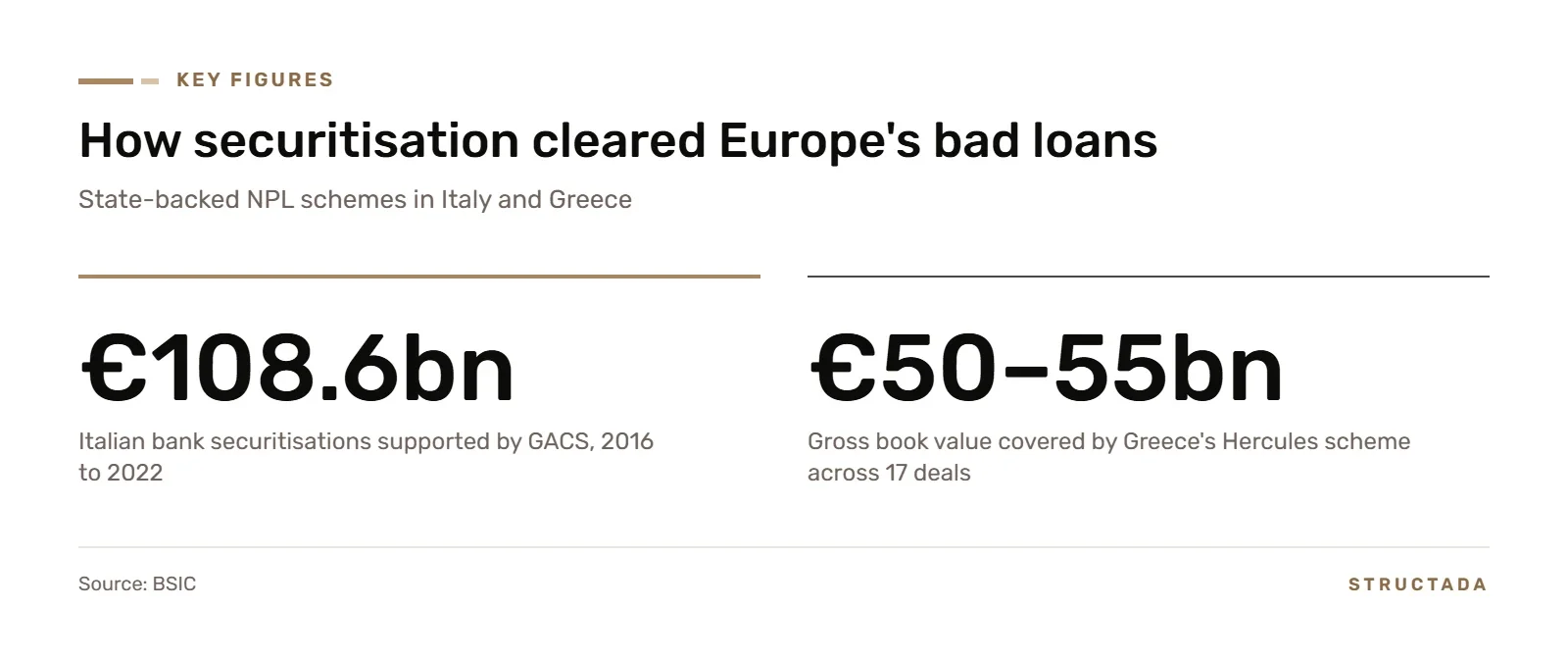
NPL securitisation has played a central role in Europe's post-crisis clean-up. Italy's GACS scheme supported €108.6 billion of bank securitisations between 2016 and 2022, and Greece's Hercules scheme covered around €50 billion to €55 billion of gross book value across 17 deals, according to BSIC. Over that period Italy's NPL ratio fell from a peak of 17% to around 2.5%.
The techniques that cleared bank balance sheets are now used by private lenders, debt purchasers and funds with distressed portfolios. Success depends less on legal structure than on the quality of the data, the credibility of the servicer and the realism of the recovery assumptions.
What is an NPL securitisation?
An NPL securitisation is a transaction in which a portfolio of non-performing loans is transferred to a special purpose vehicle, which issues notes to investors. The notes are repaid from what is recovered on the loans rather than from scheduled interest and principal. Those recoveries come from borrowers resuming payment or agreeing restructured terms, from negotiated settlements and discounted payoffs, from enforcement against property and other collateral, and from the onward sale of individual loans or sub-portfolios.
That distinction shapes everything that follows. In a conventional asset-backed security, cash flows can be modelled from contractual schedules and historical default rates. In an NPL deal, the timing and size of every cash flow depends on decisions yet to be made and court processes yet to run.
A close relative is the re-performing loan (RPL) securitisation, backed by loans that defaulted but have since been restructured and are paying again. RPL deals carry less uncertainty and are expected to grow, as Morgan Lewis notes.
How an NPL securitisation is structured
The seller transfers the portfolio to the vehicle at an agreed price, usually a fraction of gross book value, and the vehicle funds the purchase by issuing senior, mezzanine and junior notes. Part of the price is often paid in notes rather than cash. A servicer is appointed to manage the loans under a business plan that sets out expected recoveries and their timing.
Collections flow into a priority of payments, or waterfall, that meets costs and servicer fees first, then senior interest and principal, and only then the mezzanine and junior notes. Because recoveries are lumpy and unpredictable, the senior notes usually benefit from liquidity support, such as a cash reserve or a liquidity facility, to cover interest when collections are slow. Hedging may be added to protect against interest rate mismatches.
In the Italian and Greek schemes, the average capital structure was about 85% senior, 10% mezzanine and 5% junior. Sellers typically kept the senior notes and sold the mezzanine and junior notes to investors, which allowed them to deconsolidate the portfolio from their balance sheets.
How NPL portfolios are priced
Pricing starts from gross book value (GBV), the total amount legally owed, and works down to what will actually be collected. The price is based on expected net recoveries, discounted for time and risk, and the gap between the two can be very wide.
Collateral is the first driver. Loans secured on residential or commercial property recover far more than unsecured consumer debt. The legal system is the second: the speed and cost of enforcement vary enormously between countries, and long court timelines erode present value even where the eventual recovery is good. Portfolio composition, including granularity, borrower types, vintages and geographic spread, shapes the range of outcomes, and a proven servicer with local knowledge supports a higher valuation.
Data quality cuts across all of these. Missing loan files, unclear collateral values and incomplete payment histories force buyers to price in uncertainty, which widens the gap between bid and ask. Information gaps remain one of the biggest obstacles to NPL transactions.
The role of the NPL servicer
In a performing loan securitisation, the assets largely pay themselves. In an NPL deal, every recovery has to be worked for. The servicer decides when to restructure, when to settle, when to enforce and when to sell, so its judgement drives investor returns more directly than any other factor.
Investors therefore examine the servicer as closely as the portfolio. They look at its track record with similar assets in the same country, test the business plan and the realism of its recovery assumptions, and scrutinise the fee structure to see how base fees and performance incentives align the servicer with noteholders. They expect triggers that reduce fees or allow replacement if recoveries fall short of plan, and a back-up servicing arrangement that can step in if needed.
The regulatory framework for NPL securitisation
The EU Securitisation Regulation requires 5% risk retention. Amendments adopted in 2021 allow the servicer to act as retainer for NPL deals and to calculate the retention on the discounted value of the loans rather than their nominal amount. The same amendments replaced credit-granting checks, which make little sense for loans already in default, with a requirement for sound standards in selecting and pricing the exposures. Parallel changes to the Capital Requirements Regulation give banks more risk-sensitive capital treatment for senior NPL positions.
Directive (EU) 2021/2167 regulates credit servicers and credit purchasers and sets data requirements for NPL sales. Member states were required to apply it from 30 December 2023. Its rules on servicers affect how NPL portfolios are managed even where the securitisation itself falls outside its scope. Local consumer protection, debt collection, data protection and enforcement law also apply wherever the borrowers sit.
Choosing the vehicle for an NPL deal
Many European NPL securitisations use vehicles in the country of origin, such as Italian SPVs under Law 130 or Irish Section 110 companies, a structure covered in our guide to the Irish DAC. For portfolios spread across several countries, or sold to international investors, a Luxembourg securitisation vehicle is widely used. Luxembourg securitisation law expressly allows NPLs as underlying assets, its compartments can ring-fence separate portfolios, and notes can be settled through Euroclear and Clearstream.
Preparing an NPL portfolio for market
Most of the groundwork falls on the seller. It begins with loan-level data covering balances, collateral, legal status, payment history and enforcement stage for every loan, supported by up-to-date collateral valuations, often independently reviewed. Legal due diligence must confirm that the loans and their security can be transferred and establish the enforcement position in each country.
Alongside the portfolio work sits the transaction itself: appointing a servicer and agreeing its business plan, choosing between a local SPV and a compartment on an existing platform, and settling the tranching, liquidity support, hedging and servicer incentives. The investor base usually divides along the capital structure, with distressed debt funds and specialist credit investors taking the junior and mezzanine notes, and banks or institutions the senior.
What this means for issuers
NPL securitisation converts a portfolio that consumes capital and management time into notes that investors can price and hold. It works when three things are in place: credible data, a servicer that investors trust, and a structure that matches realistic recoveries to the right investors at each level of the capital structure. Europe's experience shows that the model works at scale.
For smaller lenders and debt purchasers, the more relevant lesson is that the same tools no longer require bank-sized portfolios. A compartment on an existing platform can bring a portfolio to market without the cost of establishing a standalone vehicle, provided the data and servicing are in order first. Our guide to how securitisation works covers the wider mechanics.
Frequently Asked Questions
What is an NPL securitisation?
A transaction in which non-performing loans are transferred to a vehicle that issues notes repaid from recoveries on those loans.
How are NPL portfolios priced?
On expected net recoveries, discounted for time and risk, which usually means a deep discount to gross book value.
Who retains the risk in an NPL securitisation?
Under EU rules, the originator, sponsor, original lender or, for NPL deals, the servicer can retain 5%, calculated on the discounted value of the loans.
What is the difference between NPLs and RPLs?
NPLs are loans in default or serious arrears. RPLs defaulted in the past but have been restructured and are paying again.
What were GACS and Hercules?
Government guarantee schemes in Italy and Greece that guaranteed senior notes in bank NPL securitisations, helping banks reduce their NPL ratios.
Can a Luxembourg vehicle securitise NPLs?
Yes. Luxembourg's securitisation law allows NPLs as underlying assets, and compartments can ring-fence separate portfolios.