- The UAE has three security regimes: onshore federal law, the DIFC and ADGM. Which applies depends on where the borrower is incorporated and where the assets sit.
- Onshore, security over movable assets and assignments of receivables are perfected by registration with the Emirates Movable Collateral Registry, operated by the EIRC, with priority on a first-to-register basis.
- Real estate mortgages are registered with the relevant land department, and pledges over onshore LLC shares are registered in the commercial register.
- In the DIFC, the Law of Security 2024 requires a financing statement to be filed with the DIFC Registrar of Security. In ADGM, charges must generally be registered within 21 days or they are void against creditors, liquidators and administrators.
- Foreign lenders often appoint a locally licensed security agent, particularly for real estate, and should allow time for notarisation, translation and regulatory approvals.
A lender advancing money to a UAE business wants to know one thing above all: if the borrower fails, will the security hold? Taking security is the easy part. To perfect security in the UAE, so that it binds liquidators and ranks ahead of other creditors, the right steps must be completed in the right registry, and often within a fixed time.
The difficulty is that the UAE does not have a single security regime. Onshore companies are governed by federal law and emirate-level registries. Companies in the Dubai International Financial Centre and Abu Dhabi Global Market operate under their own common law-based systems, each with its own register. A single transaction can touch all three.
This guide sets out how to perfect the main types of security in the UAE, onshore and in the financial free zones, and what lenders and issuers should plan for. For the general concept, see our guide to perfection of security.
Three security regimes in the UAE
Which regime governs each piece of collateral turns on two questions: where the security provider is incorporated, and where the asset is located. A DIFC holding company with onshore subsidiaries and Dubai property may require filings in all three systems.
| Situation | Main steps |
|---|---|
| Onshore company, movable assets or receivables | Register with the EIRC; notify debtors and account banks as needed |
| Onshore real estate | Register mortgage with the emirate's land department |
| Shares in an onshore LLC | Notarised pledge registered in the commercial register |
| DIFC company | File financing statement with the DIFC Registrar of Security |
| ADGM company | Register the charge with the ADGM Registration Authority within 21 days |
| Assets of a free zone company located onshore | Consider onshore registration as well as free zone registration |
Where a borrower is in a free zone but holds assets onshore, or the reverse, lenders often register in both places for safety.
Perfecting security over movables and receivables onshore
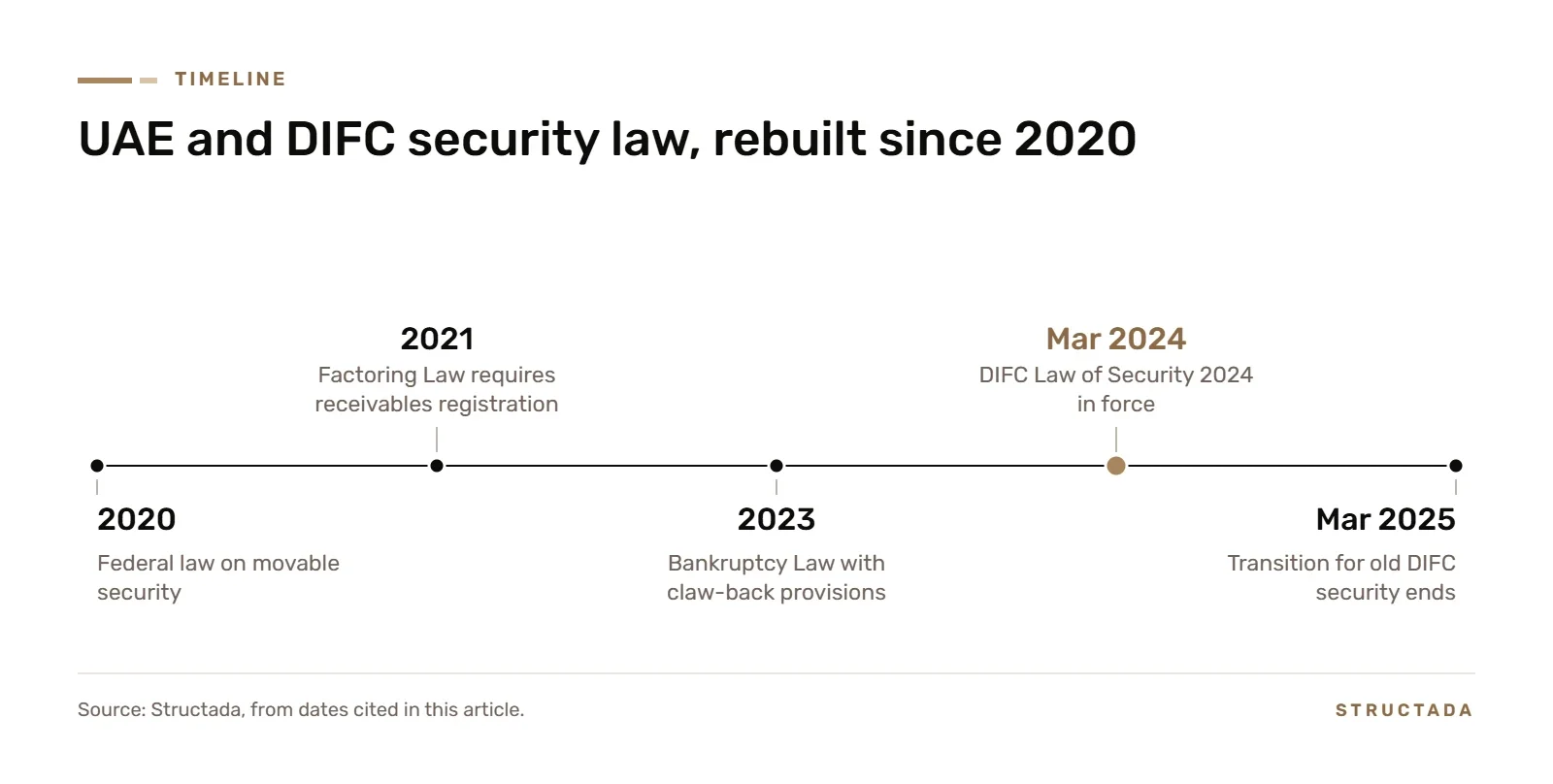
Federal Law No. 4 of 2020 on securing interests in movable property, with its executive regulations in Cabinet Resolution No. 29 of 2021, governs security over movables. It covers tangible and intangible assets, existing and future, including receivables, equipment, inventory, vehicles and bank accounts.
Security is made effective against third parties by registering a notice on the Emirates Movable Collateral Registry, operated by the Emirates Integrated Registries Company (EIRC). Registration takes effect when the details are entered and searchable, and possession and control are alternative routes for some assets. Competing interests rank by the date and time they became effective against third parties, so lenders should search the registry and register at or before funding.
Receivables follow a parallel path. Under the Factoring Law, Federal Decree-Law No. 16 of 2021, an assignment of receivables must also be registered with the EIRC to be effective against third parties. Receivables can be described generally, including future receivables. Notice to debtors is still needed for them to pay the assignee.
Security over bank accounts can be perfected by registration and supported by a control agreement with the account bank, allowing the lender to give instructions directly. Registrations need maintenance: proceeds and replacement assets may need registering within fifteen working days, and registrations must be cancelled within five working days of discharge.
Real estate, shares and other onshore assets
Mortgages over land and buildings are registered with the land department of the emirate where the property is located, such as the Dubai Land Department, and priority follows the date of registration. Only locally licensed entities may hold mortgages over UAE real estate, so foreign lenders usually appoint a local security agent, and enforcement generally requires a court order for sale.
A pledge of shares in an onshore limited liability company must comply with the company's memorandum of association, is typically executed before a notary and must be entered in the commercial register kept by the relevant economic department. It is not effective against the company or third parties until registered. Pledges over shares in public joint stock companies are recorded through the relevant exchange or clearing system.
Mortgages over ships and aircraft are registered in the specialist maritime and aviation registers, which sit outside the EIRC regime. Regulated entities, such as banks, insurers and licensed finance companies, may also need approval from their regulator before granting security.
Perfecting security in the DIFC
The DIFC Law of Security 2024 came into force on 8 March 2024, replacing the 2005 law, as Morgan Lewis reports. The general method of perfection is filing a financing statement with the DIFC Registrar of Security. Exceptions include possession for negotiable instruments and control for certain rights and digital assets.
Priority generally follows the order in which security becomes effective against third parties, usually the time of filing, and a creditor's knowledge of an earlier unregistered interest does not affect its priority.
Security created under the old law had to be brought within the new regime, with a transition period that ended on 8 March 2025. Lenders holding older DIFC security should check that filings are in place.
Perfecting security in ADGM
ADGM companies are governed by the ADGM Companies Regulations 2020, which follow the English model. Charges created by an ADGM company must generally be registered with the ADGM Registration Authority within 21 days. Under sections 784 and 785 of the Regulations, a charge not registered in time is void against creditors, liquidators and administrators, and the secured money becomes immediately payable, as DWF explains. Anyone taking a charge is treated as having notice of charges already on the public register.
The 21-day window is the single deadline in the UAE most likely to catch a lender out. It runs from creation of the charge, so closing mechanics should treat the filing as a condition rather than a post-completion task.
Practical steps before closing
Search the EIRC, the DIFC or ADGM registers and the relevant land or commercial registers before funding, and file at or before closing, because priority is first in time. Where foreign lenders cannot hold security directly, use a locally licensed security agent. Allow time for onshore documents to be notarised and translated into Arabic, describe collateral broadly enough to cover future and replacement assets where the law allows, and diarise registration periods, updates and cancellations.
Insolvency deserves particular attention. The UAE Bankruptcy Law of 2023 contains claw-back provisions, so the timing of security and the fair value given for it matter if the borrower later fails.
Perfection in UAE securitisation
In a securitisation of UAE assets, perfection applies to the transfer of receivables to the vehicle and to any security granted to investors. For an offshore vehicle, such as a compartment of a Luxembourg securitisation vehicle, the UAE steps typically include EIRC registration of the assignment, a debtor notification plan and control over collection accounts. Our guide to securitising UAE and GCC assets via Luxembourg SPVs covers the wider legal issues.
What this means for issuers
Perfecting security in the UAE is manageable once the right regime is identified. Onshore, the EIRC registry has made security over receivables and movables far more straightforward and transparent, and the DIFC and ADGM offer predictable common law-based regimes with their own registers. The risk lies in assuming one regime covers everything, or in missing a deadline such as ADGM's 21 days.
Investors in notes backed by UAE assets will look through to the security beneath them. A perfection checklist agreed with UAE counsel at the start of a deal, mapping every asset to its registry and every filing to its deadline, protects lenders and gives investors confidence in the assets behind their notes.
Frequently Asked Questions
How is security perfected in the UAE?
Onshore, security over movables and receivables is perfected by registration with the Emirates Movable Collateral Registry. Real estate mortgages are registered with land departments, and the DIFC and ADGM have their own registration regimes.
What is the EIRC?
The Emirates Integrated Registries Company, which operates the UAE's Emirates Movable Collateral Registry.
Can a foreign lender take a mortgage over UAE real estate?
Only locally licensed entities may hold mortgages over UAE real estate, so foreign lenders usually appoint a local security agent.
How do you pledge shares in a UAE LLC?
Through a pledge that complies with the company's memorandum of association, typically notarised and entered in the commercial register of the relevant economic department.
What is the deadline for registering a charge in ADGM?
Generally 21 days from creation. A charge registered late is void against creditors, liquidators and administrators.
Does DIFC security need to be registered?
Yes. Under the DIFC Law of Security 2024, security is generally perfected by filing a financing statement with the DIFC Registrar of Security.